Radiator Size for Room Calculator
Estimate room heat loss, required radiator output, BTU per hour, watts per square meter, delta-T correction, allowance, panel count, and radiator type fit for bedrooms, bathrooms, offices, basements, and living rooms.
Presets load practical room dimensions, insulation, window exposure, exterior walls, water temperature, radiator style, and sizing allowance. Adjust any field for the actual room.
Single panel K1
Output density: lower depth and lower output per wall area.
Best fit: small bedrooms, narrow halls, and rooms with modest heat loss.
Good where projection from the wall matters more than compact output.
Double convector K2
Output density: high output from a compact length.
Best fit: living rooms, corner rooms, basements, and low-temperature systems.
Often the practical default when wall length is limited.
Column radiator
Output density: moderate, with deeper sections and more radiant feel.
Best fit: rooms where height or style drives the layout.
Check manufacturer output carefully because section depth changes capacity.
Towel radiator
Output density: lower once towels cover the rails.
Best fit: bathrooms with a warm target and a separate heat loss check.
Oversize or add another heat source if the bathroom is exposed.
| Insulation level | Wall U-value | Window U-value | Air changes | Use in calculator |
|---|---|---|---|---|
| Excellent | 0.25 W/m2K | 1.8 W/m2K | 0.35 ACH | Upgraded insulation, sealed windows, low drafts. |
| Good | 0.35 W/m2K | 2.2 W/m2K | 0.50 ACH | Modern insulated rooms with ordinary windows. |
| Average | 0.55 W/m2K | 2.8 W/m2K | 0.70 ACH | Typical existing bedrooms and living rooms. |
| Poor | 0.85 W/m2K | 3.8 W/m2K | 1.00 ACH | Older rooms, leaky windows, cold exterior surfaces. |
| System water | Room target | Radiator delta T | Approx output vs DT50 | Planning note |
|---|---|---|---|---|
| 80/60°C | 20°C | 50°C | 100% | Traditional catalogue rating condition. |
| 70/50°C | 20°C | 40°C | About 75% | Needs a larger radiator than DT50 tables suggest. |
| 55/45°C | 20°C | 30°C | About 52% | Common low-temperature target for efficiency upgrades. |
| 45/35°C | 20°C | 20°C | About 30% | Requires large emitters or multiple radiators. |
| Radiator type | Approx W per sq m at DT50 | 600 x 1000 mm equivalent | Correction exponent | Best use |
|---|---|---|---|---|
| Single panel convector K1 | 850 W/m2 | 510 W | 1.30 | Low projection, smaller rooms, mild loads. |
| Double panel P+ | 1500 W/m2 | 900 W | 1.30 | Balanced depth and output for bedrooms. |
| Double convector K2 | 1900 W/m2 | 1140 W | 1.30 | High output from limited wall space. |
| Column radiator | 1050 W/m2 | 630 W | 1.28 | Taller or deeper radiators with softer heat feel. |
| Towel radiator | 650 W/m2 | 390 W | 1.25 | Bathrooms, but size generously for covered rails. |
| Low-temperature panel | 1200 W/m2 | 720 W | 1.32 | Oversized emitters for heat pump water temperatures. |
| Room type | Typical W per sq m | Typical BTU per sq ft | Comfort target | Watch item |
|---|---|---|---|---|
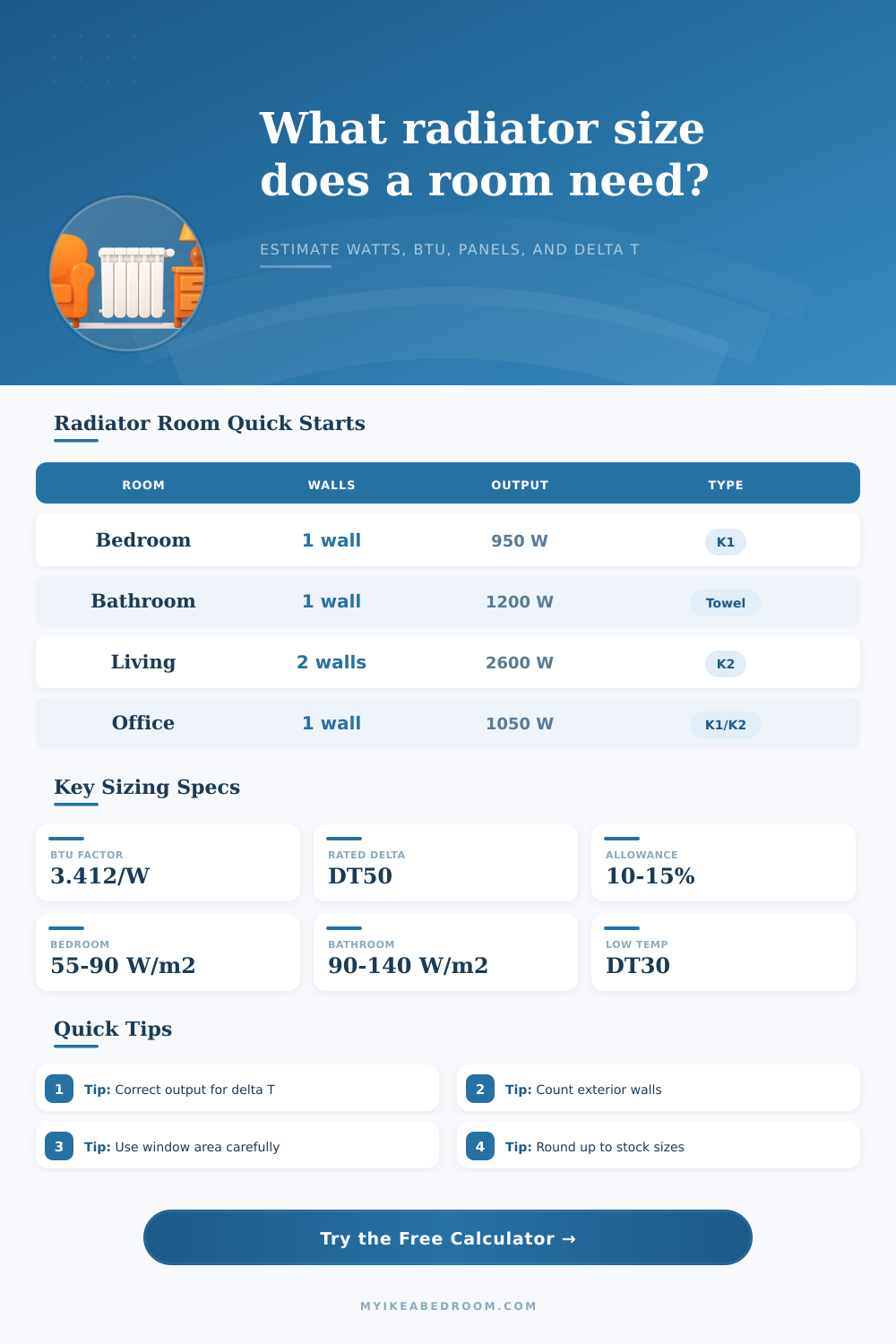
| Small bedroom | 55 to 90 | 17 to 29 | 18 to 21°C | Keep radiator quiet and avoid bed drafts. |
| Bathroom | 90 to 140 | 29 to 44 | 22 to 24°C | Towels reduce useful output from rails. |
| Living room | 65 to 110 | 21 to 35 | 20 to 22°C | Large windows and corner walls lift the load. |
| Basement room | 60 to 105 | 19 to 33 | 19 to 21°C | Cold floors and long pipe runs can matter. |
| Home office | 55 to 95 | 17 to 30 | 20 to 22°C | Steady comfort near desks is more important than warm-up speed. |
Use the corrected output. A radiator rated at DT50 can deliver much less heat on lower water temperatures, so compare the calculator's corrected output before choosing a panel size.
Round up thoughtfully. If the result lands between stock sizes, choose the next larger radiator and use the valve to trim output rather than undersizing a cold room.
You know what it’s like… You sit down for supper and shiver while radiator warms up. Don’t feel unlucky. This isn’t about your bad luck; it’s about physics doing its thing regardless of how you feel about it. The size of the room simply doesn’t match the capacity of the heater. Lots of folks select their radiator based off what size they can fit into whatever wall space remains. That’s putting the cart before the horse.
The culprit isn’t usually the pipes nor the boiler; the culprit is actualy the math of heat gain vs heat loss. And nobody want to be doing math when it’s chilly outside. With that all out of the way, the calculator (above) do the hard stuff for you when you feed in your room sizes. You don’t have to worry about conversion factors or coefficients. And knowing what goes into those fields prevents you from underestimating the size of your heater.
Why Your Radiator Is Too Small
The one input that’s hardest to understand is insulation quality. It sounds fuzzy, but here it refers to how fast heat are lost through your walls. If your house is really old and your walls is just a few inches of plaster board, you’re losing heat quicker than you think. The same goes for your windows. Do you have rattling old sash windows that shake in the breeze? You’ll need far greater power coming off something much smaller.
People mess up here: they think they should of had a radiator as big as their neighbors’ because… well … because that’s what everyone else has! But your home might be an older property and your neighbor’s got triple glazing, so you need more power coming off a little bit less.
The other wrinkle for home owners replacing their heating system is water temperature. Small radiators will strain if the water being pushed through them come from your old gas boiler which runs hot. Switching to a low-temperature condensing system (or a heat pump) change all the physics. With cooler water, what used to be called a “standard” Delta T may provide only half the advertised BTUs from a radiator. That’s why you can’t replace your old unit with a new one that has the same physical footprint and hope it will be as warm. To move the same quantity of energy, you typically need to have more surface area. That’s explained clearly in reference table on the page.
Where you live also makes a big difference, a home’s layout affects its heat behavior. A living room on a chilly corner, with big windows and two exposed sides, is different than a bedroom with just one exterior wall. These exposure factors is considered by the calculator (since each square foot of glass is a weak spot in your thermal envelope). Real losses occur through windows; solid walls don’t matter as much. Getting the glass area right is more important then guessing the wall thickness.
What about radiator choice? It is a choice between efficiency and space. Thin, one-panel convector units uses little visual space, but they do not provide enough heat in cold rooms if they are too long. Double convector units pack more heat into a given length as they has more metal mass. It is a trade off between wall-space used and amount of heat produced per sq ft.
Bathroom towel radiators can be lovely looking but tuck their heat producing surface out-of-sight under wet towels. That stifles air-flow and lowers efficiency. It is a small point perhaps, but it is worth knowing when you are dripping wet from drying off after your shower.
Radiator size: there’s always a right answer, but it’s where real life meets dreams. Put up the biggest one you can afford, and your room warms up in three minutes flat. But as soon as the sun peeks through the blinds, you’re overheating. Or you can put in a tiny unit, and it’ll barely get warm, running 24/7 to no effect. Find the sweet spot, where the room maintains a nice, comfortabley temp without wild fluctuations.
Let the tool do its thing while keeping insulation and layout in mind. That way, you won’t end up with a beautiful-looking radiator from the store that freezes your nuts off in January.