Return Air Grille Size Calculator
Estimate required return free area, nominal grille size, actual face velocity, filter-grille pressure proxy, per-room airflow split, and noise score for bedroom returns, hallway returns, central returns, basement zones, and filtered return grilles.
Load a common return-air layout, then tune the system CFM, grille free area, velocity target, duct opening, filter choice, and noise limit.
Stamped return grille
Free area: about 55% to 68%.
Compact and common, but angled fins can raise velocity and noise when undersized.
Bar return grille
Free area: about 70% to 82%.
Often quieter for the same face size because the open area is higher.
Filter return grille
Free area: about 55% to 65%.
Convenient filter access, but usually needs a larger face to protect static pressure.
Multiple returns
Free area: split by grille.
Useful when one central return would exceed the room noise target or wall opening.
| Return location | Quiet target | Normal target | Use caution above | Planning note |
|---|---|---|---|---|
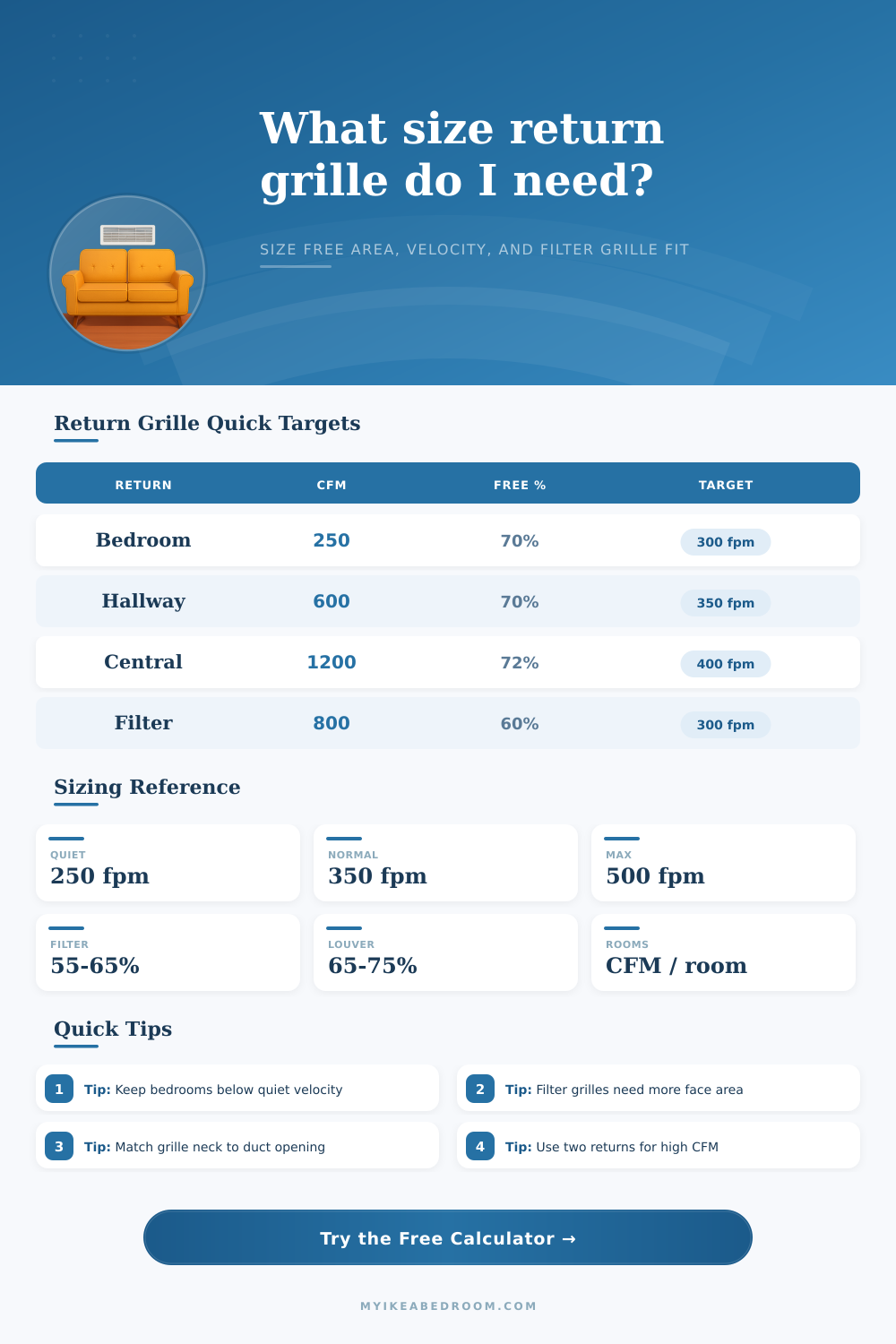
| Bedroom return | 200 to 300 fpm | 300 to 350 fpm | 400 fpm | Lower grille velocity reduces sleep-area sound. |
| Hallway return | 275 to 350 fpm | 350 to 425 fpm | 500 fpm | Good place for shared return paths if doors are undercut or transfer paths exist. |
| Central return | 300 to 400 fpm | 400 to 500 fpm | 550 fpm | Large systems often need multiple grilles or a tall central return. |
| Filter grille | 200 to 300 fpm | 300 to 375 fpm | 425 fpm | Lower velocity helps reduce filter pressure drop and whistling. |
| Basement zone | 225 to 325 fpm | 325 to 425 fpm | 475 fpm | Use lower velocities where hard surfaces reflect sound. |
| Nominal size | Gross area | Free area at 65% | Approx CFM at 300 fpm | Approx CFM at 400 fpm |
|---|---|---|---|---|
| 10 × 8 in | 80 sq in | 52 sq in | 108 CFM | 144 CFM |
| 12 × 12 in | 144 sq in | 94 sq in | 195 CFM | 260 CFM |
| 14 × 14 in | 196 sq in | 127 sq in | 265 CFM | 354 CFM |
| 16 × 20 in | 320 sq in | 208 sq in | 433 CFM | 578 CFM |
| 20 × 25 in | 500 sq in | 325 sq in | 677 CFM | 903 CFM |
| 24 × 30 in | 720 sq in | 468 sq in | 975 CFM | 1300 CFM |
| Grille or filter style | Typical free area | Pressure behavior | Best use | Calculator setting |
|---|---|---|---|---|
| Stamped grille | 55% to 68% | Moderate at low CFM, rises quickly when small | Small wall or door returns | Use 60% to 65% |
| Fixed bar grille | 70% to 82% | Lower pressure for the same face size | Quiet rooms and central returns | Use 72% to 78% |
| Eggcrate grille | 75% to 90% | Very open but visually different | Mechanical rooms and low noise returns | Use 80% to 85% |
| Low restriction filter grille | 58% to 68% | Pressure depends strongly on filter depth | Accessible wall or ceiling filters | Use 60% to 65% |
| High-MERV filter grille | 50% to 62% | Needs larger face area to avoid static rise | Systems designed for the filter load | Use 55% to 60% |
| Rooms served | Example total CFM | CFM per room | Return path concern | Sizing response |
|---|---|---|---|---|
| 1 room | 150 to 300 CFM | 150 to 300 | Door closure can starve supply airflow | Use a room return or transfer path. |
| 2 rooms | 300 to 600 CFM | 150 to 300 | Shared hall return may pull through gaps | Keep grille velocity low and check undercuts. |
| 3 rooms | 450 to 900 CFM | 150 to 300 | Central return can become noisy | Consider two grilles or a larger face. |
| 4 rooms | 600 to 1200 CFM | 150 to 300 | Single grille may exceed free area target | Split return area across zones. |
| Whole floor | 1000 CFM plus | varies | Static pressure and noise become linked | Use manufacturer grille and filter data. |
So how does that low hum come into your home? It is air passing through undersized grilles. While many of us pay attention to decorative covers and supply registers, we rarely consider the return side. After all, where do you think the air needs to go?
If you don’t size your returns for free area instead of face size, then you’re creating a bottleneck. Every time the system run, this bottleneck is costing you money while reducing your comfort.
Why You Need Bigger Air Vents
Go to the Grille Calculator. Now just plug in your grille sizes and your airflow targets and let the calculator do all the math for you. No more wondering if that 14 x 14 inch cover will work.
The key point is free area versus nominal size. From the exterior, a standard stamped steel grille appear to be a nice size hole but those slanted fins can block almost half the area. Say you are looking at needing three hundred cubic feet of air per minute, so you choose a grille which allows in only forty percent of what you think is available area… You get high velocity noise.
This is why your furnace sounds like it’s going to fail when really it’s just air rushing too quick over too small an area. The issue comes down to velocity. Air passing through a grille at over four hundred feet per minute begin singing. That’s maybe okay in a hallway where no one is attempting to sleep. But in your bedroom, you’d like it below three hundred. With the tool, you can set your target velocity and observe what nominal size are necessary. You’ll see that as you reduce your speed target, you need to select a larger grille face.
It seems counterintuitive at first but think about it: A large hole allows for slow, quiet air. Quiet air also implies lower pressure drop across whatever filter you may have installed.
Add filters and all bets is off. A filter grille’s got two jobs, let air through; clean the air. Those may be opposing tasks. Put a high efficiency pleated filter into a tight return and now you’re choking airflow so badly the air handler can barely pull the needed volume. The static pressure rise and the compressor labors. The system stays running longer, and eventually something either leaks or breaks. That’s why the table on the page recommends bigger faces for your filtered returns. Additional surface area compensate for the filter media that blocks the way.
It is a small deal, but it is hugely important for life. Many people make this mistake: they see the hole in the wall and purchase a grille that fits into the hole. That’s backward thinking. First determine how much air you require. Determine the free area needed to provide that amount of air flow. Then select a grille which delivers that free area. Almost always this means a larger (nominal) size different than the duct opening.
Don’t buy an eight by ten inch grille if your duct neck is eight by ten inches. Get a larger one, maybe a twelve by fourteen, and add an adapter or frame to fill space between. The acoustic performance is well worth the visual mismatch. A larger grille can be hidden behind furnitures or in a ceiling plenum. An undersized one cannot be hidden, and neither can its noise.
Another mistake is thinking of returns as passive openings. No. They’re an active part of the static pressure profile of your system. Closing off bedroom doors changes how their return path works. Close them all and if your single return is at some hall grille, it must draw air past narrow door gaps into the hall. Velocity spikes; so does noise level; and the imbalance sucks moisture out of walls, or makes supply registers whine. Bigger faces and/or splitting the return load among several grille helps manage velocity whether access patterns change or not.
More important than having “the right size” is knowing what’s possible and impossible. There is no way to force a lot of air through a tiny opening quietly. There is no way to use very tight filters without increasing their surface area, which will reduce pressure. The calculator shows you the bounds of that physics equation. When you plot out the free area percentage as it changes with various grille designs, you’ll quickly see the answer: bigger is almost always better (assuming you can fit it on your walls).
Open spaces allow quiet airflow. Tight squeezes does not.