Wall Vent Register Size Calculator
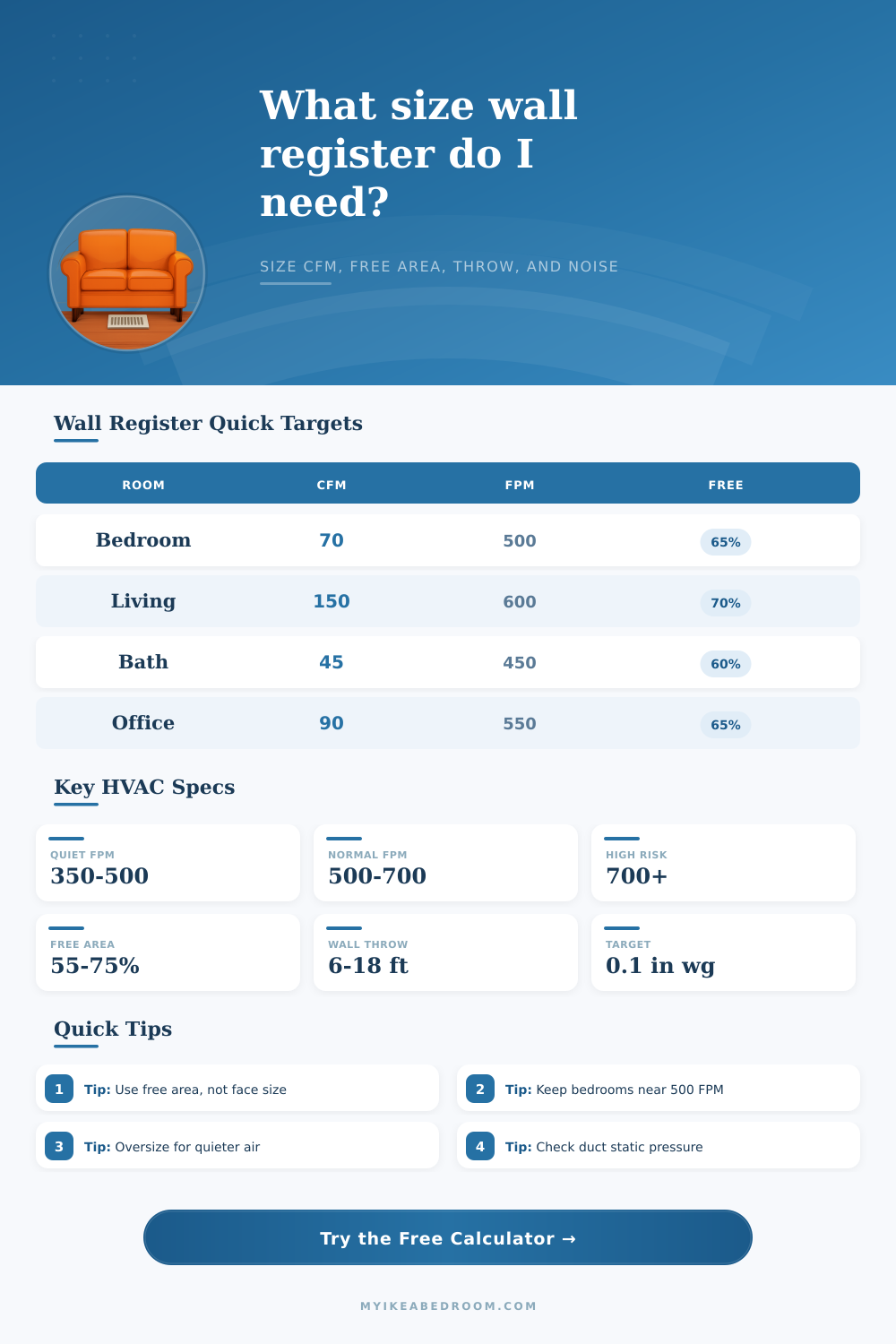
Size a wall supply register from room CFM, face velocity, free area, grille dimensions, throw distance, room size, mounting height, and noise risk.
Presets load common wall register situations. Adjust the CFM, grille size, and throw target to match the room and duct design.
| Velocity band | FPM range | Best use | Register note |
|---|---|---|---|
| Very quiet | 300 to 400 FPM | Nurseries, bedrooms, small offices | Often needs a larger free area and wider face size. |
| Quiet residential | 400 to 550 FPM | Bedrooms, living areas, finished basements | Good starting band for comfort-focused wall supplies. |
| Standard residential | 550 to 700 FPM | Short throws, compact rooms, utility spaces | May be acceptable when throw and diffuser noise are checked. |
| High velocity risk | 700+ FPM | Only when the selected grille is rated for it | Noise, draft, and pressure drop can rise quickly. |
| Outlet type | Typical free area | Air pattern | Use in calculator |
|---|---|---|---|
| Stamped steel register | 50% to 60% | Adjustable, higher restriction | Use 55% when no submittal data is available. |
| Bar grille with opposed damper | 60% to 70% | Directional with balancing | Use 65% for a conservative quick check. |
| Fixed blade wall grille | 65% to 75% | Stable long throw | Use 70% when blades are open and clean. |
| Return-style grille used as transfer | 70% to 80% | Low velocity, low pressure | Use only for non-supply transfer checks. |
| Nominal size | Face area | Free area at 60% | Capacity at 500 FPM |
|---|---|---|---|
| 4 x 10 in | 40 in2 | 24 in2 | 83 CFM |
| 4 x 12 in | 48 in2 | 29 in2 | 100 CFM |
| 6 x 10 in | 60 in2 | 36 in2 | 125 CFM |
| 6 x 12 in | 72 in2 | 43 in2 | 150 CFM |
| 8 x 12 in | 96 in2 | 58 in2 | 200 CFM |
| Room type | Typical single register CFM | Throw target | Comfort note |
|---|---|---|---|
| Small bedroom | 50 to 80 CFM | 7 to 12 ft | Low velocity helps avoid bed drafts and grille hiss. |
| Living room | 120 to 200 CFM | 12 to 20 ft | Large rooms often need two outlets instead of one noisy register. |
| Bathroom supply | 30 to 60 CFM | 5 to 9 ft | Keep supply away from direct exhaust short-circuit paths. |
| Home office | 60 to 110 CFM | 8 to 14 ft | Quiet targets are useful near desks and microphones. |
Stamped register
Strength: common replacement size and adjustable damper.
Watch: lower free area can push velocity and noise higher.
Use for bedrooms only when the calculated velocity stays in the quiet range.
Bar grille
Strength: cleaner airflow and better catalog data.
Watch: opposed dampers add pressure drop when nearly closed.
Good for wall supplies where throw direction matters.
High wall register
Strength: can mix air across a room from above furniture.
Watch: weak throw may dump cold air near the wall.
Check throw score and keep blade angle aligned with the occupied zone.
Oversized grille
Strength: lower velocity, lower noise, lower pressure drop.
Watch: too little velocity may shorten throw.
Often best when comfort matters more than compact appearance.
Use manufacturer free area when you have it. Nominal register size is only the face opening; louvers, dampers, and blade angle reduce the real path the air can use.
Split the airflow before forcing a small grille. If one wall register calculates above the quiet velocity band, two smaller supplies can reduce noise while improving room mixing.
What You Don’t Know Costs Money At the Register The problem is with the registers. Your HVAC system fight tooth and nail to force air through those ducts. But all that effort may be wasted by a limited grille or one that’s too small. It’s not so much about horsepower as open doors, it is true. A wall vent looks like nothing more than a hole in the drywall, right? Wrong. It’s the last choke point in your whole heating/cooling system. Ignore its free area and effectively ask your blower motor to scream through a keyhole.
Sizing does matter: Does your room sound comfy? Or just loud? Please share. When you enter the size of the grilles or other openings you want to pass air through, along with amount of airflow you need, the calculator (above) do all the math for you. But knowing what it’s calculating can help you steer clear of some common mistakes.
Why Small Vents Are Bad For Your HVAC System
Homeowners tend to just see the nominal size (e.g., 10 by 6 inches), and think: that’s how much space there is for air. Not true. A lot of that opening gets eaten up by the damper blades and the louvers and the frame around it, what’s left over is known as free area. So if your register has 55 percent free area, then you’re dealing with fewer than six square inches of actual breathing space in that 60 square inch face.
People makes this mistake. They buy a register that sounds big on the wall but behaves more like a straw when the air pass through it. And here’s where it all comes together: Velocity. Small = fast. If you have lots of air but a small area of freedom for it to go through, it will be faster. And fast = noisy. Turbulence causes whistling. Air rushing past objects can cause a lot of problems, it can prevent quiet conversation in your office (or it can keep you awake at night).
The tables on the page makes it clear: keeping face velocity under 500 feet per minute is usually the sweet spot for residential comfort, while anything above 700 feet per minute risks becoming annoyingly loud. Above about 700 feet per minute, you might start to find it annoyingly loud. Ideally you just need air moving fast enough to get across the room without creating a sound like wind tunnel.
There’s also the issue of throwing distance. Air must travel far enough from the wall register for mixing before dropping downward. Throw too short and you’ll have cold air pool right next to the vent. Stuffy room, but not very refreshing. Throw too long and there’s a good chance you’ll be blasting air directly at someone’s bed or chair. That is not very refreshing either.
To help strike the right balance here, the tool compares size of the space (room) vs. This is the throw distance provided by your catalog selection. Can the grille really make it all the way to the occupied zone before becoming both noisy and losing its momentum? This balance has become the deciding factor when choosing between a bar grille vs stamped steel register.
The stamped steel option is everywhere, low cost and features very detailed blades that restrict free area somewhat. Typically a bar grille will provide a straighter line of airflow and therefore higher free area percentage. This is especially important if you have a small hole in your wall/ductwork or not much pressure on the ducts. More air will flow through it without as much restriction so you can keep the sound down while keeping the velocity down.
Acoustics over Aesthetics, but sometimes quiet money well spent. If you’ve got the wall space, there’s really no such thing as too large a register. The bigger the face area, the slower the air speed at any given flow rate. That equates to less pressure drop and noise, meaning a more efficient system overall. Also, the air will diffuse better, which is nice: it won’t shoot out across the room like a jet stream but instead spread out more gently.
If you’re building or renovating, plan for plenty of room during the framing phase. It is much easier to make a hole bigger before you install drywall than it is to try and fit a quiet system into a cramped duct space later. At the end of the day, we want to be comfortable enough that it’s gone unnoticed. We don’t want to notice the air blowing. We want the heat to be even throughout the room.
Don’t think of the register as just a piece of hardware that covers something up. Instead, consider it part of the HVAC system. If you do, you won’t be running around addressing symptom issues like drafts or noise anymore. Instead, you are addressing the root issue: there isn’t enough free area for amount of airflow required.
Measure correctly. Check those velocity numbers. Give yourself some time to do so. Your ears will appreciate it, and your utility bill may as well.