Metal roof fastener planner
Metal Roofing Screw Calculator
Estimate rows per panel, field screws, side lap screws, ridge and eave screws, total fasteners with waste, screws per roofing square, and screw box count for corrugated, ribbed, barn, porch, garage, and carport panels.
The field screw estimate uses pattern spacing across the panel width and purlin rows along the panel length. Always defer to the metal panel fastening schedule for structural requirements.
| Purlin spacing | Rows on 8 ft panel | Rows on 12 ft panel | Rows on 16 ft panel |
|---|---|---|---|
| 16 in / 41 cm | 7 rows | 10 rows | 13 rows |
| 24 in / 61 cm | 5 rows | 7 rows | 9 rows |
| 30 in / 76 cm | 5 rows | 6 rows | 8 rows |
| 36 in / 91 cm | 4 rows | 5 rows | 7 rows |
| Screw pattern | Across-panel spacing | Minimum per row | Use case |
|---|---|---|---|
| Edge and center | 18 in / 46 cm | 3 screws | Small sheltered roof planes |
| Standard rib panel | 12 in / 30 cm | 4 screws | Sheds, porches, garages |
| High-wind tighter rows | 9 in / 23 cm | 5 screws | Open or exposed structures |
| Every rib / close pattern | 6 in / 15 cm | 6 screws | Barns, edges, demanding layouts |
| Box size | Good for | Planning note | Round-up rule |
|---|---|---|---|
| 100 screws | Small repair or trim | Fine for a short ridge/eave run | Ceiling(total / 100) |
| 250 screws | Sheds and porches | Common default for small roof jobs | Ceiling(total / 250) |
| 500 screws | Garage or cabin | Useful when panels exceed 20 pieces | Ceiling(total / 500) |
| 1000 screws | Barns and workshops | Reduces partial-box handling | Ceiling(total / 1000) |
| Preset | Panel size | Panel count | Typical pattern |
|---|---|---|---|
| Corrugated shed | 8 ft x 36 in | 8 panels | Standard rib panel |
| Garage roof | 12 ft x 36 in | 18 panels | High-wind tighter rows |
| Barn panel | 16 ft x 36 in | 32 panels | Every rib / close pattern |
| Carport roof | 12 ft x 36 in | 12 panels | High-wind tighter rows |
Running out of screws when installing a metal roof is the most costly oversight. Fasteners run a few pennies apiece which makes this sound odd. But running out of screws mid-project will turn your half-day job into a total nightmare. You has to drop everything, get off the ladder, jump in the truck, and make another trip to the store. After you reload, you have to trudge back up the ladder in the middle of the day while your crew sits around waiting for you or your nosy neighbor comment on how slowly you’re going.
The Metal Roofing Screw Calculator eliminates all the stress by providing an exact number of screws needed before you lift a foot onto the ladder. All you have to do is enter your roof’s dimensions and layout specifics, and it figure out the rest for you. No need to guess at any sort of conversion factors or coefficients.
How to Plan Your Metal Roof Screws
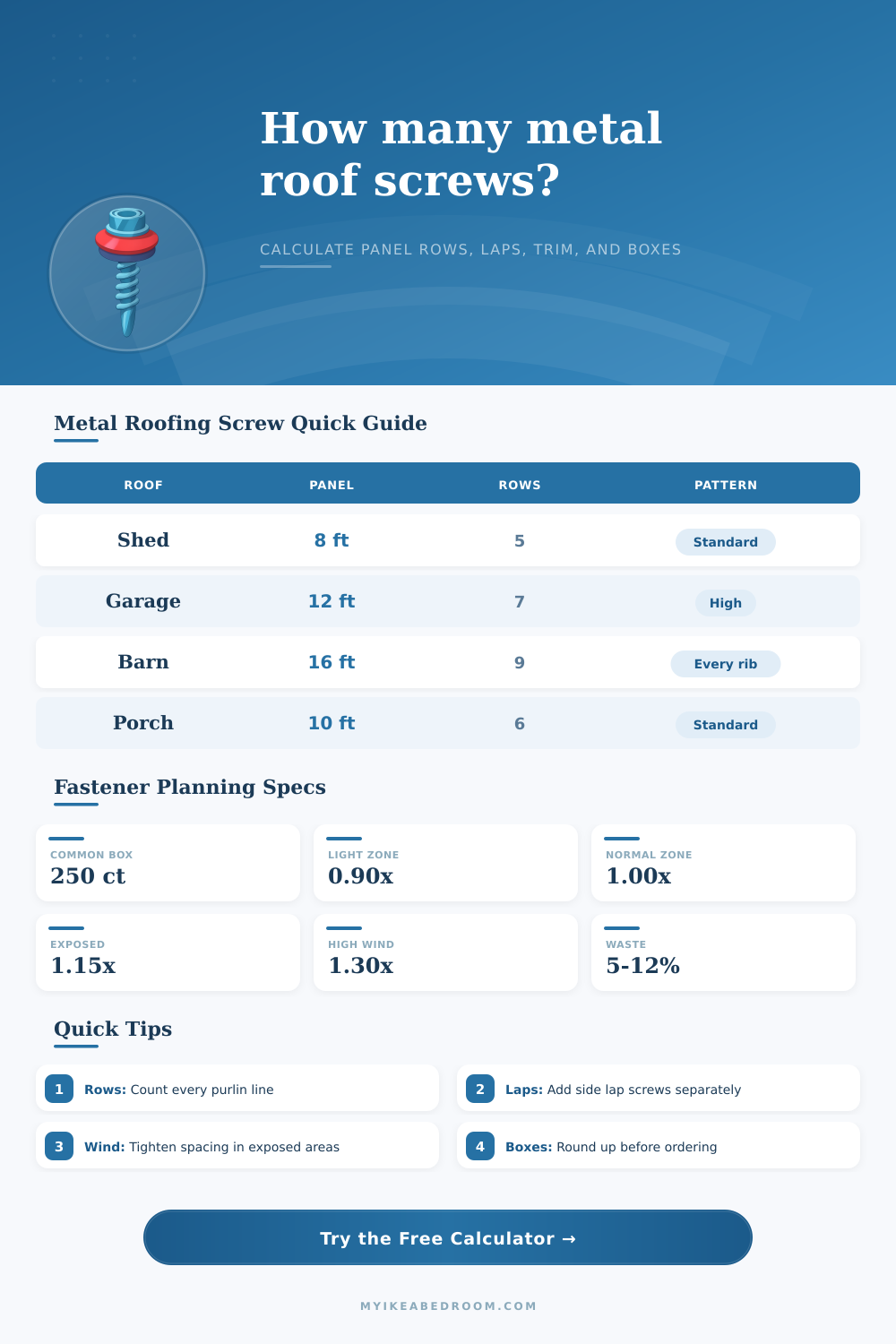
Panel length vs. Purlin spacing is the heart of any fastener estimate. How many rows of screws will go up your panels? That’s what the tool above does, breaking down the vertical run of your panels to determine how many rows of screw attachment it’ll take. For example, say you’re using eight-foot panels, with twenty-four-inch spacing between your purlins. You’d end up with five rows of attachment points. If that changes to sixteen inches, now you’ve got seven rows. That one change adds up across the whole width of your roof which makes a huge difference in overall material count. This calculator takes those vertical increments into account automatically, sparing you from doing some quick math on the fly while standing on a swaying ladder.
And then there’s the other part: the horizontal pattern. That’s where most do-it-yourselfers underbuy. Most common patterns is ribbed panels with screws going into the middle of each rib. In high wind areas or exposed ridge situations, you may need closer spacing and even as few as six inches between screws (as opposed to 12). It’s not all fear-driven prudence, though, it’s keeping your barn from being ripped off its foundation during a bad storm. You’re not merely purchasing screws; you’re getting peace of mind against wind uplift forces that will rip off an improperly secured seam like tinfoil. The chart on the page explains this well: Different patterns will vary the number of required screws per foot of panel width. Go with something tight if your barn faces wide-open farmland.
Material estimates also include trim and side laps, which people frequently overlook when estimating materials. For example, it’s easy to count main field screws and then forget about the other fasteners. This includes those that join one panel to another at the edges (side lap) or where they’re trimmed into a wall corner against an eave (trim meeting the eaves). The calculator breaks down these totals so you can clearly visualize your number of side-lap screws, and your ridge cap count, etc. That way, you won’t mistake having plenty of field fasteners for having enough long-drive ones meant for purlins. The shorter ones for trim. Running out of fastener length while closing that final seam is worse than mixing screw lengths… Which is bad enough.
The other thing that most folks overlook until it’s too late is wind zone adjustments. Higher suction forces on open hilltops, and in coastal zones vs. These are sheltered urban lots. If you choose high wind or exposed, the tool will apply a multiplier to your base count. That’s not some kind of padding; it represents the physical fact that higher winds generate higher loadings. A few extra fasteners now is cheaper insurance than catastrophic failure later. It is a cheap insurance policy but one that protects against structural damage.
Add a waste percentage You’ll lose some from the bucket drop, screws will snap off, and there will be strips. Depending on how complicated your roof is, allow for five to twelve percent waste when using the calculator. Don’t skimp on this. Round up your number of boxes so that you have spares for any repairs in the coming years. A metal roof can last decades, so having leftover fasteners means you can easily fix future leaks instead of making a quick supply run.
What is the moral of this story? Plan and measure, plan and measure, it never pays to improvise! If it were me I’d count out early and count out late and want to be done with a clean roof and no holes in it. Counting accurately means it’s just a matter of working through tasks in order without worry or stress. Having an exact idea of how much you’ll require will help you concentrate on making each shingle straight and tight instead of worrying about whether there are enough to make it up the ridge cap. Understanding exactly what you’re measuring helps, and gets the ball rolling smoothly across the eaves and over the peaks.