Roofing Nail Calculator
Estimate shingle count, bundles, base nails, wind-zone extra nails, starter and ridge nails, boxes needed, and nails per roofing square for asphalt shingle jobs.
The result separates base field nails from wind-zone extras and starter/ridge allowance so you can see which assumption drives the box count.
3-Tab Asphalt
Coverage: about 1.28 sq ft per shingle.
Often uses more pieces per square than architectural shingles.
Architectural
Coverage: about 1.59 sq ft per shingle.
Common laminated shingle profile for house and garage roofs.
Designer Shingle
Coverage: about 1.85 sq ft per shingle.
Larger exposed pieces can lower shingle count, not bundle count.
Ridge Cap
Coverage: job-specific cap pieces.
Use the allowance field when caps, hips, and starters dominate.
Standard Nails
Pattern: 4 nails per shingle.
Good for normal zones when manufacturer instructions permit.
High-Wind Nails
Pattern: 6 nails per shingle.
Modeled as base nails plus two wind-zone extras per shingle.
Coil Nails
Best for: full reroofs.
Large boxes and pails make the box count rounding important.
Hand Nails
Best for: repairs and caps.
Small jobs may still need a full box once waste is included.
| Shingle type | Typical shingle coverage | Approx shingles per square | Planning note |
|---|---|---|---|
| 3-tab asphalt | 1.25 to 1.30 sq ft each | 77 to 80 | Smaller exposed area raises the shingle count. |
| Architectural asphalt | 1.55 to 1.65 sq ft each | 61 to 65 | Common default for whole-roof estimates. |
| Designer laminated | 1.75 to 1.95 sq ft each | 52 to 58 | Check the bundle label before relying on a typical value. |
| Ridge cap pieces | Varies by cap exposure | Job-specific | Model caps with allowance or custom coverage. |
| Wind setting | Calculator extra | Effective pattern | Best use |
|---|---|---|---|
| Standard | +0 per shingle | 4 nails if base is 4 | Normal areas when product instructions allow standard fastening. |
| Moderate wind | +1 per shingle | 5 nails if base is 4 | Useful for a conservative mid-zone estimate. |
| High wind | +2 per shingle | 6 nails if base is 4 | Common upgraded pattern for wind-rated shingles. |
| Coastal uplift | +3 per shingle | 7 nails if base is 4 | Planning-only setting for severe exposure checks. |
| Item | Common coverage or count | Formula used | Rounding rule |
|---|---|---|---|
| Roofing square | 100 sq ft / 9.29 sq m | Roof area divided by 100 | Shown as decimal squares. |
| Asphalt bundle | About 33.3 sq ft | Adjusted area divided by bundle coverage | Rounded up to whole bundles. |
| Coil nail box | Often 3,600 to 7,200 nails | Total nails divided by box count | Rounded up to whole boxes. |
| Nails per square | Depends on pattern and shingle size | Total nails divided by roof squares | Shown before box rounding. |
| Preset | Area | Fastening setup | Why it changes the count |
|---|---|---|---|
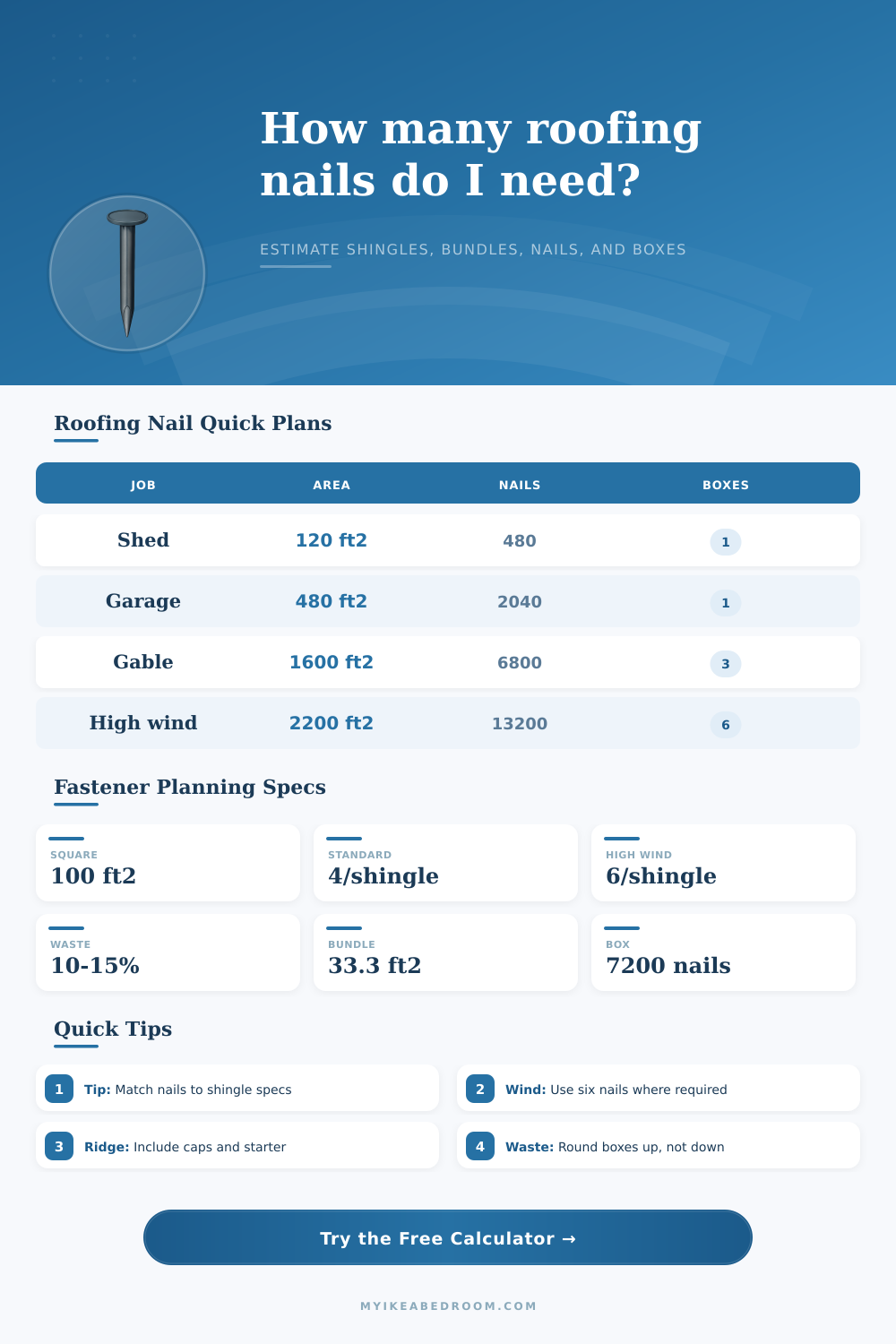
| Small shed | 120 sq ft | 3-tab, standard wind | Small area still needs bundle and box rounding. |
| Garage roof | 480 sq ft | Architectural, moderate wind | Extra wind nails increase the total fastener count. |
| Asphalt gable | 1,600 sq ft | Architectural, standard wind | Bundle count is driven by the 10% waste allowance. |
| High-wind roof | 2,200 sq ft | Architectural, six-nail pattern | Two extra nails per shingle can add several boxes. |
| Ridge cap job | 220 sq ft | Cap coverage, high allowance | Starter and ridge allowance dominates the estimate. |
Next time you’re planning a roof replacement, think off nails. Sure you look at shingles (warranties & color), but fasteners? Not so much… A costly mistake made at the lumber yard. Maybe you didn’t bring home enough nails to finish the project. Or maybe you realizes it too late.
How many boxes do you buy? What size roof are you replacing? That’s where the calculator on this page comes in. It does the math for you. Based off your roof size + wind zone, it tells you how many box of nails you’ll need.
How Many Nails Do You Need for Your Roof?
The number of nails depend on the shingle type. Architectural shingles has greater coverage per shingle compared to regular (three-tab) asphalt. That means fewer shingles, but because they’re heavier, you might actualy end up needing more nails to meet wind ratings. Since architectural shingles weigh more they typically must be fastened tighter, particularly for higher wind ratings. Your local code might specify six nails per strip instead of four. If you assume the lower number, you will miscalculate your estimate.
Refer to the shingle comparison table on the page; it lists common shingle types and how many nail each usually calls for.
Then there’s waste to consider. Your roof is not a rectangle. It has hips, rakes, valleys, and dormers, all of which slice up the space. All of these slices generate scrap. Typically, ten to fifteen percent of the material are added as waste. No adjustment is necessary for a basic shed. Add some padding for complex gables with many intersection. This covers the fact that you’ll be cutting straight lines into angled areas. Skip this cushion, and you might find yourself short on nails prior to reach the ridge.
Then there’s the matter of wind zones. In normal conditions, four nails per shingle are plenty; in high-wind regions and along coastlines, it’s not uncommon for six (or even more) nail per shingle. Why? This is to keep them down when storm hits. Two additional nails per shingle on a two-thousand-square-foot roof mean thousands of extra fasteners, and that’s just one factor that can increase your order from one box to three boxes. The tool keeps track of both base nails and wind-zone extras so you can see why weather-related conditions increases material requirements.
Fasteners also gets used quickly on starter strips and ridge caps. Both locations is worth noting because you’ll frequently see a distinct number of nails in pro bids. Add an allowance for these items when totaling up your materials to include everything in the build. Because these spots account for such a tiny part of the overall square footage, it’s simple to forget about them. But they’re important for both wind resistance and water shedding. If you don’t account for them, you miss something important on your shopping list, and that is exactly where water will gets in.
Nails come in boxes or coils. They don’t arrive one at a time. When you do the numbers, it might be four thousand two hundred nails you think you need, but you’ll purchase a box of seven thousand two hundred. You can’t buy the exact number of nails you need. You’ll round up to the nearest available package.
Better to have some over than some under. Having to run to Home Depot partway through the job is an unnecessary expense that costs time, stalls out the crew, and leaves your house open to the elements. It’s cheaper to plan on having too many then it is to plan on getting it perfect. You should of planned better.
Roofing estimation is all about risk management: How do weather, cuts, and mistakes factor into your job? Before they occur, you’re attempting to estimate their impact. The math is just the starting point; it’s your judgment that defines the safety margin. Knowing waste, knowing wind exposure, knowing the shingle type are the transition from guesswork to plan. This changes the mindset and makes the renovation project manageable instead of stressful. It also prevents your roof from being on someone else’s house when the next storm passes through.