Pom Pom Quantity for Garland Calculator
Estimate pom pom count, yarn weight, spacing count, color split, cord length, finished fullness, strand repeats, end tails, and waste allowance for handmade garlands.
Choose a common project, then adjust the length, pom size, spacing, tails, colors, fullness, strand count, waste, and units.
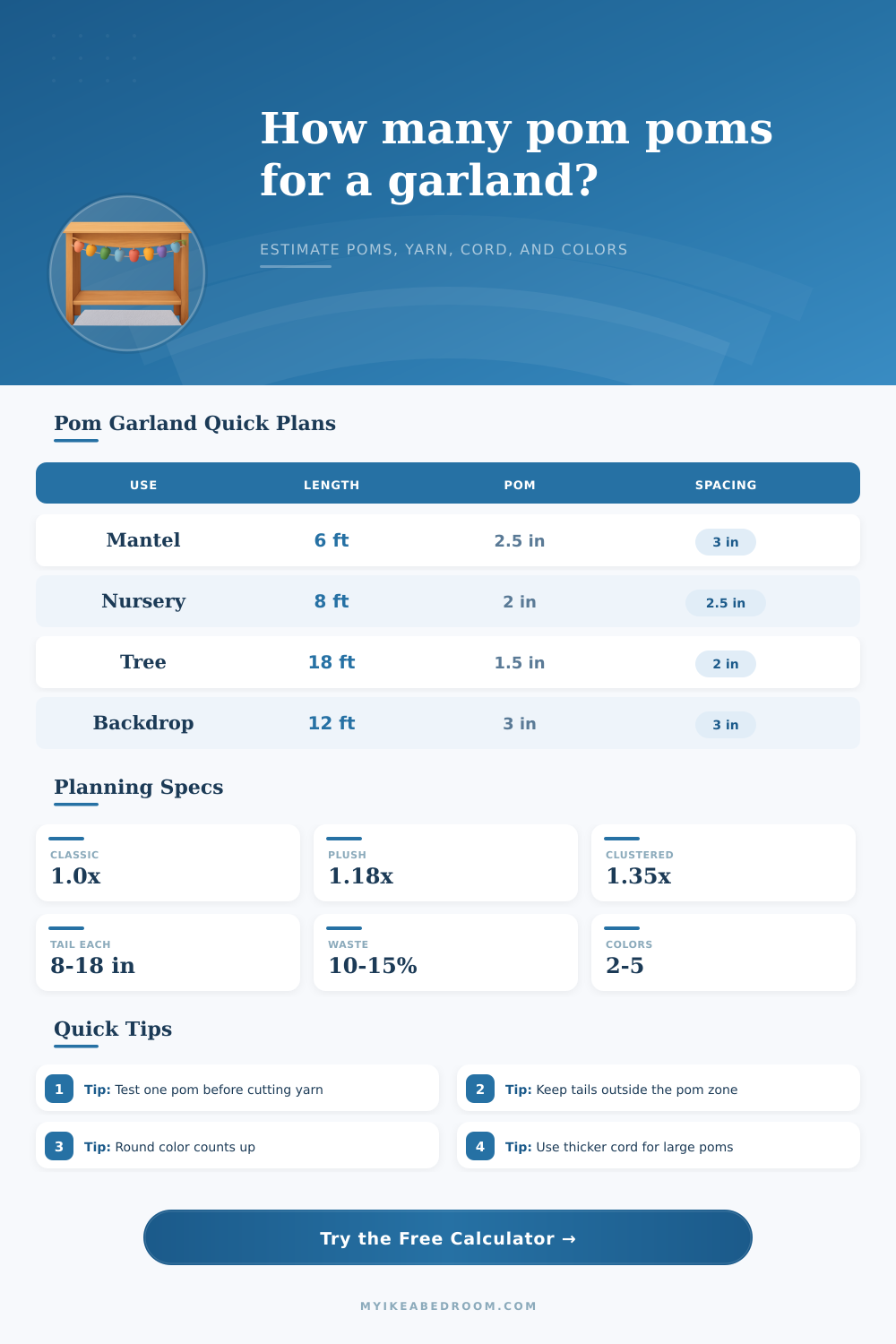
| Finished pom diameter | Airy spacing | Classic spacing | Plush spacing | Best use |
|---|---|---|---|---|
| 1 to 1.5 in | 2 to 3 in | 1.5 to 2 in | 0.5 to 1 in | Tree garlands, shelf trim, small wall accents |
| 2 in | 3 to 4 in | 2 to 3 in | 1 to 2 in | Nursery wall, kids room, headboard strand |
| 2.5 to 3 in | 4 to 5 in | 3 to 4 in | 1.5 to 2.5 in | Mantel garland, window swag, party rail |
| 3.5 to 4 in | 5 to 6 in | 4 to 5 in | 2 to 3 in | Photo backdrop, doorway trim, bold room decor |
| Pom diameter | DK acrylic | Worsted acrylic | Wool blend | Bulky yarn |
|---|---|---|---|---|
| 1 in | 1.2 g | 1.5 g | 1.7 g | 2.1 g |
| 1.5 in | 2.3 g | 2.8 g | 3.2 g | 4.0 g |
| 2 in | 4.0 g | 5.0 g | 5.7 g | 7.0 g |
| 2.5 in | 6.2 g | 7.8 g | 8.9 g | 10.9 g |
| 3 in | 9.0 g | 11.2 g | 12.8 g | 15.7 g |
| 4 in | 16.0 g | 20.0 g | 22.8 g | 28.0 g |
| Project | Typical length | Pom diameter | Color count | Fullness target |
|---|---|---|---|---|
| Mantel garland | 5 to 7 ft | 2.5 to 3 in | 3 to 5 | Classic to plush |
| Nursery wall garland | 6 to 10 ft | 1.5 to 2.5 in | 3 to 6 | Airy to classic |
| Tree garland | 12 to 24 ft | 1 to 2 in | 2 to 4 | Airy to classic |
| Party backdrop line | 8 to 16 ft | 3 to 4 in | 4 to 8 | Plush to clustered |
| Window swag | 4 to 8 ft | 2 to 3 in | 2 to 5 | Classic |
| Kids room garland | 7 to 12 ft | 2.5 to 3.5 in | 4 to 7 | Plush |
| Strand layout | Cord formula | Tail suggestion | Color planning | Placement note |
|---|---|---|---|---|
| Single straight garland | length x 1 | 8 to 12 in each end | Repeat colors evenly | Mark centers before tying poms |
| Layered mantel | length x strands | 12 to 18 in each end | Shift colors by one pom | Use fuller front strand |
| Backdrop rows | length x rows | 10 to 14 in each end | Keep color blocks balanced | Match spacing across rows |
| Tree spiral | path length x 1 | 6 to 10 in each end | Use smaller repeats | Space loosely between branches |
Acrylic yarn
Use: everyday garlands, kids rooms, party decor.
Math note: predictable grams per pom and easy color matching.
Wool blend
Use: fuller poms with a rounded, springy finish.
Math note: add a little waste for trimming and fluffing.
Cotton yarn
Use: firmer matte poms and clean modern garlands.
Math note: usually needs more wraps for the same fullness.
Scrap yarn
Use: mixed-color garlands and leftover craft bins.
Math note: weigh one test pom for the best estimate.
Test one pom first: Make and trim a single pom in the chosen yarn, then weigh it if you want the yarn estimate to be closer than the built-in averages.
Keep tails separate: The calculator subtracts end tails before spacing poms, so the tied ends stay clear and the decorated section starts where you expect.
Handmade makes mistakes… but planning avoids them. For example, it’s possible to discover too soon that your pom poms won’t stretch far enough across the mantel. Or perhaps you had an excess of thirty fuzzy little ball because they were spaced out too much?
Once you know how long you want yours and what size pom pom you’re working with, the calculator does the math for you. You won’t have to figure out the inches between gaps while using scissors.
Planning Helps You Avoid Mistakes
The span is decorated. It is not the overall length of the string. It is the true length of the string used to create the decor. Why? Because you has to leave space on both ends to tie your knots! Most folks who make these things forget about that and if you don’t account for those tails in your math then the first pom will touch a knot… and the last one will dangle over the edge of the shelf. That’s really just a little thing but it can realy mess up the balanced nature of what you are trying to achieve.
You can input the tail length of your pom poms, and the tool factors that into the equation automatically. This guarantees that the rhythm of your work remain intact throughout.
Next you have to decide how full you want it. That’s a math question masquerading as an art one. The airier pom style expose more of the cord between the poms. This produces a lighter effect that works nicely for baby items like nursery décor. A packed pom style brings the pom-poms closer and nearly touching. That requires lots more yarn and time. It also produces a rich textured piece great for use as a party backdrop or bolder statement pieces.
The trouble is that most people don’t understand they need to buy yarn based off more than just the number of poms. They also need to consider how tight or dense they want each pom to be. The amount of yarn used are affected by the weight too, which affects both price and end appearance. A standard default could be DK acrylic. That will make nice neat poms but they will have to be trimmed carefuly to achieve an even look. Bulkier yarn goes further faster because there are fewer wraps per inch building up volume. This means you get more poms made in less time and can create a really long strand of poms. Blends in wool hold their shape well after being washed. Cotton holds a flatter shape and stays firm.
You can see from the chart below how much of each fiber type to expect when you’re making one pom. This helps you avoid the shock of realizing you need twice as much cheap acrylic rather than a pricier wool blend.
Rough estimates also lead to uneven results in another area: color distribution. For example, let’s say you are planning on making a garland alternating between three different colors in a repeating order. Knowing ahead of time whether the number of pom-poms you intend to make can be divided evenly into three is important, otherwise you’ll get left with a bunch of single-colored poms at the end of your garland! The calculator does this split for you, it even rounds up to ensure you’ll have enough leftover poms from each color to keep your pattern rhythm going and avoid running out in the middle of the strand. This takes the worry out of buying extra yarn or hoping you bought enough before you begin wrapping!
The trick to a good garland is finding the right balance between your artistry and what’s physically possible. Maybe you envisioned a big installation… until you saw how much wall space you had. Perhaps you imagined delicate little poms… but don’t have enough time to make eighty of those babies. That’s where the tool can help, it takes an idea from vague and translates it into something real.
Pom pom garland making is such an easy craft to get carried away with all its creative potential. But good plans and creativity thrives under limits. When you know how much yarn and cord and time goes in before even one piece of yarn is cut, then you are freed up to create. You won’t have to worry about running out of materials anymore; just trim those pesky ends neatly with confidence! That preparation turns something as simple as a string of knots into a clean, finished decoration. It works for any occasion if it is hung just right every single time.