Macrame Plant Hanger Cord Calculator
Estimate cut length per strand, total cord, knot take-up, hanging loop allowance, fringe length, and spool count for single, double, window, and balcony plant hangers.
Start with a common hanger size, then adjust finished length, pot diameter, knot density, strand count, tail length, ring wrap, cord thickness, pattern type, spool size, and units.
Hanger length map
The calculator separates visible finished length from cord used by knots, the hanging loop, pot cradle width, and bottom fringe.
Cord calculation breakdown
| Step | Formula | What it covers | Where it appears |
|---|---|---|---|
| Visible body | Finished length minus loop allowance and fringe | The main hanger section that will hold knots and the pot cradle. | Pattern body snapshot |
| Base cord | Visible body x pattern factor | Extra length needed because knots consume cord beyond finished length. | Cut length per strand |
| Pot cradle | Pot diameter x cradle factor | Under-pot support, basket spread, and side-to-side cord angle. | Pot cradle allowance |
| Knot take-up | Visible body x density factor x thickness factor | Added allowance for tight knots and thicker cord compression. | Knot take-up card |
| Total cord | Cut length x strand count x cutting buffer | Full cord required before rounding to spool count. | Total cord card |
| Spool count | Total cord divided by selected spool length, rounded up | Whole spool planning without partial spool assumptions. | Spool count card |
| Pattern type | Base factor | Best use | Planning note |
|---|---|---|---|
| Open basket | 2.8x | Simple hangers with long plain cord sections. | Works when the pot cradle has few decorative knots. |
| Simple spiral and square knots | 3.5x | Standard plant hanger projects. | Good starting point for most 6 in and 8 in pots. |
| Beaded or wrapped accents | 3.8x | Hangers with wrapped top sections or bead spacing. | Leaves room for wraps without overestimating as much as dense knots. |
| Diamond net pattern | 4.2x | Decorative basket sides and layered nets. | Use medium or high density if diamonds are repeated often. |
| Dense decorative knots | 5.0x | Boho patterns, half knots, and repeated square-knot bands. | Add a larger buffer when learning the pattern. |
| Double hanger pattern | 5.6x | Two plant levels on the same hanger. | Includes extra length for the second cradle and spacing. |
| Spool option | Length | Approximate reach | Use when |
|---|---|---|---|
| Mini spool | 50 ft / 15.2 m | One tiny hanger or accent cord only. | The project uses short strands and few knots. |
| Standard spool | 100 ft / 30.5 m | One medium hanger or two small open hangers. | You want a common retail spool size. |
| 50 m spool | 164 ft / 50 m | One large hanger or several small hangers. | Your cord is sold in metric lengths. |
| 100 m spool | 328 ft / 100 m | Multiple hangers or dense large projects. | You are making a set of coordinated hangers. |
| Bulk spool | 500 ft / 152.4 m | Batch projects and workshops. | You need the same cord lot for several pieces. |
| Preset | Finished length | Pot diameter | Pattern and cord setup |
|---|---|---|---|
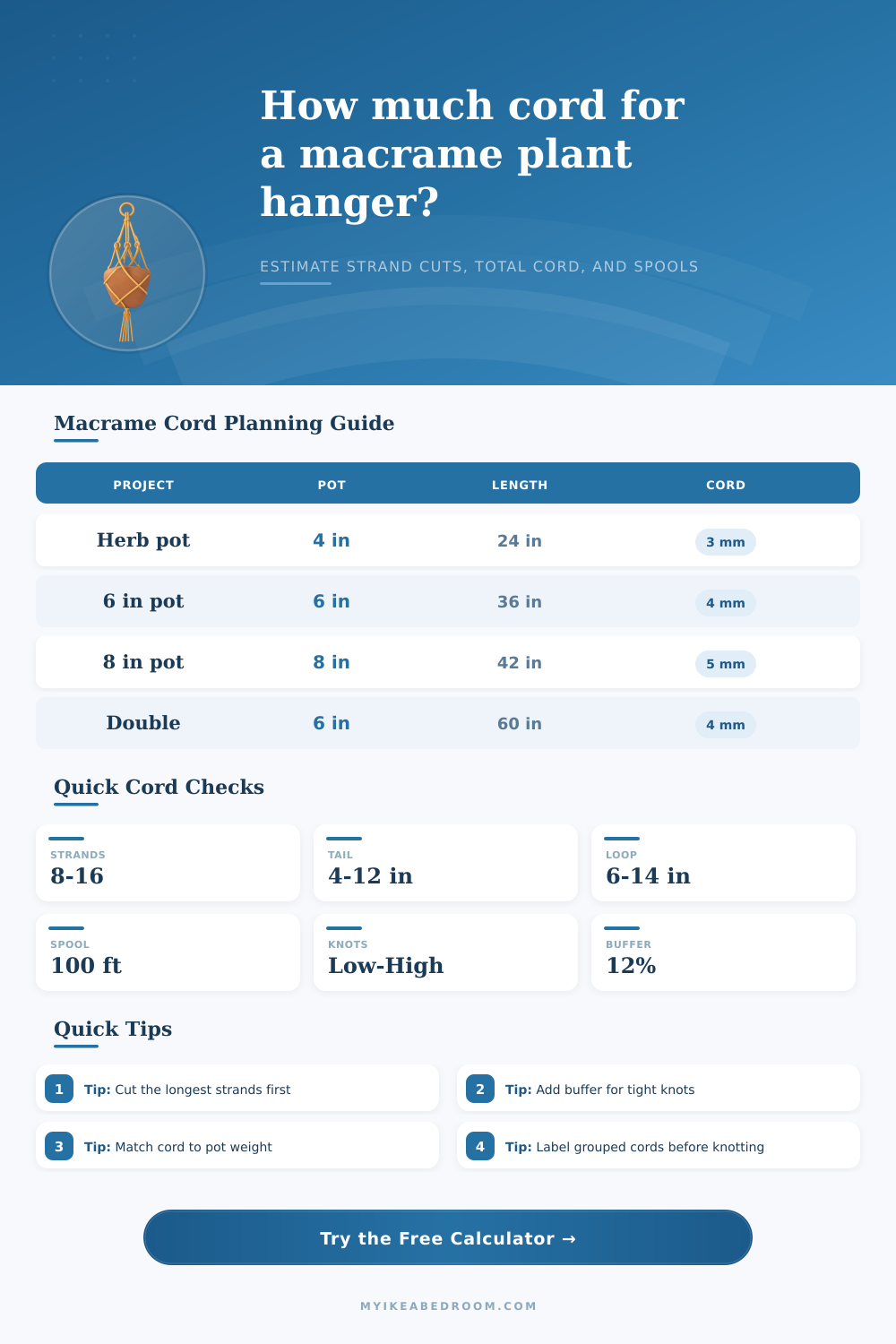
| Small herb pot hanger | 24 in / 61 cm | 4 in / 10 cm | Open pattern, 6 strands, 3 mm cord, short loop. |
| 6 in pot hanger | 36 in / 91 cm | 6 in / 15 cm | Simple pattern, 8 strands, 4 mm cord, standard tail. |
| 8 in plant hanger | 42 in / 107 cm | 8 in / 20 cm | Diamond pattern, 12 strands, 5 mm cord, medium density. |
| Double plant hanger | 60 in / 152 cm | 6 in / 15 cm | Double pattern, 12 strands, 4 mm cord, longer body. |
| Long window hanger | 54 in / 137 cm | 5 in / 13 cm | Open pattern, 8 strands, 3 mm cord, long loop allowance. |
| Balcony hanger | 48 in / 122 cm | 8 in / 20 cm | Dense pattern, 16 strands, 5 mm cord, thicker cradle. |
3 mm cotton cord
Soft and flexible. Good for herb pots, propagation jars, small window hangers, and patterns with many fine knots.
4 mm cotton rope
Common hanger size. Works for most 6 in pots, square-knot sections, and everyday indoor plant hangers.
5 mm chunky rope
Fuller visual weight. Useful for 8 in pots, balcony hangers, and patterns where the cord should look substantial.
Recycled cord blend
Check stretch first. Blended cords can vary by maker, so keep extra buffer when the pattern has tight wrap sections.
Cut one test strand first. If your knots are very tight, work a short sample with the same cord and add the measured take-up to the buffer before cutting every strand.
Keep grouped strands labeled. For double hangers, wide bowl cradles, or dense diamond patterns, bundle equal-length strands together before you start knotting.
If you’ve ever tried to make a macrame plant hanger and failed to measure twice, you know: it’s a case of damned if you do, double-damned if you don’t. Either you end up with a crooked-looking hanger with three thin strands of cord, or else you’re left with ten feet of extra-long cotton rope sitting in your craft drawer till the end of days. It’s the kind of experience all macramers must goes through. And no, it isn’t the knots that are frustrating, it’s the math of how they consume cord, which your eyes can never seem to anticipate until it’s too late.
If there’s one thing I’ve noticed about most novices, it’s that they underestimates how much rope to buy. They assume the finished length, plus maybe some extra for fringe, is all they need. Use the calculator above to handle the math for you. Once you input your measurements, it eliminates guesswork around unit conversion and complicated coefficients.
How to Plan Your Macrame Project
The key takeaway: when you make a square knot, a spiral, or any other kind of wrap, you pull much more rope through your fingers than what will ultimately remain in your finished work. We call this take-up, and it varies greatly based off the thickness of your chosen cord and how tightly you apply tension during the process. Think of it like this: if you have 5 millimeters of rope and create a really tight pattern, it’ll eat up rope much quicker then an airy open-weave with very thin 2-millimeter string.
These are the kinds of variables that can be set by picking correct starting place in the tool’s preset section, before you’ve even put scissors to twine. For something as basic as a little hanger for a tiny herb pot, the demands is low, and a single spool is likely to be more than enough, with lots left over. Change the goal posts to an eight inch terracotta planter, or a double tiered balcony system, however, and the need for cord shoots up fast. This is presented in the reference tables on the page, which illustrate just how much various patterns increase your baseline need for length.
The reason that a simple spiral uses less length then a more complex diamond net pattern isn’t because the latter looks like it has more length; it’s because the weaving of the pattern along diagonals puts friction on the working length, reducing it a bit at each step. Interestingly enough, thickness of the cord also have a large effect on this calculation. Because thicker cord is not only stiffer and heavier, it will fight harder against being pulled through the knot. That fight leads straight to excess rope usage while cinching down on the knot.
While seemingly insignificant at first glance, it’s something worth considering if you’re cutting every last inch out of a roll of material. Otherwise, you may find yourself with a completed hanger that’s two inches too small to fit snugly over the lip of the pot. To account for this, I have adjusted the take-up factor to compensate for rope diameter. This ensures the math considers real-world physics of using thick rope instead of thin string.
But here’s something else to think about: Why include a buffer at all? In theory, cutting exactly feels efficient, but real life involves messy realities like uneven tension and tangled strands. But then there are real-world factors such as uneven tension and knotted strands. There might also be a loop or two that want to stick up no matter how much slack I tug through it. Adding twelve percent extra isn’t just for bad cutting skills; it’s a way to account for the messy realities of a tactile process.
Macramé is a hands-on activity with shifting variables. Sometimes you’ll tie one perfect square knot after another…only to discover the fourth one seem too tight since your fingers are tired now. That little bit of wiggle room catches the tiny variations that would otherwise require pausing to weave in more cord halfway through.
The biggest source of headaches at retail comes from purchasing several small packages that don’t exactly match up (dye lot, etc.). Larger bulk spools guarantee that colors matches from strand to strand. This is especially true when using light-colored cords, as any slight color differences will show up more clearly against darker planters. Because the eye tracks along length of the hanger following the line of the cord, it wants uniformity of hue and texture, and any abrupt shift in thickness or sheen doesn’t look intended so much as careless.
When planning ahead, reach for a single large roll instead of rooting through bits and pieces from separate purchases over the past few months. In short: Good Macramé is all about good prep. Your knotted connections are as nothing compared to a careful look at how much cord to use, and how long each strand should be. Sit down with a solid plan in mind, knowing just how much cord and what length strands you need. That way, tying those knots can be a low-stress bit of creativity instead of a nail-biting roll-of-the-dice where you hope you’ll have enough rope by the time you’re finished.
It changes it from “stressful math” to “craft,” which is a totally different thing. Then, when you finally hang up your new hanger to swing gently there, un-fraying, unpatched, you’ll realy understand why the planning was so important after all.