Planter fill and bag estimator
Window Box Soil Volume Calculator
Estimate the loose potting mix needed for a rectangular window box after fill height, reservoir or false-bottom space, top mulch reserve, soil compaction, bag size, and plant count are included.
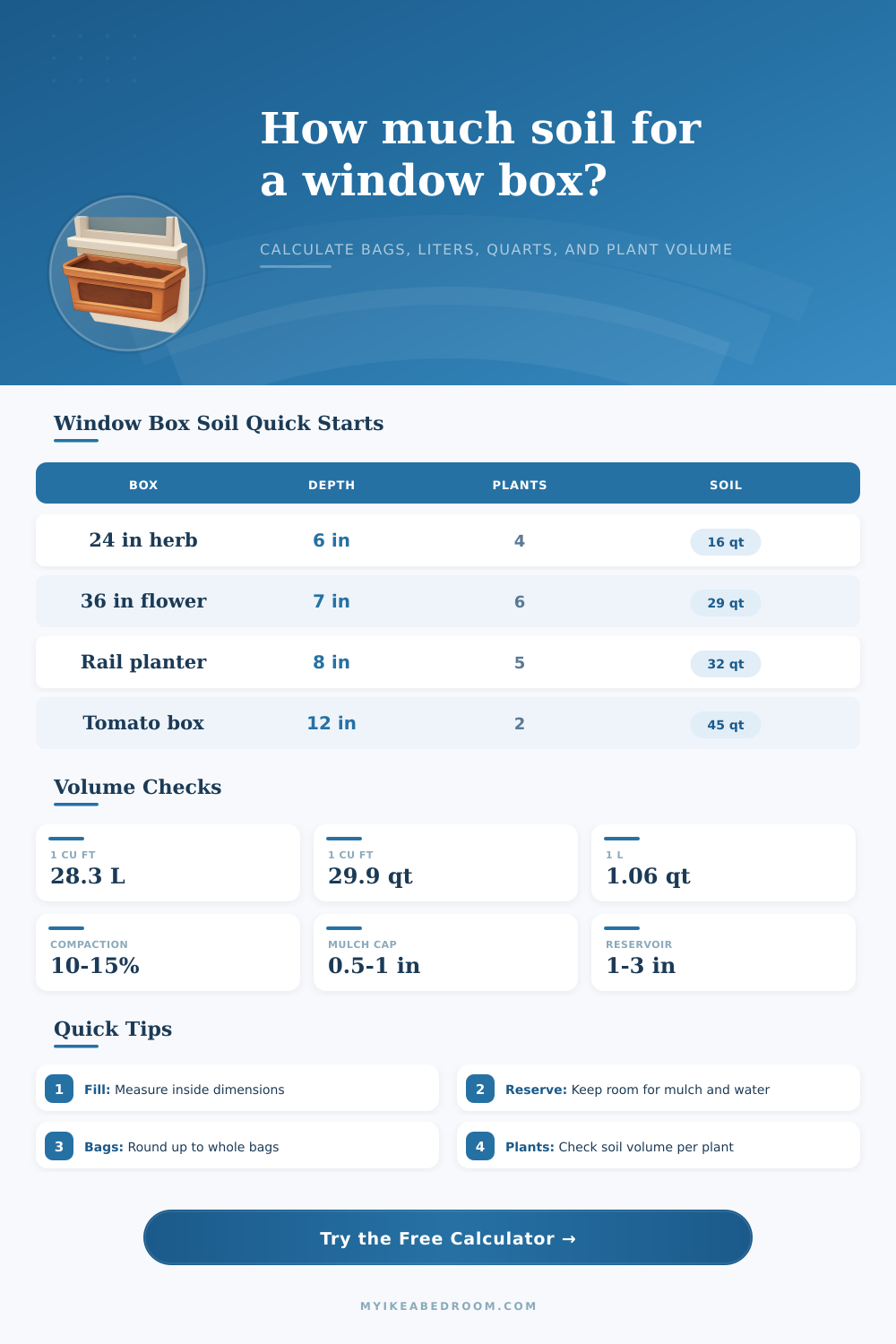
| Window box preset | Inside size | Soil planning setup | Planting note |
|---|---|---|---|
| 24 in herb box | 24 x 6 x 7 in | 6 in fill, 0.5 in mulch, no reservoir | Four small herbs or compact greens. |
| 36 in flower box | 36 x 8 x 8 in | 7 in fill, 1 in reservoir, 0.5 in mulch | Six annuals with moderate root room. |
| Balcony rail planter | 30 x 7 x 8 in | 7.25 in fill, 1.5 in reservoir | Five trailing flowers or herbs. |
| Deep tomato box | 40 x 12 x 14 in | 12.5 in fill, 1 in mulch reserve | Two patio tomatoes or peppers. |
| Narrow sill box | 18 x 5 x 6 in | 5.25 in fill, no false bottom | Small herbs, violas, or microgreens. |
| 48 in salad box | 48 x 10 x 10 in | 9 in fill, 1 in reservoir, 0.5 in mulch | Lettuce, spinach, and shallow greens. |
| Soil depth after reserves | Best plant types | Volume per plant target | Planning note |
|---|---|---|---|
| 3 to 4 in / 8 to 10 cm | Succulents, microgreens, small annuals | 1 to 2 L each | Use gritty mix and keep water movement open. |
| 5 to 6 in / 13 to 15 cm | Herbs, pansies, compact flowers | 2 to 4 L each | A common small window box range. |
| 7 to 8 in / 18 to 20 cm | Flowers, strawberries, leafy greens | 4 to 7 L each | Good general-purpose root depth. |
| 9 to 12 in / 23 to 30 cm | Dwarf tomatoes, peppers, deeper herbs | 8 to 14 L each | Use fewer plants and heavier brackets. |
| Bag size | Liters | Quarts | Useful for |
|---|---|---|---|
| 0.5 cu ft | 14.2 L | 15.0 qt | Small sill boxes and top-offs. |
| 1.0 cu ft | 28.3 L | 29.9 qt | Most medium flower boxes. |
| 1.5 cu ft | 42.5 L | 44.9 qt | Large rail planters or multiple boxes. |
| 2.0 cu ft | 56.6 L | 59.8 qt | Deep troughs and long salad boxes. |
| 25 L bag | 25 L | 26.4 qt | Common metric container mix bag. |
| 50 L bag | 50 L | 52.8 qt | Multiple planters or deep boxes. |
| Reserve type | Typical height | Volume effect | When to use it |
|---|---|---|---|
| Top watering gap | 0.5 to 1 in / 1 to 2.5 cm | Subtracts from soil volume | Prevents overflow when watering. |
| Mulch layer | 0.5 to 1 in / 1 to 2.5 cm | Reserve separately from potting mix | Useful for exposed sunny boxes. |
| False bottom | 1 to 2 in / 2.5 to 5 cm | Displaces soil below root zone | Self-watering or lightweight planters. |
| Water reservoir | 2 to 3 in / 5 to 8 cm | Large soil displacement | Self-watering rail planters. |
Many of us begin our gardens by growing something on the windowsill or balcony, and then wonder why there’s no place to put anything in the container, after we’ve filled it right up to the top. Where did all the soil go? It seems to vanish, and what remains is a heavy mass of dirt that won’t even fit inside narrow space because containers is so full. The math just doesn’t seem to add up. No wonder you keep buying more: You end up with far more soil than to fit into your window box.
The issue is typically inside the box. Even if you buy a basic window box, which appear to be eight inches deep, chances are there’s an extra couple of inches of height from a false bottom or water reservoir. No, you aren’t paying for air in your soil. Many gardeners overspend because they don’t understand this distinction: usable root zone versus total volume.
How to Buy the Right Amount of Soil for Your Garden Box
When the soil calculations is wrong, the plants suffer too. To use it, you simply input the size of your container, and it calculates how much to purchase. It separates the reservoir displacement and mulch reserve from the planting medium. That’s important: A thirty-liter self-watering planter may contain three inches of water and half an inch of space for overflow protection…so you need just five inches of soil. Purchasing that much soil would of been a waste of money (and your back).
One thing to keep in mind: Before you lug those bags up the stairs, consider the weight. Compost mixes and potting mix may seem lightweight at garden center, but get it home and it’s heavier. A concentrated compost mixture can reach almost thirty pounds per cubic foot. If you’re filling one of those long rail planter, that can be a lot of strain on your brackets. A lighter, more airy succulent mix or an all-purpose mix will lighten the load. It calculates how much weight you’ll have to handle, so you can tell whether your balcony railing can support it.
Another mistake: How densely do you pack your planting? Since we have seen how crowded things are at the garden center, we put everything in our boxes. But those nursery container were only a temporary home. Each plant should be given plenty of room for his or her roots in that new home called a window box. The calculator then breaks down the volume of the available soil among whatever number of plants is going into a particular box (e.g., a medium-sized box with six plants). Using too few liters per plant (such as two) means they will compete for resources, which is no good for your herbs. Better to purchase fewer plant, but more soil.
Besides that, soil settles. That fluffed-up fresh mix is compressed by a factor of ten or fifteen percent within a couple of weeks from gravity and watering. Should you fill the box right to the lip with all the measured volume? Within a couple of weeks of rain there’ll be an air gap between those roots and the top of the box. Account for compaction in your starting calculation, and keep the roots wet. And avoid dry spots down at the bottom.
Presets: To get you started, there are the reference tables on the page, which break down typical presets (like a deep tomato trough, or a twenty-four-inch herb box). These presets aren’t set in stone; they are just a starting point that you can adjust based off your own situation and where you live. Get off the guess-and-go and onto the measure-and-got-it.
The right soil has as much to do with knowing how much to buy (hint: less) as it does having the space in which to put it. And the “right” number shrinks considerably. This is because you must factor in breathing room on top of your beds and a place to put your water tank at the bottom. It sounds strange, I know, but all that empty space keeps the garden alive through summer’s hottest days. Actually the moddern way of gardening requires this knowledge so you can recieve more growth.