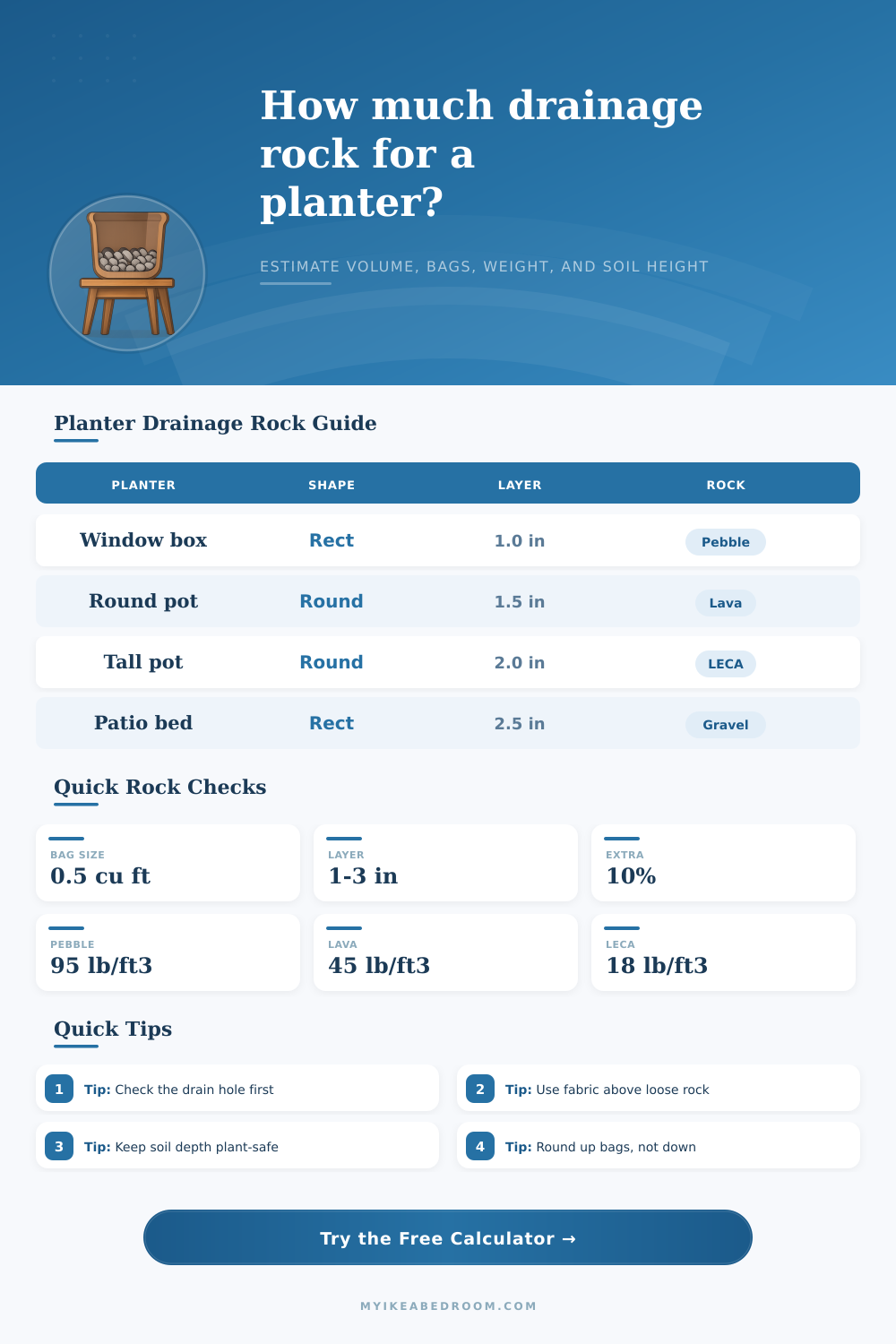
Planter Drainage Rock Quantity Calculator
Estimate drainage layer volume, rock weight, bag count, remaining soil height, and drainage ratio for rectangular troughs, round pots, raised planters, window boxes, and herb boxes.
Start with a common planter size, then adjust shape, dimensions, layer depth, pot count, rock density, fabric or false-bottom option, extra allowance, and bag volume.
Layer view
The calculator treats the drainage layer as planter floor area multiplied by rock depth, then applies pot count, fabric or false-bottom adjustment, and extra allowance.
| Layer depth | Volume per sq ft | Liters per sq meter | Typical use |
|---|---|---|---|
| 0.75 in / 1.9 cm | 0.063 cu ft | 19 L per sq m | Very shallow bowls, cachepots, and trays where soil height is limited. |
| 1 in / 2.5 cm | 0.083 cu ft | 25 L per sq m | Window boxes, herb boxes, and small pots with clear drain holes. |
| 1.5 in / 3.8 cm | 0.125 cu ft | 38 L per sq m | General container planting when soil depth remains adequate. |
| 2 in / 5.1 cm | 0.167 cu ft | 51 L per sq m | Tall planters, ceramic pots, and deeper patio containers. |
| 3 in / 7.6 cm | 0.250 cu ft | 76 L per sq m | Large raised planters where weight and soil height still work. |
| Bag size | Volume | Bags per cubic foot | Coverage at 2 in depth |
|---|---|---|---|
| Small decor bag | 0.25 cu ft / 7.1 L | 4 bags | About 1.5 sq ft before extra allowance. |
| Standard rock bag | 0.5 cu ft / 14.2 L | 2 bags | About 3 sq ft before extra allowance. |
| Large decor bag | 0.75 cu ft / 21.2 L | 1.33 bags | About 4.5 sq ft before extra allowance. |
| Bulk potting bag | 1 cu ft / 28.3 L | 1 bag | About 6 sq ft before extra allowance. |
| Large bulk bag | 2 cu ft / 56.6 L | 0.5 bag | About 12 sq ft before extra allowance. |
| Planter shape | Area formula | Layer volume formula | Soil height check |
|---|---|---|---|
| Rectangular planter | Length x width | Length x width x layer depth x pot count | Inside height minus effective rock layer. |
| Round planter | Pi x radius x radius | Round area x layer depth x pot count | Inside height minus effective rock layer. |
| Fabric over rock | Same floor area | Volume unchanged, weight unchanged | Soil and rock stay separated more cleanly. |
| False bottom insert | Same floor area | Calculator reduces rock volume by 45% | Air space replaces part of the rock layer. |
| Preset | Planter dimensions | Layer target | Best material fit |
|---|---|---|---|
| Balcony trough planter | 36 x 10 x 12 in rectangle | 2 in layer, 1 planter | Pea gravel or lava rock if the railing load matters. |
| Round ceramic pot | 14 in diameter, 14 in height | 1.5 in layer, 1 pot | Lava rock lowers load while staying stable. |
| Raised patio planter | 48 x 18 x 18 in rectangle | 2.5 in layer, 1 planter | River rock or crushed gravel when weight is acceptable. |
| Deck rail planter set | 24 x 8 x 8 in rectangle | 1 in layer, 3 planters | LECA or pumice to reduce rail load. |
| Half barrel planter | 24 in diameter, 18 in height | 2.5 in layer, 1 planter | Lava rock or river rock depending on weight target. |
Pea gravel
Dense and stable. Good for deep troughs and window boxes, but weight adds up quickly on shelves, railings, and balconies.
Lava rock
Porous and mid-weight. Useful when a planter needs a drainage layer without the full load of river stone or crushed gravel.
LECA clay
Light and round. Best for tall indoor planters, false-bottom systems, and containers that need easy lifting.
Pumice or perlite
Very light. Works for weight-sensitive pots, though lightweight pieces can float or migrate if water rushes through.
Protect soil depth first. If the drainage layer uses more than about one quarter of the inside height, reduce the layer, use a false bottom, or switch to a taller planter.
Separate loose rock from soil. Fabric or mesh keeps potting mix from filling the rock voids, which makes the calculated drainage space closer to real use.
Fill the ceramic pot with expensive succulents and fresh soil. But without a proper drainage layer, you’ll watch them rot from the bottom up in a matter of weeks.
It’s a common affliction: We act as if a planter were a mini-garden with deep-rooted plants. But it isn’t… It’s just a container for a simple fact of life called gravity, which hold water in place. A little-known fix (most common cause): No drainage layer at the bottom.
Why Drainage is Important for Pots
What’s wrong? It is not bad soil. It is not a lack of love. Just no drainage layer to let excess water out before it saturates the root zone. When you’re away, your plants will still be alive even after heavy summer storms.
If you get that layer right, you will balance three competing needs: Need #1 is enough depth to hold runoff. Need #2: not so deep that you take away precious soil volume from the roots. It is heavy enough to hold its place in the water or wind, but light enough to pick up when necessary. Again, the calculator will do this for you after you enter your own dimensions.
It saves you from guessing about conversion factors and coefficients. This lets you focus back on real plant health trade-offs. A standard assumption among most gardeners is that an inch-deep layer of pea gravel in each container will do the trick, but if it rains harder than fast enough to soak into the soil, then nope: that won’t work.
To create a storage effect, making the rainwater linger and drain slowly (instead of rushing to pool at feet of tender roots), go thicker than an inch deep. In fact, as the table of references on that page explains, the deeper the gravel, the greater the volume. It will also hold more weight, though it won’t hold much less soil, which is why even a half-inch more make a big difference.
Your goal: a drainage ratio where the rock layer occupies no more than 25 percent of the total inside height (meaning that the gravel itself shouldn’t take up more than a quarter of vertical space within the container). Deeper still and you’re really more building a stone column than a growing medium. Leaving little margin to retain nutrients or expand roots over time. It is a little thing, but it is very important for creating long-lasting plant strength.
Material selection goes beyond simply selecting something visually pleasing from the showroom floor. By weight, pea gravel and river rocks weigh about one hundred pounds per cubic foot (they’re dense!). This makes for a stable growing surface, but it is difficult to use on elevated surfaces like balconies and higher story railings. Lighter materials such as LECA or expanded clay drop this down to almost half the weight with even better porosity, if weight is an issue.
The latter will keep your planter from being an immovable piece of furnitures that requires the assistance of a friendly neighbor to turn and rearrange for better sun exposure. Weight is calculated by the planter calculator; select your material and see how much it weighs before you lift the first bag. It’ll save your back and make your building’s manager happy come inspection time, since he/she has to check for maximum loads on any shared deck.
Another easy-to-forgotten detail: using fabric to separate the soil and rock. The soil from above will wash down into the void spaces, gradually filling them up with fine particles that ultimately block drainage. What you thought was going to be a drainage layer instead becomes a muddy sponge holding moisture against roots, defeating the whole idea of the set-up. A simple piece of mesh screen or fabric separates one zone from the next, allowing the calculated volume to remain in action for years instead of just weeks.
It is an inexpensive insurance policy that helps preserve structure of your planting bed during many seasons of rain and watering to come. But what are the weight restrictions on an urban garden project? Hefty bags of crushed stone added to big pots (like my large patio planters) add hundreds of pounds to surface of your deck. That’s a lot of weight when combined with mature plants and maybe some extra moist soil. Enough to exceed any “safe” loads.
Lighter aggregates such as pumice or lava rock will reduce the load and allow for enough water movement, too… Creating those all-important air gaps. Plus they’re breathable, so no worries about the roots cooking in an environment without air (root rot is one risk in limited space). The tool allows you to view various options side-by-side; it shows you the impact of switching types of aggregate on the work required and the price. And you can play around with varying the number of bags and adding a little extra to hit your sweet spot: between convenience and accuracy.
A few percentages’ worth of added rock (say, ten percent) covers spills and won’t leave you stuck halfway through a job without enough. You want water to flow in and out freely but not take away any nutrients the plants rely on. You don’t want to guess at how much space you need for drainage; that’s why we calculate precisely what the right volume is for each pot so you know if they’re under- or over-drained.
It means a happier-looking garden immediately, and all the way until harvest, that smart planning equals good soil. Your plants will appreciate it, too, when you give them space to breathe…and you won’t have to go buy more plants to replant after yours fail because you didn’t had enough drainage. That empty space at the bottom becomes the foundation for everything else above it.