Under Bed Storage Clearance Calculator
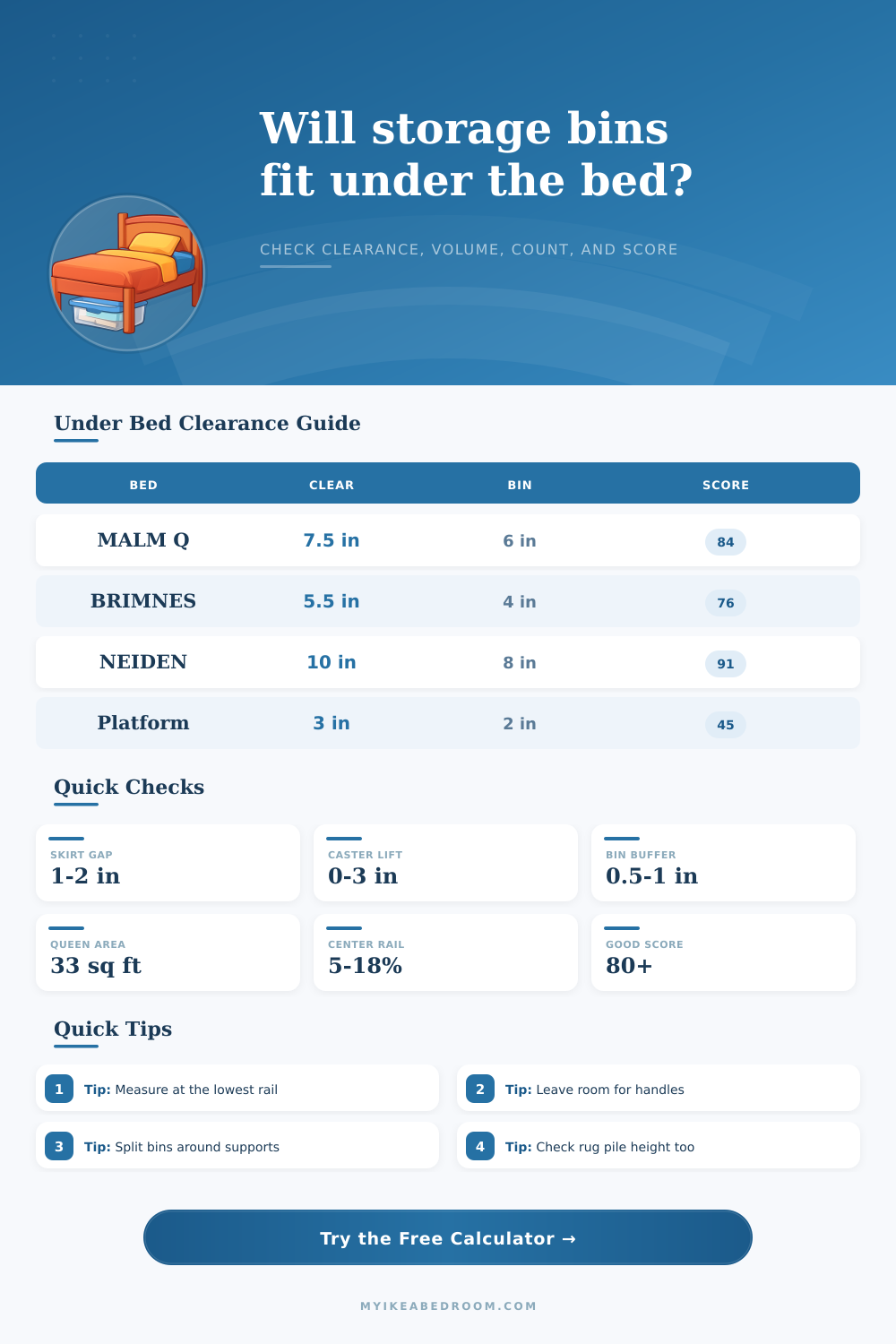
Measure the lowest bed-frame rail, subtract mattress or skirt drop, add caster lift, account for center supports, and estimate the bin height, storage volume, bin count, and clearance score.
Use a preset close to your bed, then replace the clearance, bin, caster, skirt, support, and floor-buffer values with your measured dimensions.
Clearance model
The calculator uses the lowest frame point, subtracts hanging drop, adds caster or riser lift, reserves a target sliding gap, and reduces the footprint for supports and access limits.
| Bed size | Nominal mattress footprint | Area | Under-bed storage note |
|---|---|---|---|
| Twin | 38 x 75 in / 97 x 191 cm | 19.8 sq ft | Usually fits one long row of narrow bins from one side. |
| Twin XL | 38 x 80 in / 97 x 203 cm | 21.1 sq ft | Extra length helps rolling dorm-style boxes. |
| Full | 54 x 75 in / 137 x 191 cm | 28.1 sq ft | Two rows can work if a center support does not split the path. |
| Queen | 60 x 80 in / 152 x 203 cm | 33.3 sq ft | Good footprint for four to eight low bins. |
| King | 76 x 80 in / 193 x 203 cm | 42.2 sq ft | Large volume, but center rails and legs matter more. |
| California king | 72 x 84 in / 183 x 213 cm | 42.0 sq ft | Long bins can work if side access is open. |
| Score | Fit result | Typical top gap | Practical meaning |
|---|---|---|---|
| 90 to 100 | Excellent | 1.5 in or more | Bins should slide easily and tolerate small rugs or uneven floors. |
| 75 to 89 | Good | 0.75 to 1.5 in | Works for most plastic bins if handles and lids are included. |
| 60 to 74 | Tight | 0 to 0.75 in | Use soft bags, lower lids, or smaller bins around supports. |
| 40 to 59 | Limited | Bin nearly scrapes | Try shallow trays or risers before buying full-size bins. |
| 0 to 39 | Poor | Bin too tall | Clearance is below the selected bin plus the target gap. |
| Obstruction | Loss used | What it represents | Best workaround |
|---|---|---|---|
| None | 0% | Open under-bed footprint with no center legs or drawer boxes. | Use long bins from both sides. |
| Center rail only | 8% | Narrow rail splits the footprint but does not block much volume. | Use matched bins on each side. |
| Center legs or feet | 14% | Legs interrupt long bins and reduce the clean sliding path. | Use shorter bins between legs. |
| Built-in drawer boxes | 28% | Drawer frames and hardware occupy part of the storage bay. | Measure each drawer cavity separately. |
| Low slats or braces | 18% | Cross braces lower part of the clear height and snag lids. | Choose low flexible bags. |
| Heavy obstruction | 40% | Footboard panels, big center supports, or blocked side access. | Treat storage as partial-zone only. |
| Container type | Typical height | Access allowance | Best fit scenario |
|---|---|---|---|
| Low plastic underbed box | 5 to 7 in / 13 to 18 cm | 0.75 to 1 in top gap | Everyday linens, shoes, and seasonal clothing. |
| Rolling bin with wheels | 6 to 9 in / 15 to 23 cm | 1 to 1.5 in top gap | Heavy items where casters need room to pivot. |
| Fabric basket | 6 to 10 in / 15 to 25 cm | 0.5 to 1 in top gap | Open frames where soft sides can flex around rails. |
| Vacuum storage bag | 2 to 5 in / 5 to 13 cm | 0.25 to 0.5 in top gap | Very low platform beds and off-season textiles. |
| Drawer tray | 4 to 8 in / 10 to 20 cm | 1 in plus slide path | Beds with straight side access and consistent clearance. |
| Custom wood drawer | 5 to 10 in / 13 to 25 cm | 1 to 2 in top gap | Raised beds where exact bay width is known. |
Sliding bins
Best all-around choice. They need a modest top gap, work around center rails, and make good use of queen and full footprints.
Rolling bins
Easiest for heavy loads. Wheels add height and need more clearance, but they reduce dragging on rugs and wood floors.
Soft bags
Best for tight frames. Flexible sides fit below low rails, around support feet, and through narrow side openings.
Drawer trays
Best when measured precisely. They feel built in, but they punish uneven floors and need a consistent clear sliding path.
Measure the lowest obstruction. Do not use the decorative side height if a center rail, slat end, drawer face, skirt, or sagging fabric hangs lower than the frame.
Check the sliding path. A bin can fit vertically but still fail if a center leg, rug edge, handle lip, or footboard blocks the direction it needs to travel.
Typically, this means your hopes for an endless bedroom storage end around six inches from the floor. You purchase a stylish new bed frame with extra leg room and vow to store off season bedding and winter coats out of sight… never to think about them ever again. You attempt to sneak the very first plastic bin under the bed, only to find a central rail catching on the fabric. Or worse, the beautiful bed skirt sags below where you expected it to reach and there’s no way that bin will fit beneath it. This is where the ‘friction’ happens, and it’s what makes measurement better then estimation.
While most will measure the vertical distance from the floor to where the bed leg is tallest, that’s irrelevant for storage. Storage isn’t interested in the highest point; it matter where the lowest point of obstruction is between mattress supporting structure and the floor. Enter your exact measurements into the calculator above. It does the math for you so you don’t have to figure out how much volume you’ll lose due to drawer boxes and center rails. Usable clearance is perhaps the most critical input value to enter correctly.
How to Measure for Under-Bed Storage
Don’t confuse this with space between your floor and underside of your bed frame. Subtract out anything that drops below that level; such as a lip on your mattress foundation, sagging slats, or any other fabric skirt. Add back in any risers or bed casters you might have. It’s an easy tweak but makes all the difference in determining if your bins will fit or not.
Target gap above bin: Yes, we factor this into the calculation too, since a container that fits vertically still won’t slide if it’s scraping frame with zero wiggle room. One thing that is unexpectedly influential is floor type. Plush rugs introduce an unknown factor in the mix, while hardwoods is nice because they’re consistently level and flush with the floor. Before your bin even hits the floor a deep-pile shag rug can consume a good half-inch of vertical space. That’s why the calculator requests the wiggle room, no one wants a promised fit that falls short at first contact!
Speaking of which, don’t forget the other aspect of horizontal configuration: The queen mattress has approximately 33 sq ft of potential stashing space… though not all of it will be accessible. Support rails cut the footprint down the middle. If you’re unaware of their existence, you’ll order bins wider than what fits beneath either side. To make it easy for you, the tool automatically factors in any obstruction loss depending on the type of bed you have.
That doesn’t require any mental math; just look at the number it spits out as its own clearance score. If it’s high, then you’ve got enough space for some hefty plastic boxes with lid/latches/handles. If it’s low, then you’re looking at soft fabric bags instead, which will squish around obstructions, or maybe even vacuum-sealed storage sacks. There isn’t a single right answer here: the goal is determining which solution fits best into whatever space you have available.
Do you need something soft (because it’ll bend/flex over slight imperfections in the frame or floor and not get hung up like a hard box)? Or do you want something rigid (to protect more fragile items/shoes from each other)? Rigids requires measuring carefully, while soft bins won’t mind a little slop.
The depth of the bed frame is another detail people tend to neglect. Wide wooden apron frames and upholstered beds often has rails that stretch way past the edge of your mattress. This eats into the usable width for sliding bins in from the sides. To make up for this, the calculator takes into account the reachable footprint factor: whether the bed is placed in a corner or against a wall, blocking access from either end. It is a minor point, but it will save you the irritation of being unable to reach certain spaces.
In the end, under-bed storage is as much an issue of accessibility as it is capacity. Make the bins too snug to smoothly slip out, and you have yourself a bunch of dead weight. Things will sit in there until the mythical next spring cleaning never comes. Measure your low spot first, not your high one. Look for any potential obstacles, cross braces, center legs, etc. Remember: Just a couple inches of additional vertical clearance over the bin can be the difference between a stuck-on lid and a nice easy glide. Accurate measurement goes a long way; everything else falls into place from there.