Garage Shelf Capacity Calculator
Estimate practical garage shelf capacity from span, depth, shelf material, thickness, bracket spacing, load type, shelf count, safety factor, and units.
Start with a familiar garage setup, then adjust the exact dimensions, material, load type, and safety factor for your shelf bay.
Capacity breakdown
| Material | Relative strength | Deflection behavior | Garage use note |
|---|---|---|---|
| Particleboard shelf | Low | Sags sooner under dense loads | Keep spans short and avoid fluids concentrated in one spot. |
| MDF board | Low to medium | Stiff at first, but heavy | Use close brackets and avoid humid garage conditions. |
| Solid pine board | Medium | Moderate sag over time | Good for bins when supported every 24 inches or less. |
| Cabinet plywood | Medium to high | Better long-span stability | Good all-around choice for garage shelves and tool cases. |
| Birch plywood | High | Strong and predictable | Useful when a cleaner edge and better stiffness matter. |
| Hardwood board | High | Strong if straight-grained | Works well for visible shelves, but check for knots and splits. |
| Load type | Density | Multiplier | Typical examples |
|---|---|---|---|
| Light bins and decor | 10 lb/ft² | 1.00 | Empty bins, paper goods, seasonal decor. |
| Plastic totes | 25 lb/ft² | 1.10 | Holiday totes, folded textiles, household storage. |
| Mixed garage storage | 35 lb/ft² | 1.20 | Bins mixed with small tools, cords, and parts. |
| Paint cans and fluids | 45 lb/ft² | 1.30 | Paint, cleaners, automotive fluids, compact containers. |
| Power tools and cases | 60 lb/ft² | 1.35 | Drills, saws, chargers, and molded tool cases. |
| Point load or engine parts | 75 lb/ft² | 1.65 | Dense parts placed in one area instead of spread out. |
| Support spacing | Best fit | Watch point | Calculator effect |
|---|---|---|---|
| 12 to 16 inches | Heavy tools, MDF, paint cans | More brackets and anchors required | Strongly improves load estimate and deflection proxy. |
| 18 to 24 inches | Typical garage totes and utility shelves | Check bracket rating and stud layout | Good balance for most household storage. |
| 30 to 36 inches | Light bins on plywood or hardwood | Long-term sag may appear | Capacity drops quickly as span increases. |
| Over 36 inches | Light display or reinforced shelves | Needs stiff material or front rail | Usually triggers a shorter recommended span. |
| Scenario | Common size | Material tendency | Load pattern |
|---|---|---|---|
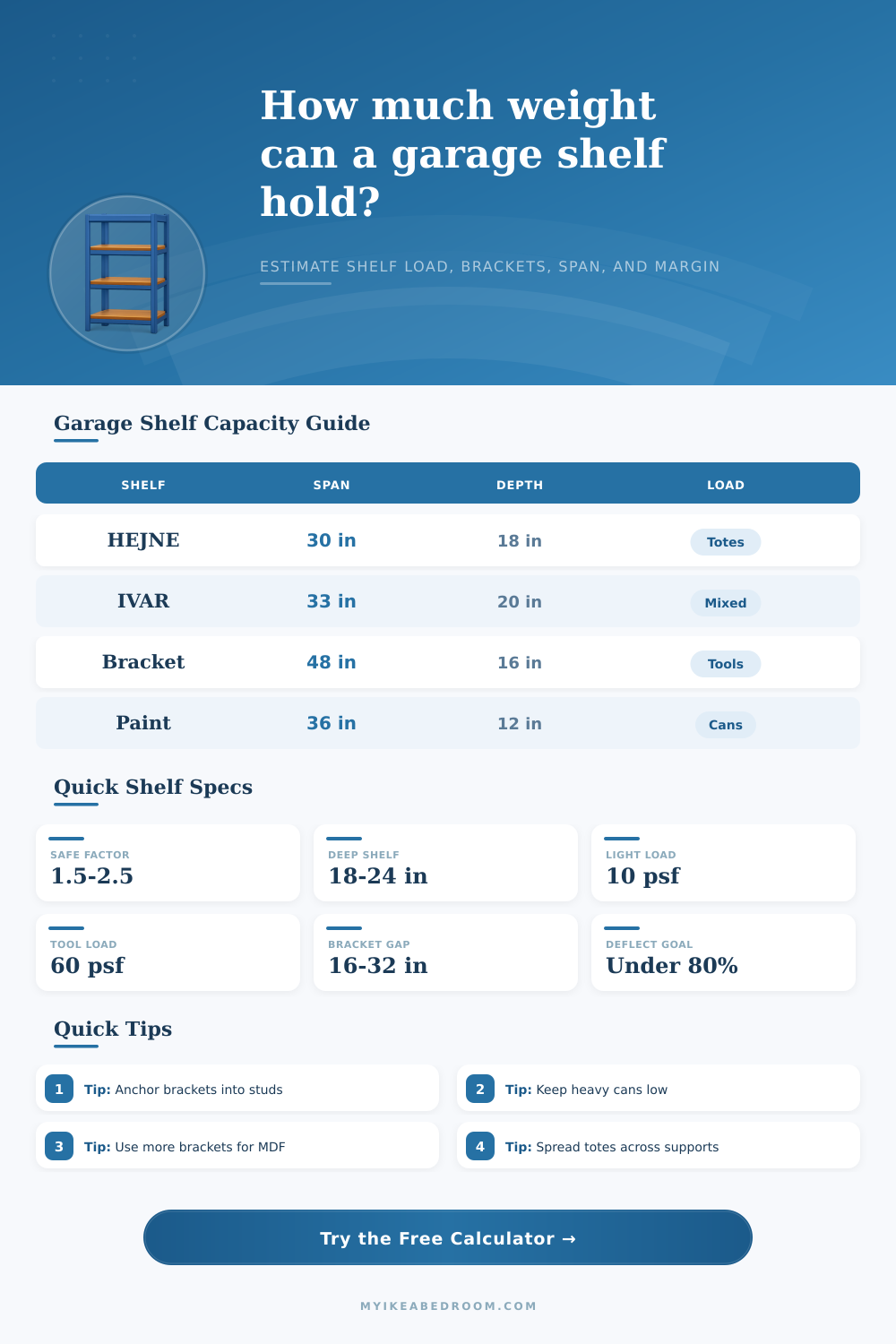
| HEJNE-style utility shelf | 30 x 18 inches | Softwood slats or boards | Bins spread across shelf width. |
| IVAR-style storage bay | 33 x 20 inches | Pine shelves on side uprights | Mixed boxes and household supplies. |
| Wall bracket shelf | 48 x 16 inches | Plywood or pine board | Load follows bracket positions and stud spacing. |
| Paint can shelf | 36 x 12 inches | Plywood preferred | Dense load needs short spans and low placement. |
| Deep tote shelf | 72 x 24 inches | Plywood with several supports | Large area but load should stay evenly distributed. |
Light-duty L brackets
Best for: short shelves, decor, small bins.
Watch: ratings assume proper wall anchoring and load near the wall.
Heavy-duty triangular brackets
Best for: tools, paint, and deeper garage shelves.
Watch: front-heavy loads increase pullout force on fasteners.
Side uprights or posts
Best for: IVAR-style bays, freestanding racks, repeat shelves.
Watch: total bay capacity also depends on frame and floor stability.
Front rail or cleat
Best for: reducing sag on long plywood or softwood shelves.
Watch: add the rail height to the effective shelf thickness only if it is firmly attached.
Anchor and load path: A strong shelf board still depends on brackets, fasteners, wall studs, uprights, and the floor. Treat the lowest-rated part as the real limit.
Sag control: If the deflection proxy is high, shorten bracket spacing before changing everything else. A small span reduction often improves stiffness more than expected.
Why do most folks purchase shelving for their garage? Answer: Because they have no more floor space! It is a fair reason until you load them up. At which point the shelf droops, and those heavy winter tire are suspended over your head. It’s not so much that the shelf supports the weight; it’s more about how to channel that weight from the bin, through the bracket, and into the wall stud … all while ensuring you haven’t made your storage solution a hazard. The calculator above lets you see this pathway before purchasing the lumber and drilling any holes.
Distance Between Supports: Distance between supports is your biggest lever. Everybody knows shorter span = stronger, but not many know how steep that curve actualy is. If the material switches from pine to MDF or particleboard, or the load moves 6″ to one side, then what may hold fifty pounds at 48″ might hold only twenty at 36″. So it really comes down to spacing of those brackets. Soft/heavy materials like mdf or particleboard require closer spacing. Plywood with good grain structure allow for a bit more breathing room over greater distances, though pine is okay even if it is less forgiving. You’ll notice a clear tradeoff on the table in the tool. A cheap board will require more hardware to perform the same function as an expensive one.
How to Make Strong Garage Shelves
But then there’s the load itself. Weight doesn’t behave the same way. A pile of plastic bins distributes their weight over surface of the shelves. This is good for the wood. But a few clusters of paint cans or a single heavy power tool case form a point load, concentrating the stress at the center of the span between brackets. It is like standing on one foot rather than two. To make up for it, the calculator adjusts the density according to your planned load so it accounts for this. If you’re planning to stack dense liquids along with light decor, the math shifts because now it’s the heaviest item and not the average weight that determine the weak point. Design it for the worst-case scenario on that particular shelf, not the ideal case.
People also become complacent with safety factors. In engineering, a safety factor is how much stronger a system is than it needs to be for regular use. For example, a factor of 1.5 would mean that the shelf could hold 50% more weight then what you expected before it would fail from structural issues. If all you store on the shelves are seasonal stuff and no one ever messes around up there, then maybe you don’t need as high a factor. But if you’re working with heavy tools every day or have kids who like to climb on the shelves, then kicking that number up to at least a factor of two will give you peace of mind. When those wall anchors finally come loose after years of temperature changes and vibration, that’s cheap insurance against sudden failure.
The other silent killer is deflection. Yes, you could have a shelf that holds the weight but the shelves bends so much they cause something to go flying forward. This is especially bad with heavy stuff like bins or cans near the front of the shelf. With this tool you can get a deflection indicator that tells you when you’re pushing up against it before you visibly see the sag in the shelf. If it’s high then you know you need to tighten up your bracket spacing. Tightening up bracket spacing is almost always cheaper than buying thicker wood. Thicker wood adds dead weight to the shelf itself. Ironically this adds even more strain to the brackets and wall anchors themselves. It’s all a balancing act between strength, stiffness and how far out from the wall your drywall anchors can hold.
But in short: A garage shelf is only as strong as its weakest link. It may be the plywood. But more than anything else, it might be a flimsy L-bracket made for hanging pictures. It could also be a stripped screw in a flaky piece of drywall. Let these estimates help you make decisions about which brackets goes where; and how much material you need. But double check your wall first; if you catch a stud, you’re gold. Catching empty space between studs? No matter what kind of thick lumber you use, the screws will still pull out. Keep the heavy stuff low, plan for the load, and respect the span. When the shelf stays put where it should of, your back (and your garage floor) will thank you.