Vanity mirror, faucet, backsplash, and light planner
Mirror Height Above Vanity Calculator
Calculate mirror bottom height, eye-line alignment, faucet clearance, backsplash clearance, ceiling top clearance, light fixture gap, and a centered placement score for bathroom vanities and medicine cabinets.
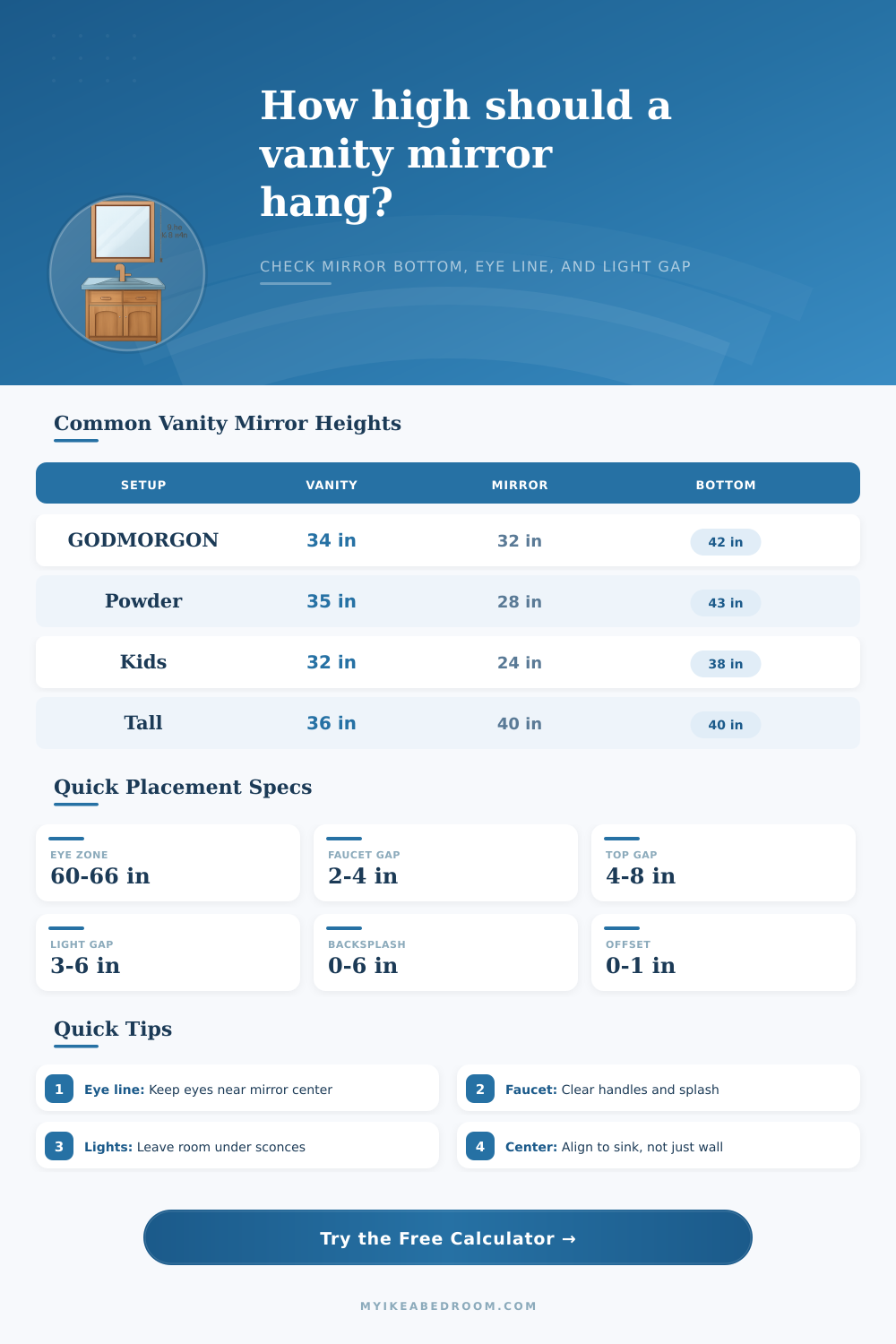
| Vanity setup | Typical vanity height | Common mirror height | Starting bottom height |
|---|---|---|---|
| GODMORGON style vanity | 32 to 36 in | 28 to 36 in | 40 to 44 in above floor |
| Small powder room | 34 to 36 in | 24 to 30 in | 42 to 46 in above floor |
| Double vanity mirror | 34 to 36 in | 30 to 40 in | 40 to 44 in above floor |
| Kids bathroom | 30 to 34 in | 22 to 30 in | 36 to 40 in above floor |
| Tall statement mirror | 34 to 36 in | 38 to 48 in | 38 to 42 in above floor |
| Clearance check | Comfortable range | Watch zone | Calculator response |
|---|---|---|---|
| Faucet top to mirror bottom | 2 to 4 in | Under 1.5 in | Raises mirror bottom to prevent crowding. |
| Backsplash top to mirror bottom | 1 to 3 in | Touching tile or stone | Uses backsplash top plus a small breathing gap. |
| Mirror top to vanity light | 3 to 6 in | Negative or under 2 in | Lowers mirror if ceiling and eye line permit. |
| Mirror top to ceiling | 4 to 12 in | Under 3 in | Flags tight ceiling placement. |
| Sink to mirror centerline | 0 to 1 in | Over 2 in | Deducts from centered placement score. |
| User height | Approx eye height | Mirror center target | Practical adjustment |
|---|---|---|---|
| Child or lower shared bath | 48 to 56 in | Lower third to center | Use a taller mirror when adults also share the room. |
| Average adult | 59 to 65 in | Near middle of mirror | Set the mirror center a little below eye height. |
| Tall adult | 66 to 72 in | Upper middle | Raise the top before raising the bottom too far. |
| Mixed household | 56 to 68 in | Wide usable band | Choose more mirror height instead of a very high bottom. |
| Example room | Inputs that drive height | Likely result | Secondary check |
|---|---|---|---|
| Vessel sink vanity | High faucet and bowl rim | Bottom around 44 to 48 in | Confirm the mirror still catches the user's eye line. |
| Low ceiling bathroom | 84 in ceiling and hardwired light | Shorter mirror or lower bottom | Keep at least a few inches above the mirror top. |
| Medicine cabinet | Cabinet height and fixture lower edge | Bottom often 40 to 44 in | Check cabinet door swing and wall obstacles. |
| Wide double vanity | Centered sink pair and light bar | Bottom often 40 to 43 in | Align mirror to the vanity or the sink pair center. |
| Makeup station | Eye height and even lighting | Center near eye height | Avoid placing the light directly against the mirror top. |
It’s a new bathroom vanity and you’re standing before it, when you realize: something isn’t quite right. Is the mirror too tall, so you have to stare at the backsplash? Is it too short, so you can barely see around the faucet handles? It can make or break whole room. There’s no “one size fits all” way to find the proper height. But there are three constraints, the ceiling lights, the plumbing (e.g., faucets), and where you want to see yourself in the mirror. Those constraint rarely combine in a perfect way. Your best bet is some math, except you don’t want to do the math. Which is why this calculator does it for you. Just plug in the sizes of your vanity and mirror. Then let the thing figure out what works.
The first thing that comes to mind for most folks is eye level. For example, I’m six feet tall, so my eyeballs are roughly sixty-three inches off the ground. A common instinct is to center the mirror exactly at that height but that can cause it to clash with your faucet. That’s all good except when you consider an eight inch backsplash or maybe a really tall vessel faucet. In those scenarios, bottom of your mirror might line up with the spout. Then each time you wash your hands, you’re splashing water onto the drywall. What happens here is that most people ignore the area under the mirror and think only of how they stand. You want some space above whatever block the mirror will be sitting on. Usually two to four inches above the tallest obstacle (faucet or backsplash) is plenty. It gives it a nice clean look but doesn’t make it seem like the mirror is hanging very high.
How to Hang Your Bathroom Mirror
Also think about where the mirror top meets the ceiling. A 40-inch mirror could knock into the wall sconces if your ceiling height are eight feet. Or it could leave just an inch of clearance at the top. This is too close together, which looks cramped and unfinishe. Ideally there should be some breathing room between the mirror frame and light above it. Three to six inches is nice. This keeps functional lighting while avoiding making the mirror appear lost up on the wall. A negative light gap means something has to change. Either opt for a shorter mirror, relocate the light fixture, or settle for a higher bottom edge. Each choice make a trade-off that impacts visual balance or eye line.
Finally, the tool consider who will be using that bathroom. If there are both kids and grownups sharing a bathroom, aiming for adult eye height has the kids looking at the base of the mirror. Here’s where having a taller mirror comes into play; it offers a larger area of mirror that is within reach. As long as the mirror is tall enough to capture everyone’s face comfortabley, you don’t have to center your mark perfectly. The chart on the page shows which vanity height hits that ideal measurement, so you can see that a typical thirty-four inch vanity paired with a thirty-two inch mirror generally requires the bottom edge of the mirror to be roughly forty-two inches off the ground. Adjust those figures immediately when incorporating a shorter powder room vanity or a higher vessel sink.
Another easy tweak: Center your mirror on the sink. Sometimes, the sink isn’t centered inside its vanity cabinet. When the mirror is centered on the cabinet, it’ll make the setup look lopsided. Align it with either the faucet base or the sink’s drain instead. This check of mirror alignment and vertical clearance is reflected in the placement score: The higher your score, the more you’ve cleared away any physical obstacles without sacrificing visual balance. That way, the mirror appears proportionate to the sink different than just the wall.
When doing this task, measuring twice may not be sufficient. Before you drill through your drywall, imagine how it will look. Use some sort of tape (masking or paper) as your marker on the wall for where the bottom will be based off your calculations. Then stand up in front of it. What’s your eye line? How much clearance do you have around the faucet? Trust your eyes. If it looks OK to you, follow what looks best and forget the general rule. Remember, the math provides the boundary, you provide the comfort. Getting it right makes the bathroom functional and pleasant to be in, it would of been better if you measured first.