Kitchen ventilation airflow, duct, and makeup-air planner
Range Hood CFM Calculator
Compare BTU or watt heat output, hood width, kitchen volume, cooking intensity, duct run, elbows, mount type, makeup-air threshold, and duct velocity in one ventilation sizing check.
| Cooking setup | Typical input | Starting rule | Notes |
|---|---|---|---|
| Standard 30 in gas range | 40,000 to 55,000 BTU/hr | 400 to 550 CFM before duct loss | Total all burners; high-output front burners drive capture needs. |
| 36 in pro-style gas range | 60,000 to 90,000 BTU/hr | 600 to 900 CFM before duct loss | Often needs larger ductwork and a makeup-air review. |
| Electric smoothtop | 6,000 to 9,000 W | 205 to 307 CFM heat check | Width and room checks may exceed the watt heat check. |
| Induction cooktop | 7,000 to 11,000 W | 239 to 375 CFM heat check | Pan efficiency is high, but frying still needs capture. |
| Duct condition | Calculator factor | Equivalent effect | Design note |
|---|---|---|---|
| Straight duct length | 0.5 percent per ft | 10 ft adds 5 percent | Use the actual routed length, not cabinet width. |
| Each 90-degree elbow | 5 percent per elbow | 2 elbows add 10 percent | Sweep elbows perform better than sharp elbows. |
| Island or peninsula mount | 20 percent airflow factor | Open capture zone | Also consider a wider canopy when possible. |
| Heavy cooking intensity | 18 to 55 percent factor | More plume and grease load | Frequent wok or griddle use needs the upper range. |
| Round duct diameter | Area | Velocity at 400 CFM | Velocity at 600 CFM |
|---|---|---|---|
| 6 in | 0.196 sq ft | 2,037 FPM | 3,056 FPM |
| 7 in | 0.267 sq ft | 1,497 FPM | 2,245 FPM |
| 8 in | 0.349 sq ft | 1,146 FPM | 1,719 FPM |
| 10 in | 0.545 sq ft | 733 FPM | 1,100 FPM |
| Kitchen volume | 12 ACH check | 15 ACH check | 18 ACH check |
|---|---|---|---|
| 900 cu ft | 180 CFM | 225 CFM | 270 CFM |
| 1,200 cu ft | 240 CFM | 300 CFM | 360 CFM |
| 1,800 cu ft | 360 CFM | 450 CFM | 540 CFM |
| 2,400 cu ft | 480 CFM | 600 CFM | 720 CFM |
You start searing a steak and suddenly your kitchen smells like an old commercial fryer. You realize that proper ventilation capture heat and prevents it from spreading. This makes you wonder how in the world they came up with all the rules for sizing a range hood. It seems more hard then just picking one. Do I have enough? Does mine need upgrading? Most homeowners just want to know.
How does it work? It’s a calculator (see image up top) that puts all those sizing rules in perspective. There’s no “pick one of these” and pray. It factors the heat generated versus size of the room (volume) and the size of the hood (width). That’s important because if you have a high BTU burner then you also has a big ole plume coming off it, more than some simple width-only equations can account for. You input your duct details and cooktop specs and let the system tell you how much air to move so you don’t get any smoke creeping out into the livig room.
How to Choose the Right Size for Your Range Hood
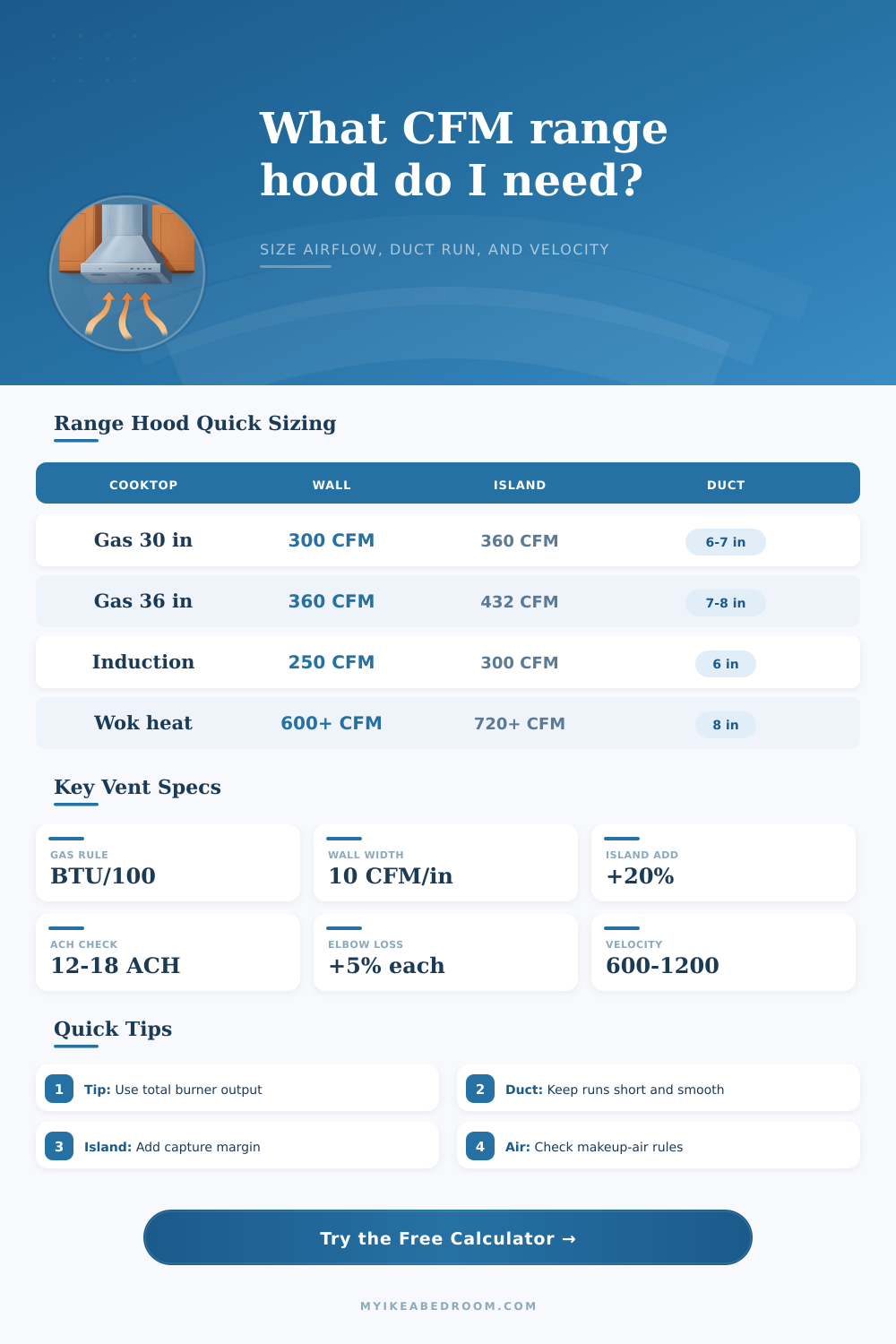
First it’s typically heat output. A general rule states: Divide total BTU by one-hundred for a ballpark CFM value. That works fine until you add in reality factors like long duct runs or multiple elbows that restrict airflow. Each elbow in your ductwork imposes a resistance which will slow the air down and make your hood work that much harder to push an equivalent volume of smoke. The calculator include a loss factor to account for those elbows and prevents you from ending up with a powerful motor pushing air through a restricted pipe.
Because island hoods don’t benefit from the back-wall containment of a conventional wall mount, they has to be monitored more closely. Without that solid wall to keep smoke pinned down, it fans outward in all directions. The resulting plume must be pulled into the vents with additional capture margin, so island installs typically call for higher CFM ratings than otherwise similar jobs against a wall. It is partly due to airflow and partly due to geometry.
Another metric many people overlook is duct velocity. You know when the air is blowing too hard because you’ll hear it, lots of whooshing as it passes by in the cabinet. In this case, more isn’t necessarily better; high-velocity air passing through a small duct will cause static pressure and noise, which ultimately decreases overall efficiency. You want to use a bigger diameter for smooth airflow with less wind noise. Based off the diameter of your duct, the tool will tell you if you should size up to a larger diameter.
Ventilation performance is greatly affected by makeup air, especially if you live in a newer home. Since houses are getting tighter and more energy efficient, extracting 600 CFM of air can be enough to pull smoke right back into the room (or make it difficult to open doors). Depending on where you live, many local building codes will activate a makeup air system requirement after reaching some kind of airflow threshold… Usually around 400 to 600 CFM. If you plan to buy a hood, check the limit first so you’re not forced to do a costly retrofit later when you discover you also need a dedicated outside air source just to get the hood running correctly.
So the page lays out some typical scenarios and then lets you see if your scenario matches these benchmarks (the tables at the bottom of the page). That way, you know if a standard induction cooktop will work for you, or if you should step up to a 36-inch pro range. It takes all those conversion factors and coefficients into account for you; there’s no need to commit any of them to memory. Just make sure what you’re cooking will fit inside the system you choose; and won’t strain the system.
A good sized hood is not always the largest one. It is about the balance between capturing what you need, making everyone comfortabley, and staying within code. The goal is to have enough power to remove the smoke but not too much where your ducts and negative pressure are loud and constant. Ideally a good sized hood will run quietly, keep your air clean and do its job without calling attention to itself. If the plume goes up not out, then you could of got it right.