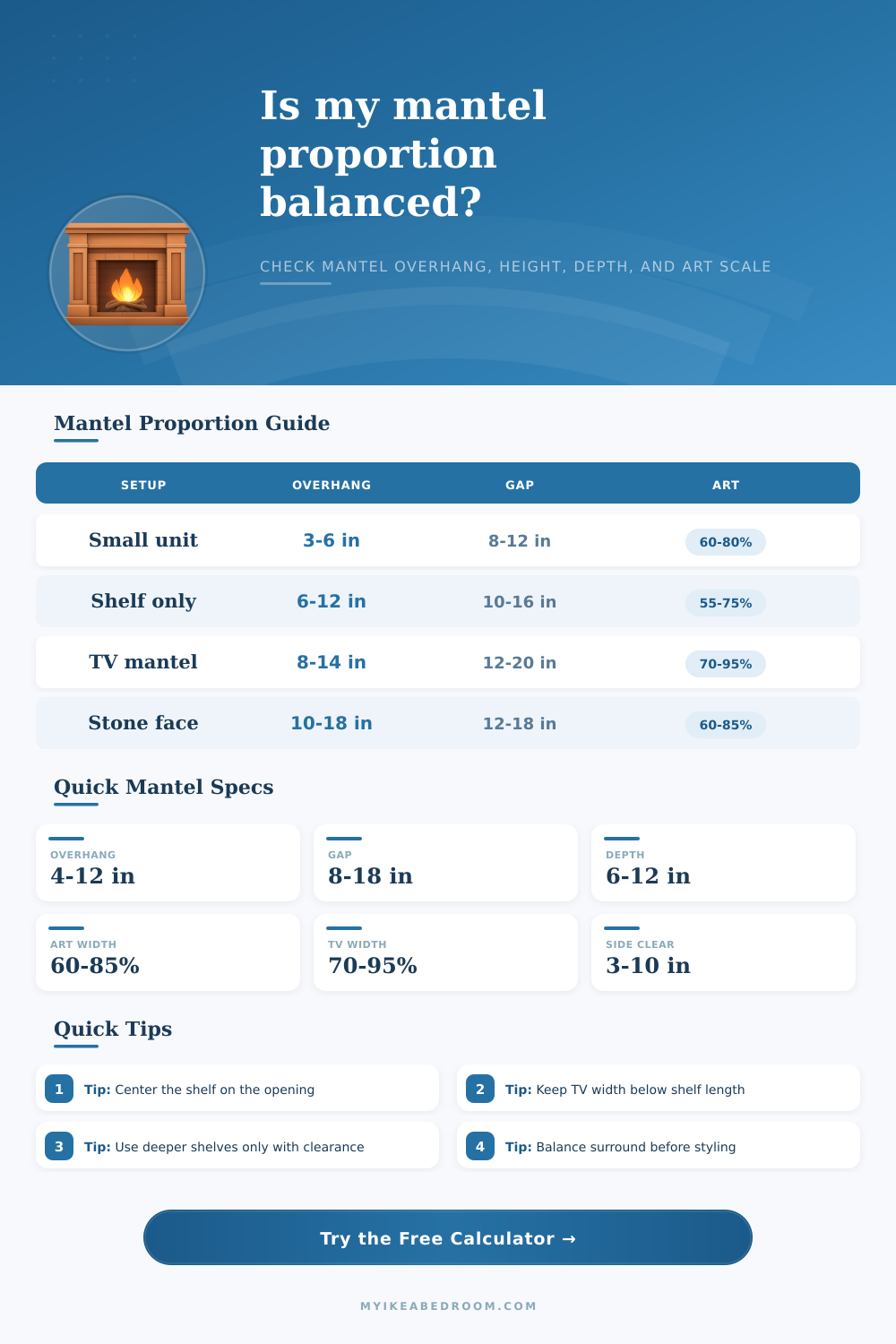
Fireplace Mantel Proportion Calculator
Check firebox size, surround width, shelf length and depth, mantel height above the opening, ceiling height, art or TV width, and side clearance in one layout score.
Start from a familiar fireplace wall, then adjust the exact dimensions you measured on site.
Reading the proportion score
Overhang: Calculate to see whether the shelf frames the firebox and surround cleanly.
Height: The mantel gap is compared with opening height and ceiling scale.
Depth: Shelf depth is checked against side clearance and material profile.
Art or TV: Above-mantel width is compared with the shelf length and use type.
Surround: The surround is tested for balanced side mass around the firebox.
| Fireplace style | Shelf overhang per side | Shelf length target | Best use |
|---|---|---|---|
| Compact electric insert | 3 to 6 in / 8 to 15 cm | Firebox width plus 8 to 16 in | Small rooms, apartments, and media nooks |
| Simple shelf mantel | 5 to 10 in / 13 to 25 cm | Surround width plus 8 to 20 in | Painted wood, MDF, or ledge style shelves |
| Traditional surround | 6 to 14 in / 15 to 36 cm | Surround width plus 12 to 28 in | Brick, tile, and trim-framed openings |
| Wide masonry surround | 10 to 18 in / 25 to 46 cm | Surround width plus 20 to 36 in | Large stone, cast surround, or broad feature wall |
| Check | Compact range | Balanced range | Review when |
|---|---|---|---|
| Mantel above opening | 6 to 10 in / 15 to 25 cm | 10 to 16 in / 25 to 41 cm | Gap is less than shelf depth or more than half opening height |
| Shelf depth | 4 to 7 in / 10 to 18 cm | 7 to 12 in / 18 to 30 cm | Depth is greater than side clearance or visually heavy |
| Side clearance | 3 to 6 in / 8 to 15 cm | 6 to 12 in / 15 to 30 cm | Shelf ends nearly touch walls, cabinets, or trim |
| Ceiling relationship | Good below 9 ft with modest art | Good at 9 to 11 ft with larger art | Upper wall looks empty or TV crowds the ceiling |
| Above-mantel piece | Width vs shelf | Width vs firebox | Visual note |
|---|---|---|---|
| Single art or mirror | 55% to 80% | 110% to 160% | Leaves the shelf as the broader anchor |
| Layered picture ledge | 50% to 75% | 100% to 150% | Works with asymmetrical small objects |
| TV over mantel | 70% to 95% | 130% to 190% | Check ceiling space and viewing comfort |
| No major piece | 0% to 35% | 0% to 70% | Shelf, sconces, or surround carry the composition |
| Scenario | Opening and surround | Shelf profile | Proportion watch point |
|---|---|---|---|
| Small electric fireplace | 30 x 18 in with 42 in surround | 52 x 6 in shelf | Keep TV or art modest so it does not overpower the insert |
| Wide stone surround | 42 x 30 in with 76 in surround | 96 x 10 in beam | Long shelf needs enough side clearance to feel intentional |
| Apartment mantel shelf | 28 x 20 in with 40 in surround | 50 x 7 in painted shelf | Depth should not exceed tight side clearances |
| TV over mantel | 36 x 28 in with 58 in surround | 72 x 9 in shelf | TV width can be large, but shelf length should still lead |
| Picture ledge mantel | 34 x 24 in with 50 in surround | 64 x 5 in ledge | Thin ledges work best with lighter art and balanced surround |
Painted wood shelf
Depth: 7 to 10 in works for most trim and shelf mantels.
Good when the surround is modest and the room needs a clean horizontal anchor.
Stained wood beam
Depth: 8 to 12 in can feel substantial without looking oversized.
Best when overhang and side clearance are generous enough for the visual weight.
MDF boxed mantel
Depth: 6 to 9 in keeps the profile tidy after paint.
Works well with traditional trim, tile surround, and shallow electric fireplaces.
Stone slab mantel
Depth: 8 to 11 in usually reads balanced with stone mass.
Use longer shelves carefully so the slab does not dominate the firebox.
Slim metal shelf
Depth: 5 to 8 in suits modern fireplace walls.
Because the profile is thin, art or TV width can become the main scale driver.
Picture ledge mantel
Depth: 4 to 6 in is enough for layered frames.
Keep objects light and check that shelf length still frames the opening.
Built-in wall shelf
Depth: 8 to 12 in can align with cabinets or side shelves.
Side clearance becomes the main issue when shelves terminate near cabinetry.
Floating mantel box
Depth: 7 to 11 in gives shadow and storage-like presence.
Best when the gap above the opening is at least similar to shelf depth.
How many times have you bought a mantel without measuring? Then when you hang it, you notice. It doesn’t look like it fits the fireplace or its too big/heavy for the wall.
It is not just because of the material. It just doesn’t fit the room. Size matter. The TV width, the ceiling height and size of the firebox all matter in this equation. And proportion is more critical than trendy style.
How to Choose the Right Mantel Size
This calculator takes all of the guess work out of your project. It runs the relational math for you. It makes sure there’s enough depth to clear sides. It confirms that your TV (or art) will fit into the space.
You may have a fireplace that feels small and think you need a larger mantel. Chances are, that is not true. A long shelf in a narrow opening become cluttered. Before you cut a piece of wood, this tool shows you what it will look like.
First examine the overhang. That’s how far the shelf projects beyond the surround on both sides. Three to six inches per side work for a compact electric insert. It frames the fire without being intrusive. With a wider stone surround, you might go wider. You can go up to 18 inches if there is plenty of room. Those limits are illustrated on table on the page.
Enter the widths of your firebox and surround. Then the system will tell you whether the shelf length would work. This check ensure the shelf won’t look like it is floating.
Then consider the distance between the shelf and the bottom of the fireplace opening. It require breathing room. If the mantel is closer, the whole thing feel heavier and tighter. The farther out, the less connected it will feel with the fireplace.
The ratio of this distance versus ceiling height are checked by the calculator. The higher your ceiling, the bigger the distance can be since you have more wall space. With low ceilings, you want it a little tighter so that furnitures doesn’t seem lost. But the material changes the rule. A painted wood shelf feel lighter than a chunky stained beam. Stone is heavier than both. So the tool changes its suggestion to match your material selection. Thick stone requires more clearance all around. Thin metal can sits closer to the opening without feeling oppressive because its visual weight is low.
Putting a television over the mantle shifts the width considerations. TVs are wide things; they demand that the shelf below them be broad enough to act as a base. Otherwise it feel top-heavy and precarious.
You should also consider side clearance. That’s the remaining wall space between where your shelf ends and other things like corners or cabinets on either side. When a shelf meet the sides it looks like it’s stuck there. Even when you have the right length, poor clearance kills it. The calculator flags that immediately. It is a small detail that people often miss but it can make a big difference in opening up the space.
Lastly, consider style. To add some flair to the piece, consider hanging something over the shelf such as art or a mirror. Before purchasing art, measure its width and compare it with length of the shelf. In general, art is most pleasing when it spans between 60-80% of the shelf. If the art is wider than the shelf, both will compete for attention. This is a simple design rule that many designer use.
The proportions are not magical. They’re simply consistent part-to-part relationships. When you nail those ratios, the fireplace starts being a foundation for the room. Look at the entire wall. See it’s all about the proportions. Believe in the numbers first and then believe in your gut. This way you would of made the wrong decision when purchasing a mantel that doesn’t fit.