Closet lighting planner
Closet Lighting Lumens Calculator
Estimate target lumens, adjusted lumens, fixture count, spacing, lux, foot-candles, and LED watts for reach-in closets, PAX wardrobes, walk-ins, linen storage, and sensor-lit closet zones.
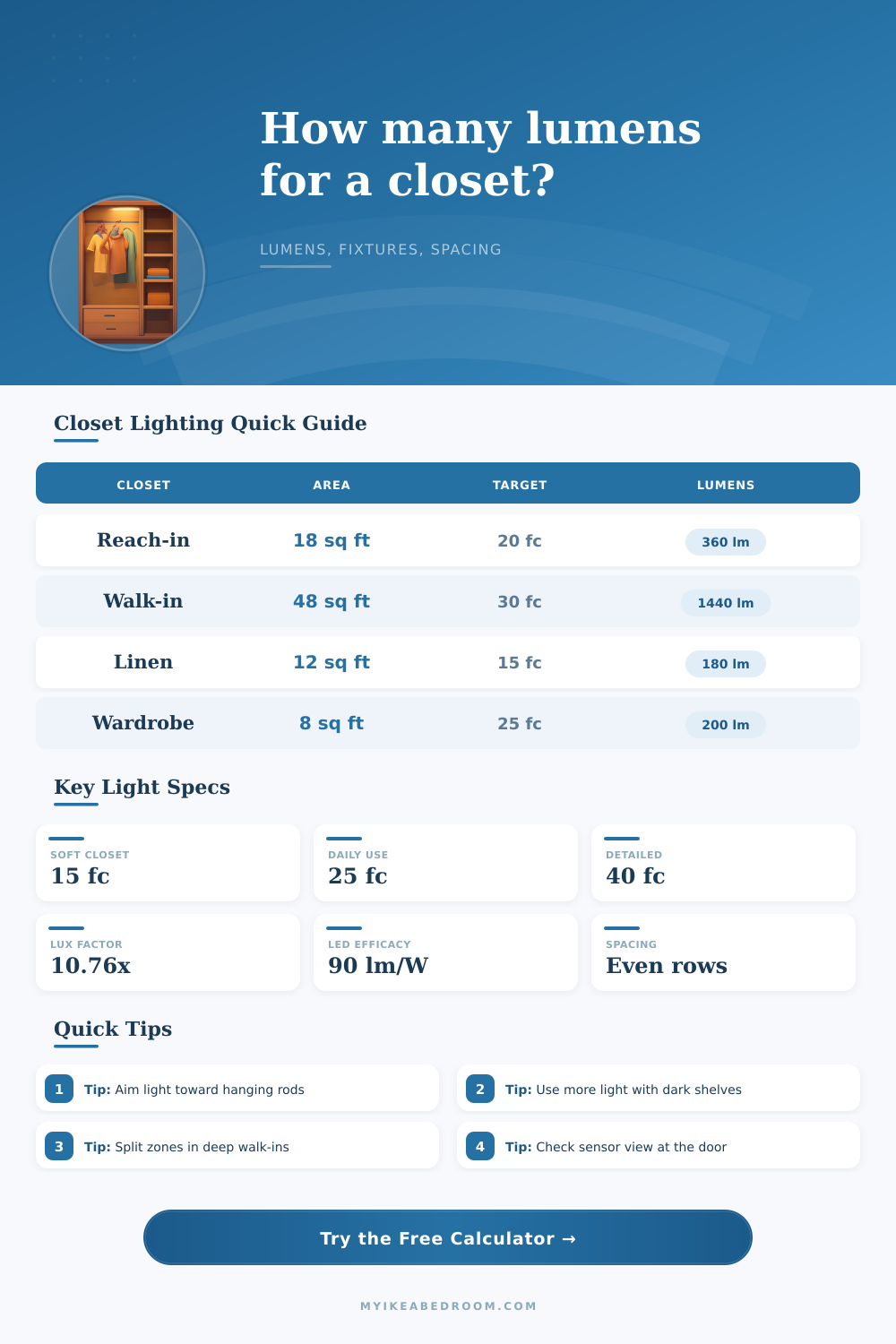
| Closet use | Typical target | Lux equivalent | Planning note |
|---|---|---|---|
| Soft storage light | 10-15 foot-candles | 108-161 lux | Useful for rarely used storage or guest linens. |
| Daily reach-in closet | 20-30 foot-candles | 215-323 lux | Good default for clothing color checks and rods. |
| Walk-in closet | 30-40 foot-candles | 323-431 lux | Helps reduce shadows across aisles and shelves. |
| Detailed shelves | 40-50 foot-candles | 431-538 lux | Useful for shoes, drawers, and darker finishes. |
| Surface reflectance | Calculator factor | Common surface | Effect on lumens |
|---|---|---|---|
| Light | 0.95x | White, pale wood, light drawers | Reflects more light back into the closet. |
| Mixed | 1.08x | Light cabinet with clothing shadows | Adds a modest allowance for contents. |
| Medium | 1.18x | Gray, oak, mid-tone interiors | Needs a stronger light level to feel clear. |
| Dark | 1.35x | Black-brown, dark gray, navy | Absorbs more light and increases lumens. |
| Shelf density | Calculator factor | Examples | Why it changes light |
|---|---|---|---|
| Low | 1.00x | Hanging rods, open top shelf | Few horizontal surfaces block the beam. |
| Medium | 1.15x | Rods plus shelves or drawers | Small shadows appear under shelves. |
| High | 1.30x | Cubbies, stacks, folded clothes | More dividers create pockets of shade. |
| Very high | 1.45x | Shoe wall, pantry-style closet | Dense shelving often needs multiple fixtures. |
| Fixture layout | Spacing method | Best closet shape | Sensor note |
|---|---|---|---|
| Single centered fixture | Center of footprint | Small reach-in or linen closet | Door sensor usually sees the fixture zone. |
| Two along length | Length divided by count | Long reach-in closet | Keep sensor away from hanging coats. |
| Two parallel rows | Rows split across width | Walk-in closet with aisle | Use door or dual zone if entry is offset. |
| Linear shelf strips | Per shelf or per bay | Wardrobe and display shelves | Sensor line of sight matters more than area. |
The problem is that hallway lights don’t reach the closet, so you have to grope around for your clothes in the dark (or at least, see the colors clearly). Why? Because when designing closets, we forget that they’re highly-trafficked areas that need good lighting! We might think: “Oh, I put one bulb up there… That should be plenty!” But no (that’s not why). That’s because we just don’t know how many bulbs is necessary to combat dark wood finishes and cast shadows.
The number of watts in a fixture determines what most folks purchase… Either by price, or sometimes by wattage. But the light output should of been the issue. What you care about is lumen output, which measures visible light. Only half of that story are raw lumens. Rods cast shadows, beams is blocked by shelves. Dark colors may absorb instead of reflecting.
Why Closets Are Often Too Dark
Adding a puck light on the back side of a shelving unit will give you just a puddle of light. Everything else around it are dark. Knowing the numbers help solve the conundrum. The page’s calculator do the math for you. No more guesswork with conversions or coefficients. It accounts for variables like color of your interior and the density of your shelves. Darker wood shelves absorbs a lot of light. It increases the base by a factor that accounts for this. If it’s really dark in there, even a bright bulb feel dim. There’s no light bouncing around. But you need to think about what falls on those objects as well.
Overhead lighting, though handy, isn’t great when you’re trying to see something in the air like your hanging garment. Light that comes straight down from the ceiling also doesn’t work so good because it’s blocked by your body (your head/shoulders). With this tool, you can account for how far apart and high your fixtures should be spaced out. For a shelving system, under-cabinet or linear lights placed along the back wall will serve you much better different than a single bright light shining directly onto them. This allows you to avoid any shadow cast by their hangers. Plus, each section will recieve equal light coverage. You want uniformity. It does not necessarily need to be maximum brightness.
Another variable is where to place sensors. Energy-saving motion sensors don’t work if the light doesn’t sense your entry. Swinging doors or tall coats can obstruct line-of-sight to the sensor, and it won’t matter how many lumens you have when the light never turns on. Closet types requires various approaches, as indicated in the reference table. Less intensity works for a linen closet than a daily wardrobe closet. It’s about grabbing towels, not matching outfits.
Closet Lighting should be good. That means bright, but no glare! You want to see fabric texture and color differences clearley. When you open the closet, you don’t want it to blind you! First, work out how much space you have. Then adjust the plan based off how you will store things inside the closet. Because LEDs use very little energy, high brightness numbers aren’t an issue for the budget. And remember, these bulbs last a long time, so you won’t have to change them in the middle of the night. That’s why planning correctly from the start matter.