Fabric, lining, pleat, tail, ring, and cord planner
London Shade Fabric Calculator
Estimate cut width, cut length, order yardage, lining yardage, side-tail drop, pleat fabric consumed, ring count, and lift cord count for a tailored London shade.
Live checks show how the finished width is divided into tails, center flats, and pleat folds before yardage is rounded.
These live cards compare the same shade against common fabric widths, using the calculated cut length, repeat rounding, and handling allowance.
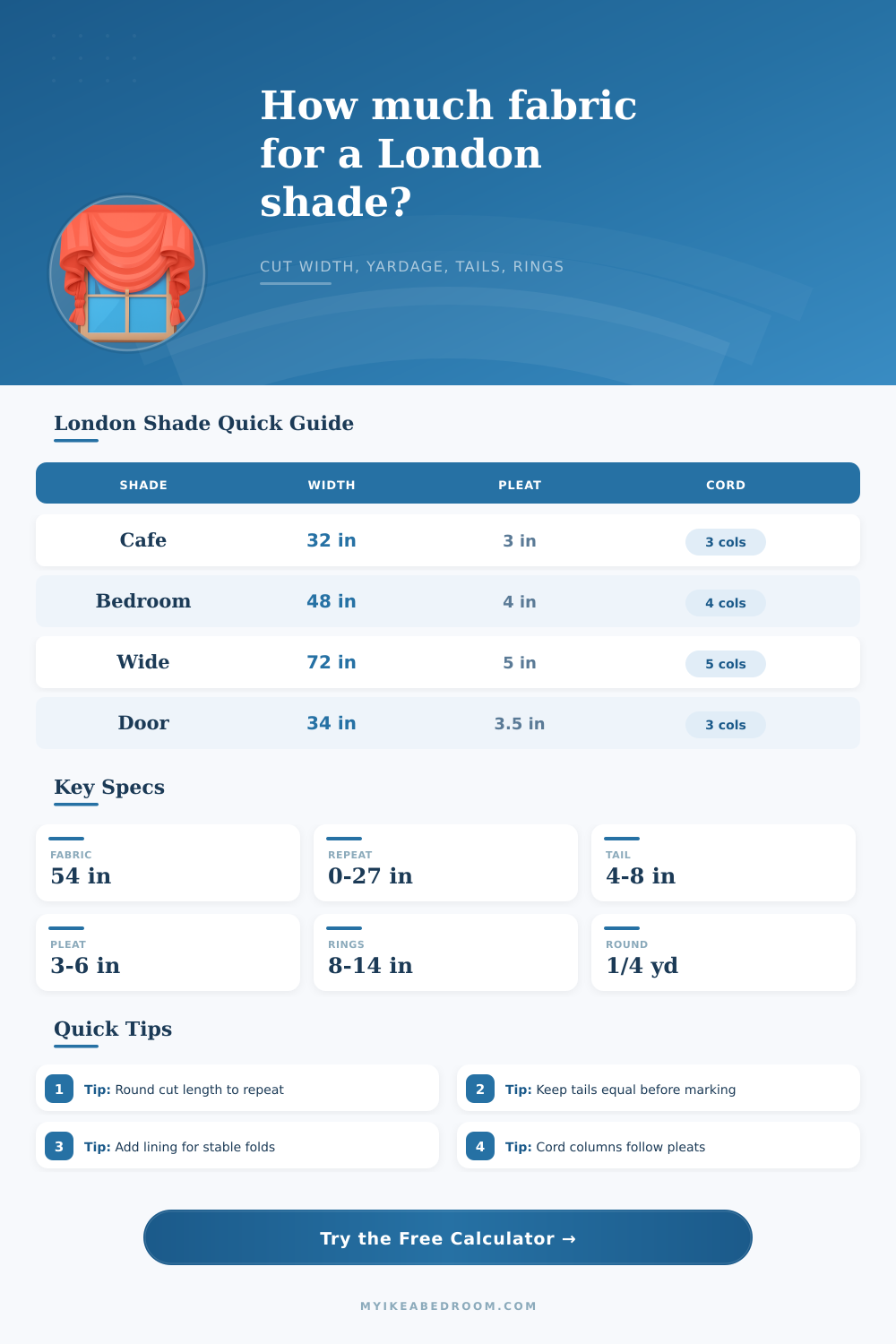
| Finished width | Typical tail width | Typical pleat depth | Likely cord columns |
|---|---|---|---|
| 24 to 36 in | 3 to 4.5 in each side | 2.5 to 3.5 in | 3 columns: two tails and one center pleat. |
| 37 to 54 in | 4 to 6 in each side | 3.5 to 4.5 in | 4 columns: tails plus two inner pleats. |
| 55 to 72 in | 5 to 7 in each side | 4 to 5.5 in | 5 columns are common for wider shades. |
| 73 to 96 in | 6 to 8 in each side | 4.5 to 6 in | 5 to 7 columns, depending on flat spacing. |
| Formula item | Calculator method | Why it matters | Adjustment input |
|---|---|---|---|
| Cut width | Finished width + side turnbacks + pleat fabric consumed | Shows how much fabric is needed before width joins. | Tail width, pleat depth, center flat, side turnback. |
| Cut length | Finished drop + header allowance + bottom hem allowance | Controls the vertical cut before repeat matching. | Finished drop, header, bottom hem. |
| Repeat length | Cut length rounded up to the next full vertical repeat | Keeps the visible motif aligned from shade to shade. | Vertical pattern repeat. |
| Yardage | Fabric widths x repeat-rounded cut length, plus handling | Converts cut plan into a linear order amount. | Fabric width, repeat, order rounding. |
| Ring spacing | Drop range | Ring rows estimate | Planning note |
|---|---|---|---|
| 8 in | Short to medium drops | More rows | Creates tighter, smaller folds on light fabric. |
| 10 in | Most bedroom and living room drops | Balanced rows | Good default for a soft London shade lift. |
| 12 in | Tall drops or bulky lining | Fewer rows | Allows larger folds and reduces ring count. |
| 14 in | Very relaxed decorative shades | Lowest rows | Use only when folds can stack evenly. |
| Fabric type | London shade behavior | Repeat sensitivity | Calculator note |
|---|---|---|---|
| Plain linen | Soft tails and relaxed folds | Low unless striped | Use moderate handling allowance. |
| Cotton print | Crisp folds with visible motif | High when repeat is large | Enter vertical repeat and round length. |
| Velvet or heavy weave | Full folds and thicker stack | Medium | Use deeper pleats and larger ring spacing. |
| Sheer or voile | Light decorative tails | Low to medium | Lining can change the drape completely. |
Fabric is not only used to cover a window; it also shapes something, making a particular window shade requires treating fabric as a structural element rather than just a covering! And those yards of fabric is wasted if you don’t plan for how much will be used in pleating and hanging. That extra fabric isn’t included when you only measure the straight, flat rectangle that fits your window.
Typically, when people try to figure out how much fabric to use, they take the window measurement, plus add some extra since “it should of been fine.” So then you get an uneven hang, or too short on bottom hem. This calculator solves that problem for you: it converts the final window dimension into the total amount of yardage required to make those soft pleats without any waste.
Why You Need More Fabric Than You Think
The problem is that a London shade takes much more width than it looks like it should take up. It’s not simply a cutout rectangle; there are decorative tails on both sides and double-depth pleat in the middle. The material turns back on itself at every fold, consuming twice as much material as what you see. If you ignore this consumption, your center panels will shrink and appear sparse.
To make up for it, the tool lets you set the pleat depth and tail width separately, allowing it to compute the number of columns of lift cord necessary to support those particular folds. More pleats equals more ring and cord columns, meaning added complexity but also increased fullness.
The same is true with height, particularly for patterned items. You should round up to the next whole pattern cycle to ensure the item fits together vertically without the pattern being cut off at the edge. For example, stripes and florals will look odd at the edge if you do not adjust your cut length to include this rounding. The calculator therefore requires you to input the height/repeat length right at the start. It adjusts its outputted linear yards to match this. This avoids people’s tendency to calculate based off just the raw inch measurements and then realize too late that the pattern didn’t quite work out. And you end up having to leave three inches uncut at the cutting table because the pattern didn’t match.
But I didn’t know until I got one of these out that lining plays a greater part; it adds weight and thickness to help the pleats keep their shape. Without lining, a heavy velvet may sag between rings, or a lightweight voile might drape different once a blackout liner is attached. The tool allows you to choose your lining plan accordingly and adjust the amount of allowance to give you margin for error at sewing time.
The thicker the layers, the larger the margin for error; this little tweak in the numbers will save you from having to buy additional fabric down the road when seams use up more material then expected. Be sure to also consider the spacing between your rings; how far apart are your pleats? Wider spaces will result in a relaxed appearance; closer is crispier and tighter, so while you can use standard ten inches for many bedroom shade, you may want to use slightly wider intervals on taller windows to keep the hardware manageable. This spacing is what the calculator assumes for you when estimating how many rings you’ll be sewing, saving you the headache of guessing (and then counting out) hundreds of little grommets.
Also consider the width of fabric. Standard upholstery fabric is typically fifty-four inches wide. If the width you calculate for your cut is more than that, you will have to join your panels using a seam. You can see from the tool how many widths each panel take. This allows you to plan where you want to join them, ideally somewhere not very noticeable like at the side tails or behind a pleat. Knowing this in advance helps you plan your pattern pieces and makes putting it all together much easier.
But what about the math? If you can imagine the multiple layers, the math is simple. These include the face fabric, the lining, the header casing for the wand, and the bottom hem weight. The calculator adds them all together and produces an order list that takes away the worry of wondering if you purchased enough or not. With firm numbers in hand, assembling the parts becomes a process of sewing instead of crisis management.
The result is even tails and clean folds. This results in a window treatment that looks intentionaly designed. This distinguishes a professionally made shade from a homemade one.