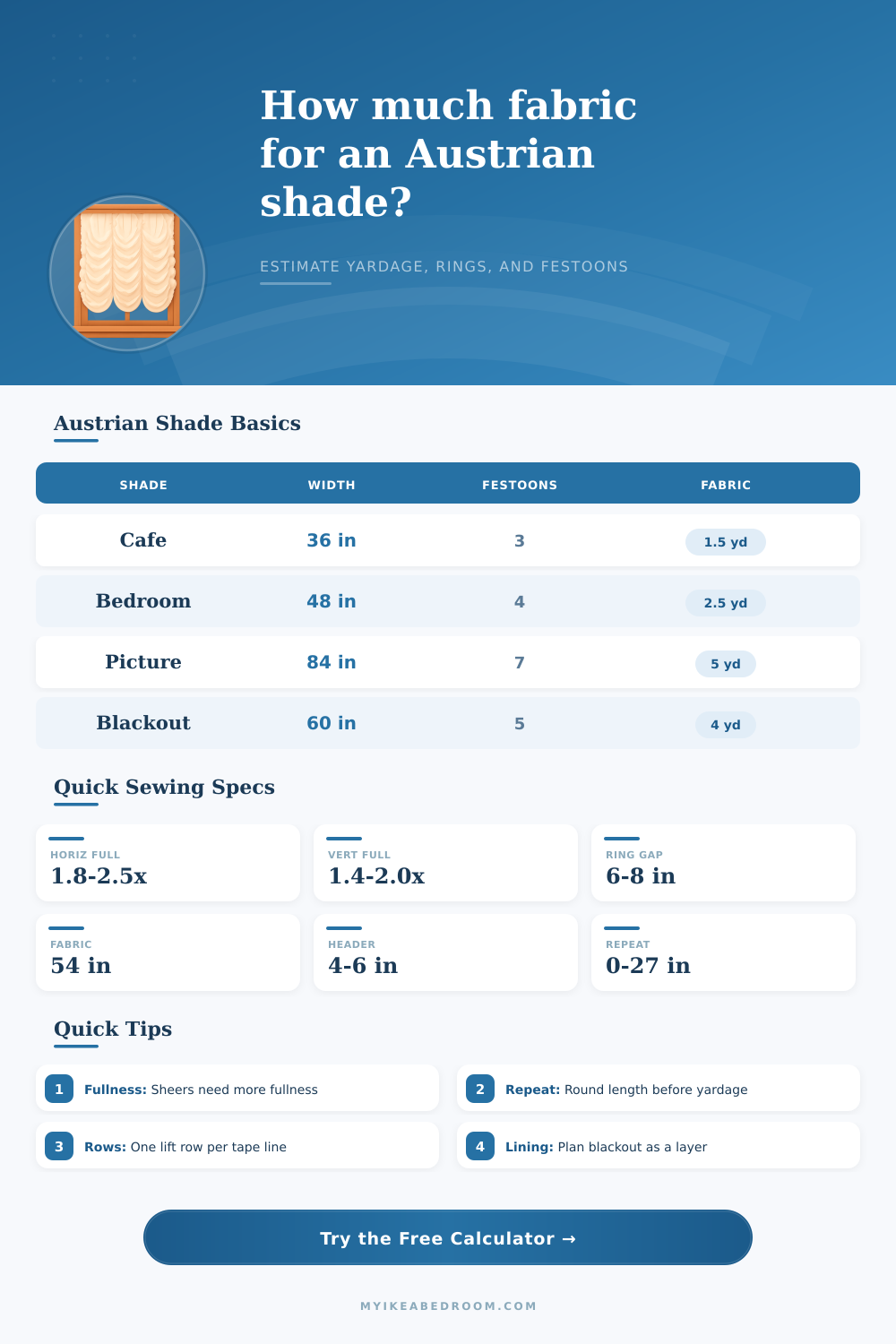
Fabric fullness, festoon spacing, lift lines, rings, and repeat yardage
Austrian Shade Fabric Calculator
Estimate Austrian shade cut width, repeat-rounded cut length, fabric widths, yardage, scallop spacing, lift line length, and ring count from finished size, fullness, ring tape rows, fabric width, allowances, repeat, and units.
Austrian shades gather both across and vertically. This planner treats the shade as a full fabric rectangle, then estimates the ring tape and lift cord that draw the scallops upward.
| Finished shade width | Typical festoons | Approx. spacing | Best use |
|---|---|---|---|
| 24-36 in | 2-3 festoons | 10-12 in | Narrow door glass, small cafe windows, side panels |
| 37-54 in | 3-5 festoons | 10-14 in | Bedroom windows, nursery windows, desk alcoves |
| 55-78 in | 5-6 festoons | 11-13 in | Double windows, wide headboard walls, dressers |
| 79-96 in | 6-8 festoons | 12-14 in | Picture windows and broad layered treatments |
| Fullness target | Horizontal multiplier | Vertical multiplier | What it changes |
|---|---|---|---|
| Light gather | 1.5x to 1.8x | 1.35x to 1.5x | Cleaner folds, less bulk, useful for blackout lining |
| Standard Austrian | 1.8x to 2.2x | 1.5x to 1.75x | Balanced swags with practical yardage and lift weight |
| Dressy fabric | 2.1x to 2.5x | 1.7x to 2.0x | Deeper scallops and fuller vertical puffs |
| Sheer voile | 2.4x to 3.0x | 1.8x to 2.2x | Soft translucent clouding with more ring rows |
| Fabric repeat | How calculator treats it | Yardage effect | Cutting note |
|---|---|---|---|
| 0 in solid | No repeat rounding | Lowest yardage | Mark tapes from the shade centerline |
| 4-9 in small print | Rounds cut length to next repeat | Small increase | Check that scallop bottoms land consistently |
| 10-18 in medium print | Rounds every joined width | Moderate increase | Center the motif before sewing widths |
| 19-27 in large repeat | Large repeat buffer | High increase | Buy enough for motif placement and flaws |
| Hardware item | Calculator formula | Typical range | Planning note |
|---|---|---|---|
| Ring tape rows | User-entered row count | Festoons + 1 | Rows form the vertical lift columns |
| Rings per row | Ceiling(drop / spacing) + 1 | 7-15 rings | Add one ring near the lower hem |
| Total rings | Rows x rings per row | 30-120 rings | Order extra rings or tape for seams |
| Lift line length | Rows x (drop + extra) | 20-80 ft | Final routing can require extra cord |
The tricky part about buying fabric for Austrian shades is it’s never as simple as measuring the width of your window. You pick up a measuring tape and hold it up against a bolt of fabric and realize you are trying to divide your window width by a number you don’t actualy have. And then you add vertical fullness (which isn’t the same as horizontal) so you end up buying too little or too much. Because the math behind a gathered treatment is less about geometry and more about physics, you’re asking a soft thing to act like a rigid one. To get the gathering effect you want, you have to has extra length to give it volume. The result is plush-looking scallops instead of flat ones.
After you input your window dimensions into the calculator, it does all of the tricky math for you. You don’t have to worry about figuring out what the correct conversion or coefficient should of be. You just plug in the final size of your window, and then it provides a multiplier for both the width (how much fullness horizontally) and height (how much fullness vertically). That last part is key, because an Austrian shade gathers in opposite directions at once.
How to Calculate Fabric for Austrian Shades
Use the height multiplier to calculate how much fabric you need for the gathered puffs between each ring tape. Use the width multiplier to determine how wide your fabric needs to be to produce soft folds over the length of the scallops. If you use one set of numbers for both multipliers, you’ll end up with a boxy, stiff looking shade.
People tend to underestimate how much fabric they will really need. After trimming off the selvage, most decorator fabric is only fifty four inches across (unless noted otherwise). A one-hundred twenty inch cut width allows for standard two-fold fullness on a sixty inch window. In other words, you’re going to have to join at least three widths of fabric. Knowing this, the tool factors in fabric widths needed according to your chosen side hem allowance and fullness. It also includes an extra bit of waste, for things like more than just cutting mistakes.
Fabric pattern repeats don’t always line up exactly with your cut line, especially with large vertical repeats. Because of this, you need a cushion. When most of us choose patterned fabric, that’s when budgets often dissapears. The cuts are rounded to make sure all widths seem to start on the same spot in the pattern. For example, if the fabric has a 20-inch repeat, that will change the cut length so that your scallops don’t look out of alignment along the seams. It’s a little thing but can make the difference between a professionally installed blind and one that feels like an amateur job.
Then there’s the issue of header allowance, or how much more you must add to the top of the shade for the rod pocket and heading tape. Otherwise, the lift cord mechanics get covered by the fold and everything look bulky and unfinished.
The other key input is hardware. Based off your desired ring spacing, the calculator estimates how many rings you’ll need, how much yardage of what kind of fabric you’ll need, and how many rows of ring tape (the special fabric used for a shade) are required. To create those characteristic puffs, the rings has a loop of webbing sewed vertical down both sides of each scallop; when the lift cord is pulled, the rings ride up to hold the fabric taut. Spacing the rings too widely means the fabric will bunch unevenly; too close together, and the shade is heavy to raise. The calculator recommends a happy medium between aesthetics and mechanics. It also figures out approximately how long a piece of lift cord you’ll need (plus extra for knots and threading).
This is where your fabric choice matters. If you’re using a sheer voile (no surprise there), you’re going to need much more fullness to get a softer look then you would with blackout or even cotton lining. There’s simply no ‘body’ to a sheer fabric, only volume. Use volume to make something look deeper and hide the hardware. When selecting a fabric behavior profile, the calculator adjust the guidance accordingly to help prevent treating all fabrics similarly. For example, blackout fabrics tend to be heavier & stiffer and therefore do not require as much gathering to appear substantial. Applying a high fullness multiplier to a dense blackout layer will instead result in a stiff curtain that does not drape well.
The tool calculates how much yardage you’ll need based on the length and width of the window; however, as you know by now, building an Austrian shade involve using more fabric than necessary. You’re purchasing more fabric than the surface area of the window alone would indicate. It’s elegant, or it’s voluminous, but not both so let your eye make the style decisions and the tool do the number-crunching.
If you don’t know where to begin, start with the presets and adjust the fullness multipliers till the yardage projection seems right for your design goals and budget. Measure twice, cut once, and know that a bit of extra fabric is less expensive than another shopping trip. Rarely does a first calculation yield the perfect shade, but knowing the math of the gathering makes it naturaly closer.