Ergonomic cushion height and desk-fit planner
Seat Cushion Thickness for Height Calculator
Calculate the uncompressed cushion thickness needed to raise a chair, then check loaded sitting height, knee clearance, desk fit, foot support allowance, and foam firmness for dining chairs, desk chairs, benches, piano seats, stools, and window seats.
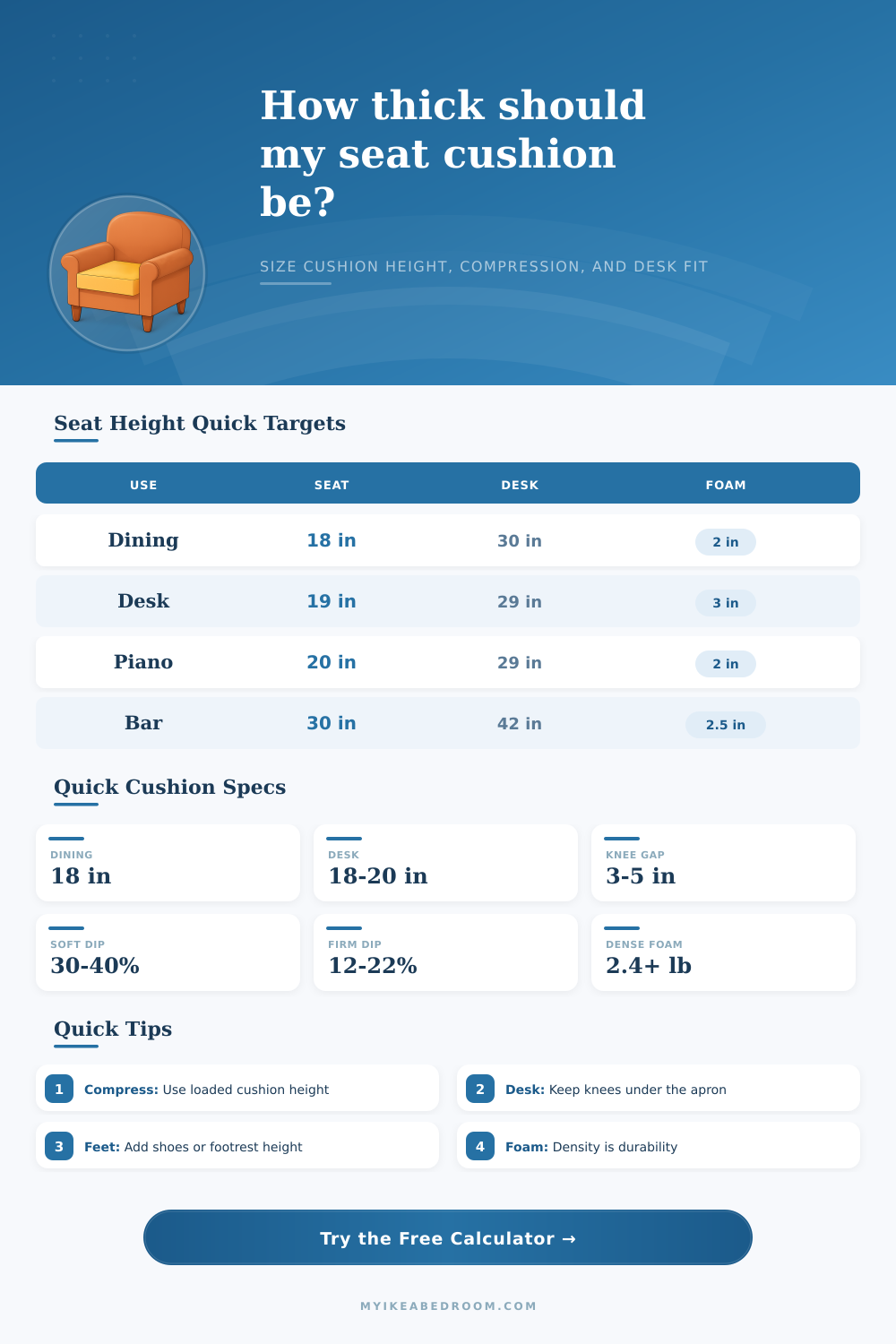
| Chair or seat use | Common loaded seat height | Typical table height | Practical cushion note |
|---|---|---|---|
| Dining chair | 17 to 19 in / 43 to 48 cm | 28 to 30 in / 71 to 76 cm | Keep loaded cushion height moderate so thighs still slide under the apron. |
| Desk or task chair | 18 to 21 in / 46 to 53 cm | 28 to 30 in / 71 to 76 cm | Use a footrest if the cushion raises the knees and feet too far from the floor. |
| Piano bench | 19 to 21 in / 48 to 53 cm | Keyboard about 28 to 29 in / 71 to 74 cm | Choose firmer foam so playing posture does not sink during use. |
| Counter stool | 24 to 27 in / 61 to 69 cm | 35 to 37 in / 89 to 94 cm | Count the foot rail as support when checking comfort. |
| Bar stool | 28 to 31 in / 71 to 79 cm | 40 to 43 in / 102 to 109 cm | A firm pad works better than a soft thick cushion at tall seating heights. |
| Compression setting | What it means | Best foam use | Formula impact |
|---|---|---|---|
| 10% to 18% | Firm, low-sink cushion | Piano benches, stools, thin pads | Uncompressed thickness stays close to the loaded lift. |
| 19% to 28% | Medium everyday cushion | Dining chairs, desk boosters, benches | Good default for calculating a realistic cushion thickness. |
| 29% to 40% | Soft, plush cushion | Window seats, lounge pads, casual seats | Needs a thicker cut because more foam height is lost while seated. |
| Over 40% | Deep sink or overloaded foam | Use only when intentionally plush | May feel unstable for work chairs and high stools. |
| User height | Estimated popliteal height | Floor support check | Footrest cue |
|---|---|---|---|
| 58 to 62 in / 147 to 157 cm | 14.5 to 16 in / 37 to 41 cm | Low to medium seats usually fit | Add a footrest when loaded seat exceeds about 17 in. |
| 63 to 67 in / 160 to 170 cm | 16 to 17.5 in / 41 to 44 cm | Most dining heights work | Small footrest helps when desk boosters pass 19 in. |
| 68 to 72 in / 173 to 183 cm | 17.5 to 19 in / 44 to 48 cm | Standard dining and desk heights fit well | Footrest mainly matters for stools and high cushions. |
| 73 in+ / 185 cm+ | 19 in+ / 48 cm+ | May prefer taller chair height | Check knee clearance before adding thick cushions. |
| Example preset | Current seat | Target loaded seat | Typical uncompressed foam |
|---|---|---|---|
| Dining chair to 18 in | 16.25 in / 41 cm | 18 in / 46 cm | About 2.3 in at 25% compression |
| Desk chair booster | 16 in / 41 cm | 19 in / 48 cm | About 4.3 in at 30% compression |
| Piano bench pad | 18.75 in / 48 cm | 20.25 in / 51 cm | About 1.8 in at 18% compression |
| Bar stool pad | 28 in / 71 cm | 30.5 in / 77 cm | About 3.1 in at 20% compression |
It’s easy to get suckered into buying something because its photo is sexy. You might only discover the seat is too low for your legs once you sit on that new piece of furnitures. The old ones do it, too; and so does moddern design with wonky proportions. So you reason that adding bulk must help, more cushioning must equal more comfortable, right? Wrong.
More times than not, that route doesn’t work either, since it doesn’t account for how much a cushion compresses when someone sit in it. What feels like a solid, three inches when upright ends up as nearly nothing but cushion beneath your rear come dinnertime. The key to getting the cushion correct isn’t so much about total volume as it is about controlling the gap created when you go from standing to sitting.
How to Choose the Right Seat Cushion
The compression ratio. To understand why cushion size matters so much, let’s talk about the compression ratio, as engineers do. This is a measure of how far any piece of material sink when weight is applied to it. For example, dense high-resilience foam might only sink by fifteen percent. A softer memory foam could sink as much as forty percent.
If you’re choosing a soft cushion and want to get up to a table without straining or stretching, you might need an additional two inches for comfortable seating. In that case, you’ll have to purchase a cushion well over two inches thick. This is because the material needs to make up for sinking in before you are seated.
With the calculator above, all you have to do is enter your desired seat level compared to the height of the chair you sit in now, and we’ll crunch the numbers for you, no more guesswork required to determine how stiff your cushion should be.
Seat height vs. Desk clearance is one of those things we don’t think about most of the time, at least until our knees knock into the apron of a table as we sit down. Raising the total size of a seat increases its overall center of gravity. And what happens when you increase something’s center of gravity? Your knees will be higher relative to the floor and the underside of whatever is in front of you.
Desk clearance is one of those things we don’t think about most of the time, at least until our knees knock into someone else’s legs as we sit down at a table. Raising the total size of a seat increases its overall center of gravity. And what happens when you increase something’s center of gravity? Your knees will go up from where they were originally sitting in relation to both the floor and the bottom of whatever’s in front of you.
The standard clearance beneath a dining table is roughly six inches. Give yourself too large of a lift by adding a thick plush pad to a low chair and you run the risk of having your thighs collide with the wood first while your feet dangle below. This is a small geometric tradeoff that can make or break a long work session or dinner.
You need enough cushion to feel connected to the table surface, but not so much that you are perched on top of it like a statue.
Thickness vs. This section covers foam density. Foam Density So, what about density? That’s not referring to thickness but the amount of material per cubic foot of space. And it relates directly to durability, not initial softness. Plush does not necessarily mean low density. High density foam can feel plush when engineered with open cells. Or it could feel firm despite a high ILD rating.
So why the confusion? Because consumers think firmness means quality. But it’s not. You wouldn’t want high density foam for a window seat intended for a cozy read while wearing your slippers, yet you would want high density foam for a piano bench where stable sitting is paramount. The reference table on the page shows how to match use cases to the appropriate firmness band.
The last thing people tend to overlook is foot support. Where do your feet go if you don’t have arm rests (and especially if you’re shorter than average) when you sit down on a lifted chair? They hang there, cutting off circulation and putting unnatural strain on your lower back as it tries to adjust. Include a foot rest or consider how high your shoes are. This ensures the extra lift from the cushion helps your posture instead of making you worry about sliding off the seat.
All told, it comes down to finding a happy medium between these three desires: 1) how far up you want to sit vertically; 2) how much space you need horizontally for your legs; and 3) how resilient (or soft) you want the seat cushion to be. There’s no perfect solution here, no way to achieve all three goals at once. Is it more important for you to have comfortable reach to your desk? Or do you prefer having a flat surface against the back of your chair?
For most people, everyday comfort lies somewhere in the middle. A seat cushion made from a medium density, compressed-just-enough foam gives you a little extra boost to correct for any mismatched heights while maintaining enough structure to clear your knees from the table apron.
So measure yourself: Where do you sit? What do you want to sit like? Work backwards, not forwards (wishful thinking is a form of time compression), and then apply some logic about how to compress things into what fits best; which means the seat dissapears in your consciousness, allowing you to attend to the music or the meal, not fiddle with sitting up straight every ten minutes.
Which is the true purpose of good ergonomics, and begins with selection of appropriate thickness for any given task.