Beanbag volume, bead weight, and refill planner
Beanbag Filling Volume Calculator
Estimate beanbag filler for spheres, cylinders, pear chairs, teardrop bags, floor poufs, gaming seats, and rectangular loungers with firmness, compression, liner, and refill allowances.
| Shape | Input Dimensions | Volume Formula | Best For |
|---|---|---|---|
| Sphere or round bag | Diameter | 4/3 x pi x radius cubed | Classic round kids, teen, and adult beanbags. |
| Cylinder or pouf | Diameter and height | pi x radius squared x height | Floor poufs, ottomans, pet poufs, and firm circular seats. |
| Teardrop or pear chair | Base diameter and height | Cylinder volume x 0.62 taper factor | Pear chairs, gaming bags, and tall back-support seats. |
| Rectangular lounger | Length, width, and height | Length x width x height | Loungers, daybeds, sofa-style beanbags, and floor mattresses. |
| Setting | Typical Range | Calculator Effect | Use When |
|---|---|---|---|
| Soft lounge fill | 70% to 80% | Lower adjusted volume and deeper sink. | Kids seats, floor lounging, and casual cushions. |
| Everyday seating | 82% to 88% | Balanced adjusted volume with moderate give. | Adult chairs, teen bags, reading seats, and gaming bags. |
| Supportive fill | 90% to 96% | Higher adjusted volume and firmer side walls. | Pear chairs, upright support, poufs, and low ottomans. |
| Compression allowance | 5% to 15% | Adds volume before refill reserve. | EPS bead settling, foam break-in, and stretchy covers. |
| Liner allowance | 2% to 8% | Adds volume for liner folds and internal seams. | Double covers, inner bags, baffles, and thick fabric. |
| Bag Size | Liters | Typical Use | Planning Note |
|---|---|---|---|
| 1 ft3 | 28.3 L | Small refill or cushion top-off. | Good for tuning firmness after the main fill. |
| 2 ft3 | 56.6 L | Small poufs and partial beanbag refills. | Easy to handle indoors but often needs multiple bags. |
| 3.5 ft3 | 99.1 L | Common beanbag bead bag size. | Useful default when supplier lists cubic feet. |
| 100 L | 3.53 ft3 | Common metric beanbag filler bag. | Nearly the same as a 3.5 ft3 bag. |
| 200 L | 7.06 ft3 | Large refills and adult seats. | Often enough for a medium chair or partial lounger fill. |
| Beanbag Type | Typical Dimensions | Common Firmness | Refill Reserve |
|---|---|---|---|
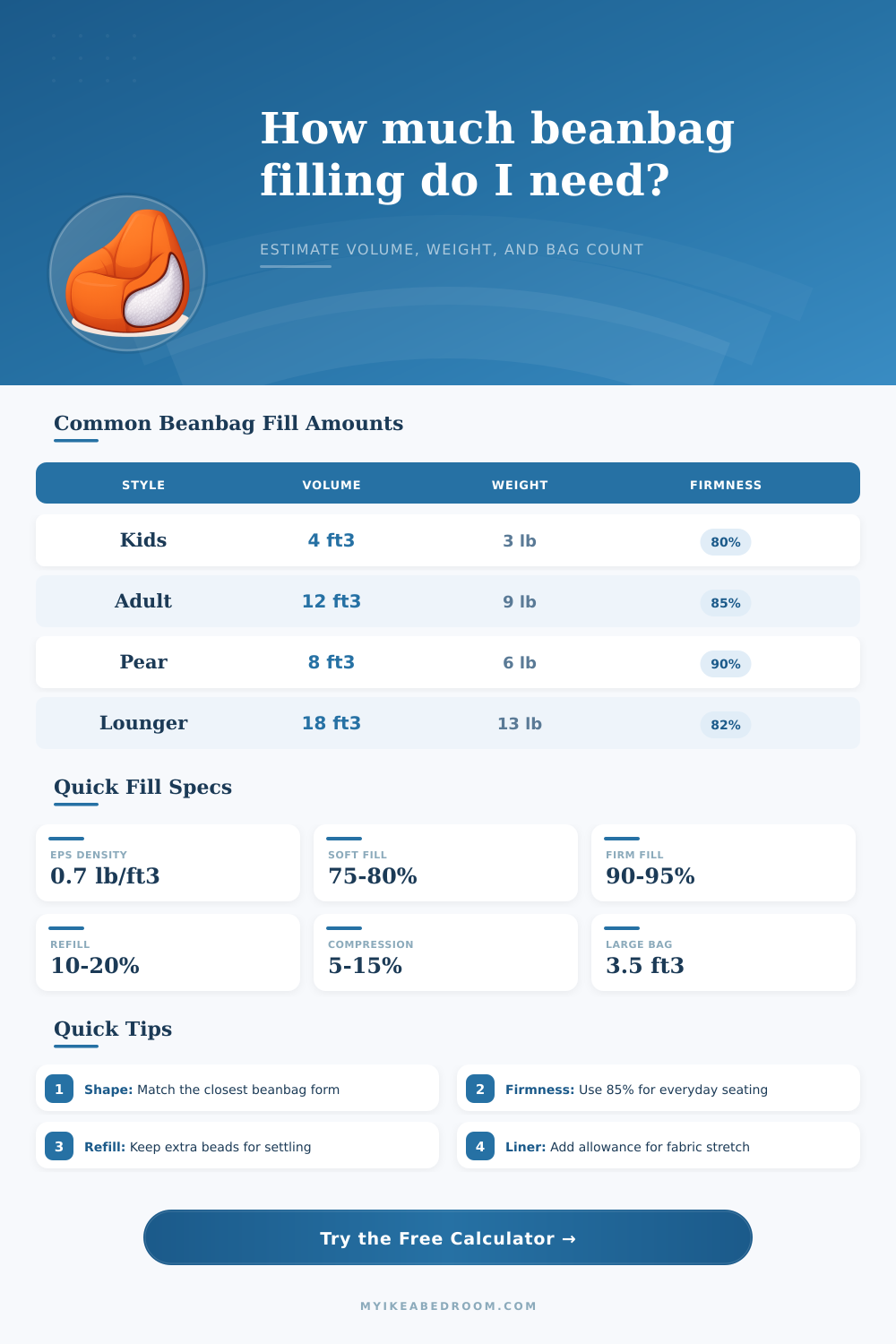
| Kids round beanbag | 30 to 36 in diameter | 75% to 82% | 10% to 15% after first settling. |
| Adult round chair | 42 to 52 in diameter | 82% to 88% | 12% to 18% for long-term top-offs. |
| Pear or teardrop chair | 34 to 44 in base, 42 to 56 in tall | 88% to 95% | 10% to 20% depending on back support. |
| Rectangular lounger | 60 to 72 in long, 34 to 44 in wide | 78% to 86% | 15% to 25% for foam or bead settling. |
When you’re buying a beanbag cover made of fabric, you expect it to be comfortable, but if it’s underfilled, what do you get? It is heap of uselessness on your floor. When it comes to cushions, there isn’t much that separates an OK one from a good one, except knowledge about volume and density, and how those two things combine when gravity gets involved. Most people don’t know they should of measure instead of guess, and knowing how to estimate your filling needs is a huge help.
To do the math yourself, use the calculator up top; it takes your rough dimensions and turns them into concrete bags-and-weight estimates. But don’t trust results completely; the inputs matter more then you might think.
How to Fill Your Beanbag Correctly
For instance: Firmness. That number determine everything. Go low, and you get a soft, sinking sensation as beads disperse wide beneath your weight. Go high, and they pack tightly, building up side walls that retain their shape upon leaning back. This feel better and is more stable. If you fill a pear chair too lightly, the top half caves in because the beads beneath lack side support. There’s just not enough volume there to build up any pressure, just to exist.
The other trickier part is material density. Floating, light material such as virgin EPS beads will be easier to work with, but settle faster. Denser materials, such as EPP beads or even shredded foam, give you instant shape. However, they significantly increase weight of the finished product. Do you want an airy, moldable chair? Or a dense, unmovable one?
That’s where chart on the page comes in, which shows that density has a direct impact on amount of weight you’ll be carrying around and moving. A dense, heavy filler may get tiresome if you intend on rearranging your living room frequently. Secondly, remember to account for liner allowances and compression. These are things that quietly steal volume. As beads settle, they take on the shape of your body through pressure, heat, and break-in. An inner liner occupies space within main cover and fabric does stretch with usage. If you calculate based off the bag being a perfect sphere, it won’t account for real-world factors and your beanbag will feel empty after a couple of weeks of use. Adding a compression buffer makes sure your beanbag stays how firm you want it long after new-bag-excitement has worn off. A little filler reserve now is better than tracking down some months from now.
Measure carefully, this will take a minute since you don’t want to measure an old flat beanbag and think it’s going to be the same size as your new one! Measure empty cover when it is inflated or at its proper size. Do not include seams if they will stretch tight later. Use true height from bottom to top and diameters at the widest points. It also helps to fill gradually. You can put most of calculated amount in at once, hop into bag, and let the weight spread out. Then, top it off again until everything look nice and even without appearing strained.
Overfilling is just as bad than underfilling. You stress the material and it’s uncomfortable. Whether you want a soft lounge experience or a solid sit-down depends completely on what you are doing in the seat. Generally kids like a little give to make playing around fun but if you are sitting to game or read, balance or support is nice. And it doesn’t have to be either or, just whatever is good for you based off your posture and habits.
Once you understand how material density and settling affect total volume of the seat, you aren’t just guessing; you’re building a seat that really works. It’s pretty straight forward. You want something that supports you now and later, but still maintains shape so you don’t end up with a flat disk on the ground.