Outdoor sling replacement planner
Deck Chair Sling Fabric Calculator
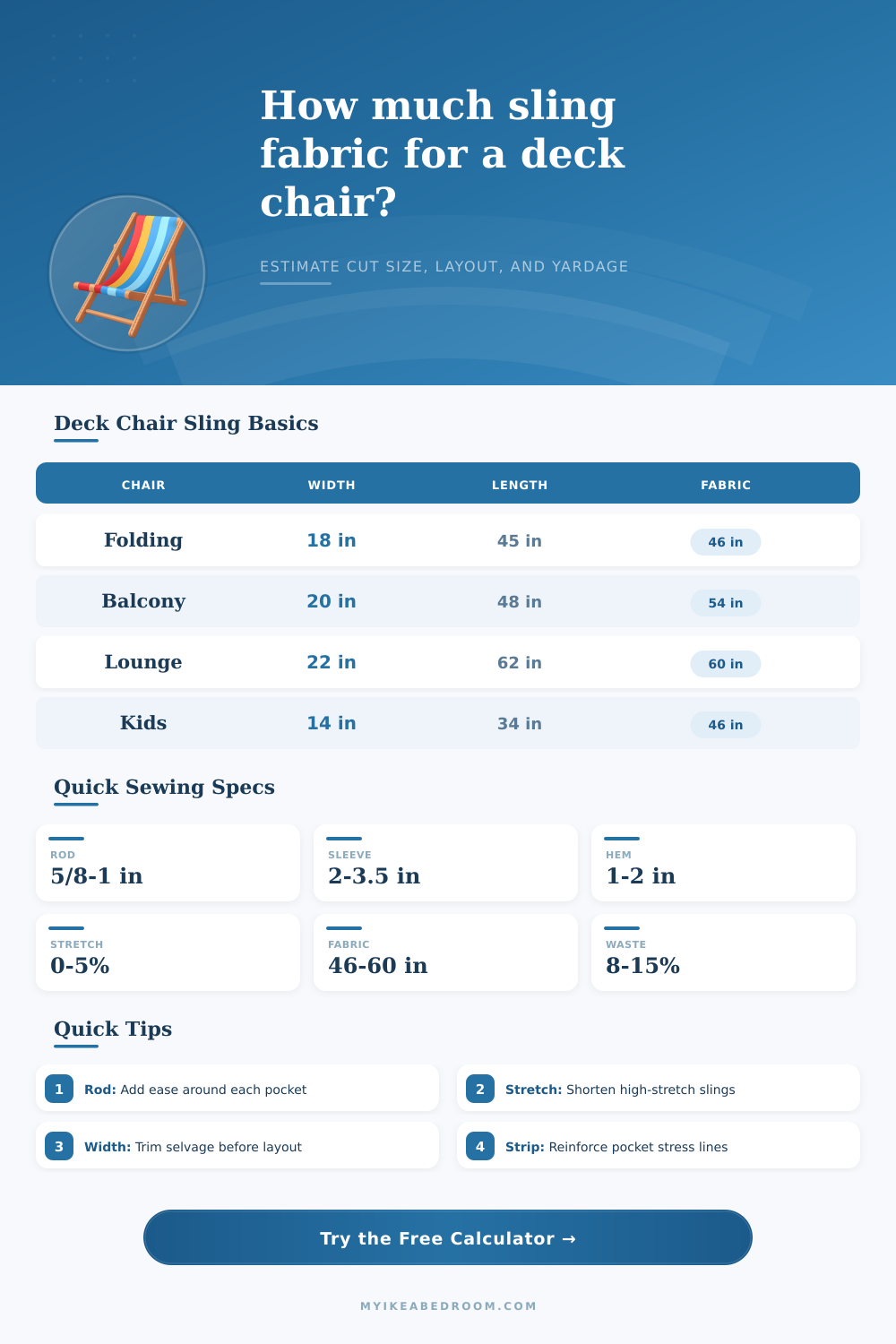
Estimate deck chair sling cut width, cut length, sleeve fold depth, rod pocket length, fabric layout, yardage or meters, stretch-adjusted tension length, and reinforcement strip length.
For a snug sling, measure the existing panel after removing rods and compare both the finished length and the cut length before sewing replacements.
| Chair Style | Typical Frame Width | Finished Sling Length | Sleeve Allowance | Fabric Width |
|---|---|---|---|---|
| Folding deck chair | 17-19 in | 42-48 in | 2.5-3.25 in | 46-54 in |
| Balcony sling chair | 18-21 in | 44-50 in | 2.75-3.25 in | 54 in |
| Outdoor rocker | 20-23 in | 48-56 in | 3-3.5 in | 54-60 in |
| Lounge sling | 21-24 in | 58-68 in | 3.25-4 in | 60 in |
| Kids sling chair | 13-15 in | 30-36 in | 2-2.5 in | 46 in |
| Rod Diameter | Minimum Pocket Inside | Suggested Fold Depth | Good Sleeve Allowance | Use Case |
|---|---|---|---|---|
| 0.50 in | 0.70 in | 1.5-2 in | 2.25 in | Kids or light chair |
| 0.625 in | 0.88 in | 2-2.5 in | 2.75 in | Classic folding chair |
| 0.75 in | 1.05 in | 2.25-3 in | 3 in | Common deck chair rod |
| 1.00 in | 1.40 in | 3-3.5 in | 3.75 in | Heavy lounge frame |
| Usable Fabric Width | Cut Width 18 in | Cut Width 21 in | Cut Width 24 in | Layout Note |
|---|---|---|---|---|
| 46 in | 2 across | 2 across | 1 across | Narrow canvas may limit wide chairs |
| 54 in | 2 across | 2 across | 2 across | Common outdoor fabric width |
| 60 in | 3 across | 2 across | 2 across | Useful for sets of chairs |
| 72 in | 3 across | 3 across | 2 across | Wide mesh roll layout |
| Stretch Percent | Tension Length Formula | When to Use | Fit Result | Sewing Check |
|---|---|---|---|---|
| 0% | Finished length | PVC mesh or rigid canvas | True measured length | Test rod slide only |
| 2% | Length / 1.02 | Most woven outdoor fabrics | Lightly snug | Baste second sleeve first |
| 4% | Length / 1.04 | Looser polyester canvas | Noticeably tighter | Load test before topstitch |
| 6% | Length / 1.06 | High-give replacement fabric | Firm when seated | Confirm with scrap pull test |
Here’s an example: Look at that porch deck chair. The fabric is saggy and sun bleached. Do you replace the sling? Or invest in a whole new chair? In most cases, the frame has years of life left. It’s the fabric that falters first. And it isn’t a question of throwing in the towel on comfort. It is about ordering something that fits by making sure to get measurement right.
Most do not. They measure the old fabric, rather than what that fabric fills. Guessing doesn’t cut it. Planning does. After that, you simply input your frame size into the calculator, and it figures out the rest for you. You don’t need to worry about complicated geometry any longer.
How to Measure and Replace a Porch Chair Sling
The process begins by measuring the interior width across the frame rails. What’s that? That’s what they’re called: those metal or wood bars along which the sling will ride. Next, you measure the desired finished length, what you want the finished product to be before adding folds. Those two measurements makes up the core rectangle. Everything beyond that is just engineering and a little seam allowance.
It seems simple until you forget that fabric stretches, which is where things get tricky. Not all outdoor fabrics act the same. For example, woven acrylics such as Sunbrella have some flex while PVC mesh remain stiff. When cutting a rigid fabric tight to final size, it will become shorter when pulled snug around the rods. That’s why the tool allow you to adjust for stretch. Most woven materials are adjusted by about two percent. This keeps the sling nice and taut, but not so tight that it tears at the seam. You want something holding you in place, but not something tearing out your pocket.
Another important variable is sleeve allowance. That’s the excess fabric that’s folded onto itself to form the chair’s rods’ pouch. How much do you have? Do you need length to slip in a fat rod like three-quarter inch in diameter? With help from the calculator, you can find out the least amount of depth to fold. It will calculate minimum fold depth for any rod diameter along with allowance for side hems.
Outdoor fabric comes 54 inches wide standard. A common folding chair sling cuts across a bolt and often yields two complete sling. Know how it lays out prior to purchase. This saves money and avoids unpleasant piecing. Consider reinforcement strips on heavily trafficked chairs. A heavy duty webbing strip add strength and spreads the weight load. This way you don’t get a hole where the user’s body has worn through the edges of the sling.
Allowances vary by chair style as seen in the reference table. Compact balcony types require less width and less length than say a lounge chair. Adjust for waste also, generally about eight to ten percent. Cut wrong? Happens. Better to have an extra few yard rather than cut short three inches from the end.
First off, cut squares from the fabric. Outdoor fabric is often not straight when it is made. Unless you line up your cut with the grain, the fabric will twist as you sew the sling onto the chair. Baste the first sleeve in place and slip one rod inside. Test for a good fit, then sew that other end closed. That way if there’s any fiddling to do with sizing, it’s done now rather than hours later unraveling it all.
So it isn’t really an advanced sewing exercise. It is more like taking careful measurements. Think of it as making a sort of tensioned bridge from one point to another. Replacing that sling brings the chair back to life. A new one will cost less then buying a replacement chair. You get to decide what it’s made of and how it looks.
When the inputs are clear, the math doesn’t have to be complicated. Get your measurements. Factor in stretch. Allow some wiggle room for the rods. Snip and feel confident. Getting those details right before you even touch the needle makes all the difference in your porch comfortly.