Round cushion yardage, boxing, piping, zipper, and repeat planner
Round Cushion Fabric Calculator
Estimate fabric for circular cushions using finished diameter, thickness, cushion count, boxing strip height, seam allowance, fabric width, pattern repeat, piping, zipper length, and unit system.
The calculator treats the top and bottom as two cut circles per cushion, then estimates straight-grain boxing strips and optional cut fabric for piping strips.
Fabric Breakdown
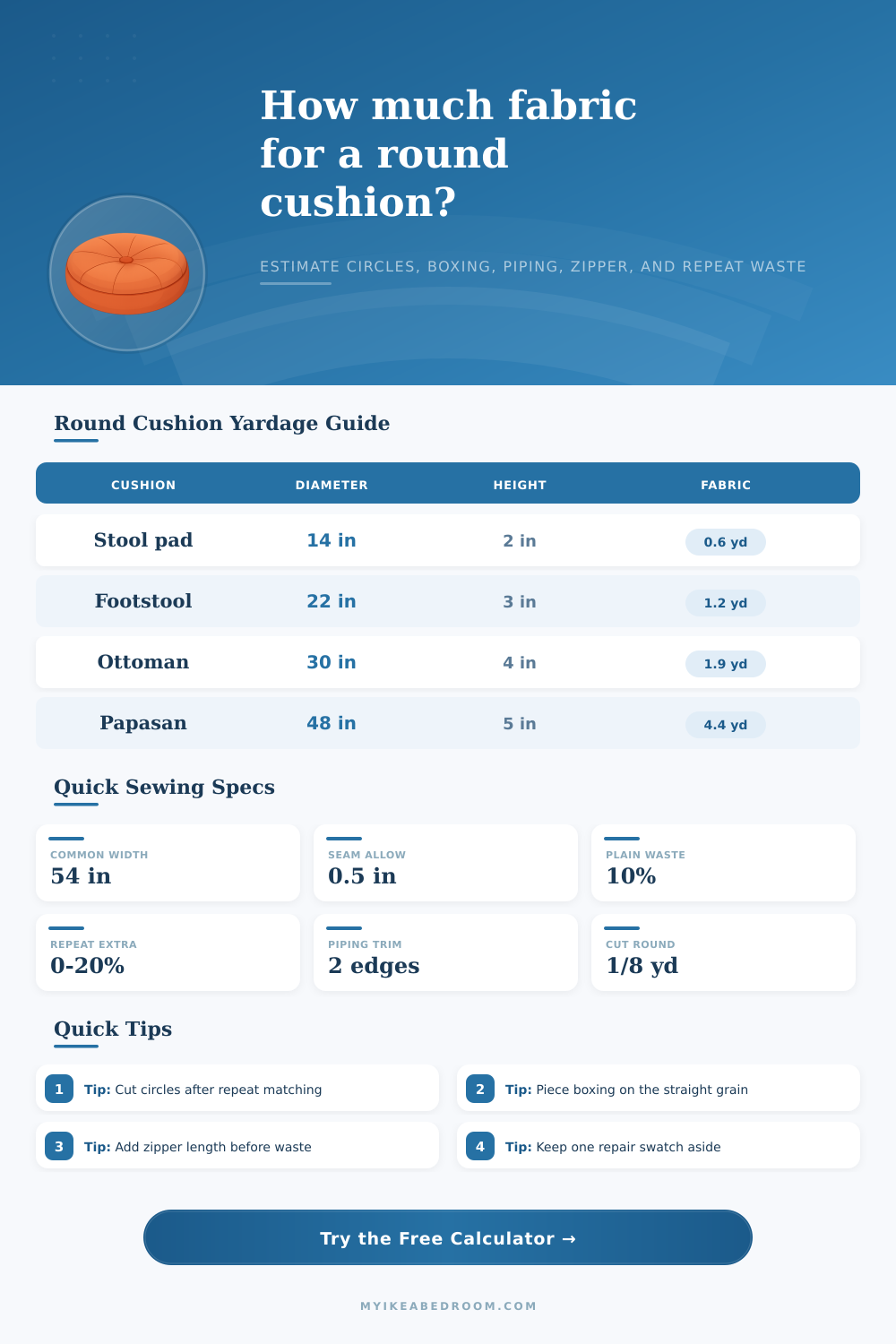
| Round cushion type | Finished diameter | Typical thickness | Common details | Plain fabric estimate |
|---|---|---|---|---|
| Round stool pad | 12 to 16 in | 1.5 to 2.5 in | Single boxing strip, ties optional | 0.5 to 0.75 yd |
| POANG-style footstool pad | 20 to 24 in | 2.5 to 4 in | Top and bottom piping, short zipper | 1.0 to 1.4 yd |
| Round ottoman top | 28 to 34 in | 3 to 5 in | Tailored boxing and zipper access | 1.6 to 2.4 yd |
| Papasan cushion cover | 44 to 54 in | 4 to 6 in | Large plates, long boxing, repeat waste | 3.6 to 5.4 yd |
| Formula item | Imperial formula | Metric formula | What it estimates |
|---|---|---|---|
| Cut circle diameter | d + 2 seam | d + 2 seam | Template size for each circular plate |
| Top and bottom area | 2 x pi x r2 | 2 x pi x r2 | Flat fabric area before layout waste |
| Boxing length | pi x d + zipper + joins | pi x d + zipper + joins | Side strip length per cushion |
| Piping length | pi x d x edge count | pi x d x edge count | Cord needed around selected edges |
| Fabric width | Best for | Circle layout note | Boxing strip note |
|---|---|---|---|
| 45 in / 114 cm | Small stool and vanity pads | Large circles use one per row | Narrower width means more joins |
| 54 in / 137 cm | Most upholstery cushions | Pairs many circles up to 25 in | Good width for long side strips |
| 60 in / 152 cm | Floor cushions and poufs | Pairs some 28 to 29 in circles | Less piecing for tall boxing |
| Wide decorator goods | Papasan and oversized rounds | May reduce length dramatically | Check directional pattern first |
| Pattern repeat | Suggested extra | Best use | Layout caution |
|---|---|---|---|
| 0 to 3 in | Base waste only | Solids, boucle, canvas, small texture | Rotate pieces only if nap allows |
| 4 to 8 in | 5% repeat extra | Small geometrics and checks | Match boxing joins at front |
| 9 to 14 in | 10% repeat extra | Medium floral or stripe layouts | Center motifs on top circles |
| 15 in or more | 15% to 20% extra | Large scenic or medallion prints | Avoid pairing if motifs must align |
A circle is easy to understand. It’s a round shape that needs to fit inside straight-grain weave. That same piece of fabric in rectangular form? Not so much. How do you turn the straight grain weave of your material into the round shape needed for a cushy seat? Turns out there’s a lot of wasted material around each corner when cutting a rectangle down to a round shape.
Enter: the magic calculator! Because pi represents a concept for circles, calculators turns that concept into usable, purchasable yards of cloth. Once you know what to plug into the top calculator (above), it does the rest. But knowing where those measurements come from helps you avoid upholstering mistakes that is all too common.
How to Use the Cushion Calculator
And so we come to the first question: what is the seam allowance? It seems like a small fraction of an inch, perhaps half an inch on each side, but it compounds quickly when you are dealing with circumference and area. But seams compound fast, especially in area and circumference! To make sure your final cushion ends up being just the right size, you don’t want to cut all the way around your pattern to exact size of finished diameter. Because then the part you’ve cut away to get there dissapears inside the stitching line, and your finished cushion won’t have enough room for the fabric that goes into making the seam.
The calculator takes care of that by adding seam allowance automatically. This calculates the diameter you should cut, which is actual size of the circle you need to draw onto table as a template. Why does it matter? A cushion that’s too small looks cheap & unfinished. One that’s too big stretches the limits of the seam allowances and results in bunching-up at the edges.
Finally, there’s the boxing strip, the sidewall of the cushion. Not only does this has to be long enough, but also tall enough! The calculator calculates the distance around final diameter plus additional length for joining seams and for zipper flanges (the part that wraps around the other fabric). It’s easy to under-estimate this element: you see the side as merely a rectangle, but it have to wrap around a circle AND have flanges for the zipper tape.
When you’re working with standard width of fabric (fifty-four inches), the calculator helps you visualize what will happen. It also shows if there’s an efficient way to cut out your required number of strips without having to piece too much together. As you’ll see from the reference tables on the page, the bigger your final diameter, the longer those strips has to be, more so than circles on top, which affects your overall yardage more then you might expect.
Another wrinkle is repeat patterns. A small amount of texture or solid color can be rotated around to maximize efficiency. But with a large floral motif or medallion you’re locked in. Want the pattern to line up on both sides of a seam? Then you must match the repeat both horizontally and vertically. This means you will waste lots of fabric as you jump ahead to find matching section.
There’s a field in the calculator to allow for vertical pattern repeat, which helps it estimate this added use. Even if the dimensions of two cushion are exactly the same, buying fabric with a three-inch repeat will require fewer yards than one with a twelve-inch repeat. This is not because it’s inefficient, but because looks come at a price.
Not only does piping create visual interest, it also provides a bit more structure. Remember though…you are going to be losing some width from your fabric for every edge that you wish to pipe. You must determine the amount of fabric required for piping each edge (top only?). Will it be the top or both the top and bottom? If you use extra accented welts, you will need to factor in how much fabric will be used to cover the cord and turn under on each edge.
A note about piping: although purchasing pre-covered piping can save time when it comes to cutting, if you make your own, you will have control over thickness of the cord as well as matching the color actualy.
And lastly, think about the layout. Normally you’ll stack your circles vertically along length of the fabric, but sometimes it makes sense to pair them across the width. That will save some fabric for some circle diameters. The calculator gives you a place to choose a layout option and see how that impacts the estimate. This is especially helpful on bigger cushions where each inch of fabric matters.
Run those scenarios through this tool. You will know exactly what size to order so you can start your round cushion project with enough material and finish with something that looks like a pro made it. The secret, as I said, is knowing where to cut your fabric width-wise (that matters most) and not length-wise. So make sure to measure well beforehand, you should of checked the pattern first.