Dining chair cushion foam planner
Dining Chair Seat Foam Calculator
Calculate foam cut size, rounded-corner area, cushion volume, foam board sheets, density weight, dacron wrap build-up, and finished seat height for dining chairs, stools, benches, and upholstered seats.
The sheet count combines area needs, waste percent, and rectangular nesting so rounded cushions do not accidentally overpromise from area alone.
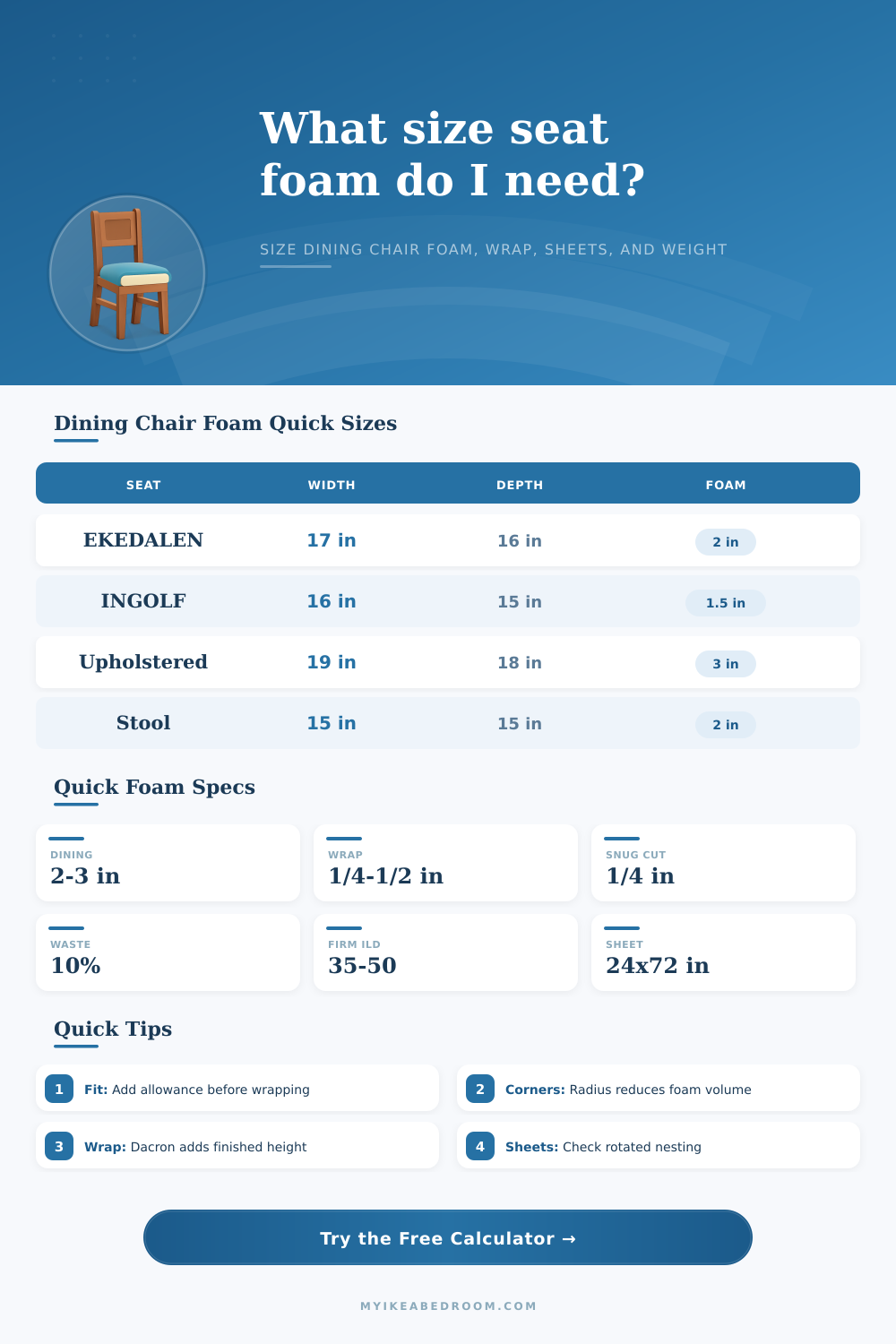
| Seat type | Typical width | Typical depth | Foam thickness | Corner radius |
|---|---|---|---|---|
| IKEA-style dining chair pad | 16 to 18 in | 15 to 17 in | 1.5 to 2 in | 1 to 2 in |
| Upholstered dining chair | 18 to 20 in | 17 to 19 in | 2.5 to 3 in | 1.5 to 3 in |
| Round stool cushion | 14 to 16 in dia. | 14 to 16 in dia. | 1.5 to 2.5 in | Circle shape |
| Dining bench section | 42 to 72 in | 15 to 20 in | 2 to 4 in | 2 to 4 in |
| Vintage cane chair pad | 15 to 17 in | 14 to 16 in | 1 to 1.5 in | 1 to 2 in |
| Foam sheet size | Board area | Common use | Example chair blanks | Planning note |
|---|---|---|---|---|
| 24 x 72 in | 12.0 ft² | Dining chair sets | 2 to 4 pieces | Works well for 16 to 18 in seats. |
| 30 x 72 in | 15.0 ft² | Wider seats | 3 to 5 pieces | Gives more rotation options. |
| 36 x 82 in | 20.5 ft² | Benches and banquettes | 4 to 6 pieces | Useful for deeper chair cushions. |
| 48 x 72 in | 24.0 ft² | Large upholstery projects | 6 to 8 pieces | Best when cutting many matching seats. |
| Density | Approx kg/m³ | Typical ILD | Seat feel | Dining chair use |
|---|---|---|---|---|
| 1.6 lb/ft³ | 26 kg/m³ | 20 to 28 | Soft | Light pads and occasional seating. |
| 1.8 lb/ft³ | 29 kg/m³ | 28 to 35 | Medium | Standard replacement cushions. |
| 2.2 lb/ft³ | 35 kg/m³ | 32 to 40 | Medium firm | Durable everyday dining seats. |
| 2.6 lb/ft³ | 42 kg/m³ | 40 to 50 | Firm | Thin seats that need support. |
| 4.0 lb/ft³ | 64 kg/m³ | 60+ | Very firm | Support layer, stools, or benches. |
| Wrap thickness | Height added | Edge effect | Best use | Calculator setting |
|---|---|---|---|---|
| None | 0 in | Crisp foam edge | Slip-in loose pads | 0 in per face |
| 1/4 in dacron | 1/2 in | Softer crown | Most dining seats | 0.25 in per face |
| 1/2 in dacron | 1 in | Plush rounded edge | Upholstered cushions | 0.5 in per face |
| Foam plus batting | Varies | Fuller profile | Thick banquettes | Enter measured wrap |
Swapping out foam on a dining room chair sounds easy: Cut to size, wrap, done! Until you realize that there’s a lot of surface area in chairs. Then there’s density. Your new cushion come out wonky or too thin because you guessed wrong on volume. With the calculator, all you do is plug-in how much space you want for cushions (desired firmness), along with dimensions of your seat, and let the math figure it out. That part’s easy.
The hard part is grasping what makes foam respond to pressure. Filling the space are only half the battle. Don’t measure the old cushion and then order same size…that’s a no go. The original foam has been under your butt for who knows how long and has lost its spring back…aka squished permanently. When you create your pattern using the same reduced measurements, you’ll end up with something that feels sloppy and flops about in seat frame.
How to Choose the Right Foam for Your Chair Cushion
Instead, measure the seat itself (wood or metal). Give yourself a bit of extra room so you can sew it nice and snug once it’s wrapped. This option let you set a compression allowance as part of the tool. This makes the blank you cut out slightly larger than the final hole size. That little bit of wiggle room make for a snug fit and a pro-looking upholstery job.
Comfort depends on thickness more then width. Although you might think a two inch looks great in the box, if density isn’t right you’ll bottom out. Density has nothing to do with hardness. What does density mean? It’s a measurement of how much of something there is in a given amount of space, in this case a cubic foot. Even though high-density foam may feel softer to the touch, the ILD (Initial Load Deflection) rating determine its firmness. This is how the force required to reduce the foam by 10% are measured.
If you’re sitting in a dining chair where you sit upright and move frequently, then a medium-to-firm ILD between thirty-five and fifty is ideal. It will support your back while allowing movement without feeling as if it were a brick. Soft foam will sink to quickly and create a hammock feel that is uncomfortable when you’re eating.
Don’t forget the dacron wrap! Polyester batting wraps around the foam before you add the last layer of fabric. It gives cushion a little more weight and rounds out the hard corners left behind by rounded or squared off cut. A quarter-inch wrap on each side adds half an inch to your total thickness, which makes for a much nicer looking finished piece with less obvious seams showing through the fabric. The calculator accounts for this when estimating height so you can see just how tall your end product will be. Don’t skip the wrap and order foam that is too thin while trying to account for all the other layers.
Your wallet will also appreciate the cutting efficiency. Foam is typically cut from large 24” x 72” sheets. To minimize waste (and because foam is not cheap) you’ll want to nest your cuts as close together as possible. It depends on your shape and whether you have rounded corners. You don’t?) the tool indicates how many cushion will fit on one sheet. Having some rounded corners will decrease the overall surface area being used; this can be a money-saver when you’re cutting several seats at once. It’s a little optimization, but adds up when you’re replacing a set of four or six chair.
Use quality materials. The $5/yard foam that sags flat within months doesn’t save you money because you have to sew and cut again. Spend a little more on high density polyurethane foam, which make the seat feel fresh for years. Plan wisely by taking measurements, including some wiggle room for wrapping, and believing the math (volume calculation). You’ll all thank me for the comfy seat, even if nobody thanks me for the math.