Bedroom frame slat row, bundle, and cut planner
Bed Slat Quantity Calculator
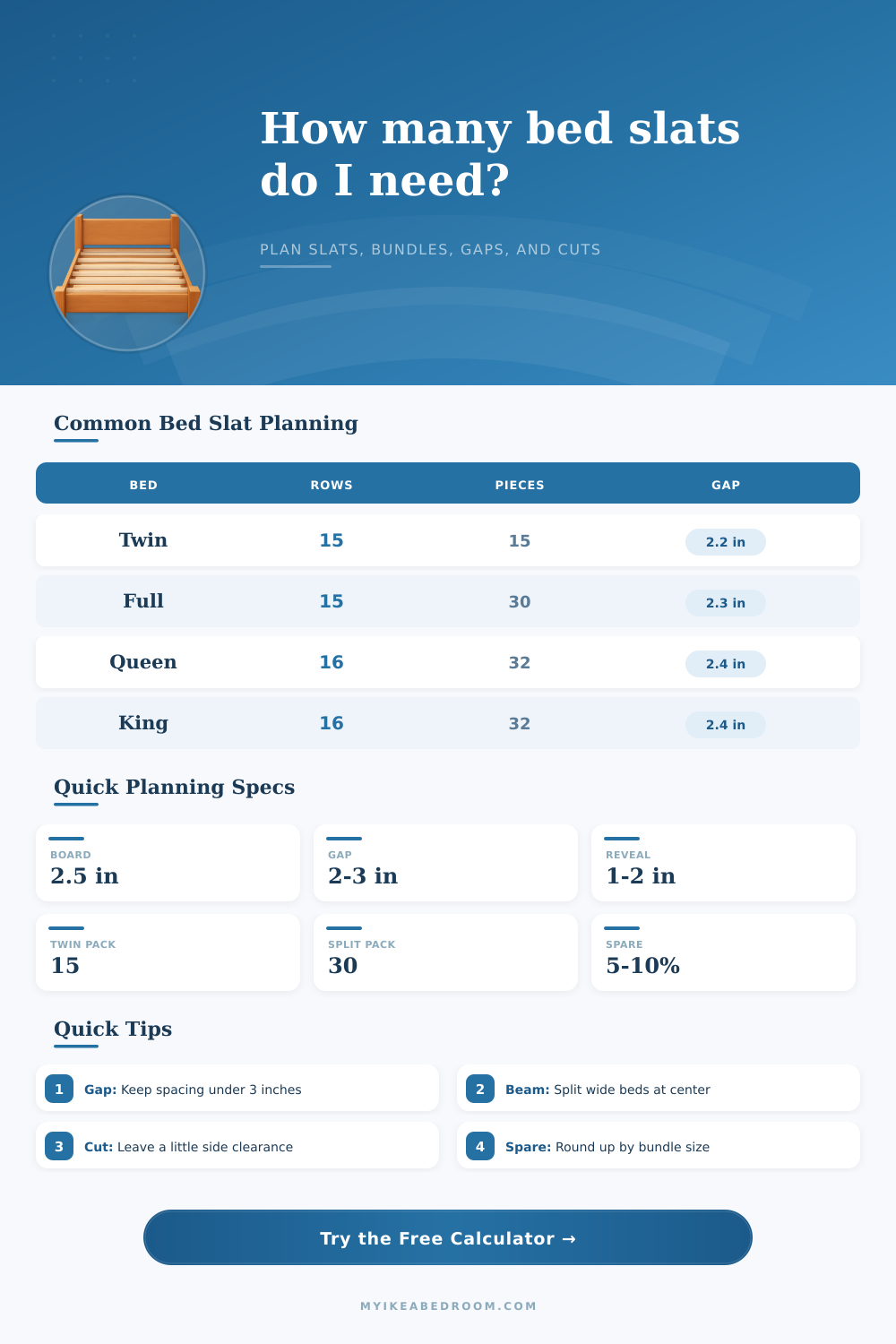
Estimate how many slat rows, split slat pieces, bundle packs, spare boards, actual spacing, cut length, and total linear length are needed for IKEA-style twin, full, queen, and king bedroom frames.
A low actual gap usually means a firmer slat deck. A high support span means each board crosses a wider opening before it reaches a rail or center support.
| IKEA-style preset | Nominal size | Inside length | Inside width | Typical support |
|---|---|---|---|---|
| MALM Queen | Queen | 80.5 in / 204.5 cm | 60.5 in / 153.7 cm | Standard center beam |
| BRIMNES Full | Full | 75.5 in / 191.8 cm | 54.5 in / 138.4 cm | Standard center beam |
| SONGESAND Twin | Twin | 75.5 in / 191.8 cm | 39.5 in / 100.3 cm | One-piece slats |
| HEMNES King | King | 80.5 in / 204.5 cm | 76.5 in / 194.3 cm | Wide center beam |
| TARVA Queen | Queen | 80.25 in / 203.8 cm | 60.25 in / 153 cm | Narrow center rail |
| NEIDEN Full | Full | 75.25 in / 191.1 cm | 54.25 in / 137.8 cm | Standard center beam |
| SLÄKT Twin | Twin | 75.25 in / 191.1 cm | 39.25 in / 99.7 cm | One-piece slats |
| IDANÄS King | King | 80.75 in / 205.1 cm | 76.75 in / 195 cm | Wide center beam |
| Board width | Target gap | Feel on bed | Planning note |
|---|---|---|---|
| 2.0 in / 5.1 cm | 1.75 to 2.25 in | Firmer, dense rows | Needs more slats but gives smaller mattress openings. |
| 2.5 in / 6.4 cm | 2.25 to 2.75 in | Balanced support | Common starting point for replacement slat planning. |
| 3.0 in / 7.6 cm | 2.5 to 3.0 in | Broad board support | Fewer rows can cover the same length. |
| 3.5 in / 8.9 cm | 2.75 to 3.25 in | Wide slat deck | Check mattress guidance before allowing larger openings. |
| Center beam choice | Pieces per row | Cut length formula | Use case |
|---|---|---|---|
| No center beam | 1 | Inside width minus clearance | Twin and narrow guest frames with short board span. |
| Narrow center rail | 2 | (Width minus 1.5 in) / 2 | Light wood frames or rail-supported replacement sets. |
| Standard center beam | 2 | (Width minus 2.5 in) / 2 | Full and queen frames with a central support rail. |
| Wide center beam | 2 | (Width minus 3.5 in) / 2 | King frames and wider upholstered-style frames. |
| Bundle pack size | Best fit | Typical rows covered | Rounding behavior |
|---|---|---|---|
| 15 pieces | Twin one-piece slats | About 15 rows | One bundle usually covers a simple twin deck. |
| 17 pieces | Extra row twin set | About 17 rows | Useful when the target gap is tighter than standard. |
| 30 pieces | Full or queen split slats | About 15 split rows | Two-piece rows make the bundle disappear faster. |
| 34 pieces | Queen or king dense set | About 17 split rows | Often leaves a practical spare after rounding. |
When you started this journey, I’m sure it began with thoughts of “a nice comfy night’s sleep” and “I know we have a solid frame to put my mattress on.” Then you go to measure the interior of the side rail of the bed. You see the stack of wood slats sitting before you and remember that math isnt your buddy when it is 2am. There are bundles, center beam lengths, board width…all creating a confusing maze of choices in the gap between buying a mattress and actualy having a functional bed. It was a test of carpentry that you did not prepare for.
Once you plug in your unique frame measurements into the calculator above it spits out the math so you don’t need to guess about waste and spacing. Your frame’s inside length (that’s the second piece). It’s not about how long the outside shell is or how long your mattress is. It’s about how far apart the rails on the footboard and the headboard are from each other, where your slats would actualy sit.
How to Measure Your Bed Frame for Slats
If you measure too wide then your slats dont fit. If you measure too narrow, they rattle around whenever you roll over in bed. Standard queen frames tend to be roughly eighty inches inside, but older designs and custom builds vary wildly. That’s why having direct control over it via the tool is so important; a half-inch difference can throw off the whole layout.
And then there’s the question of board width and target gaps. Usually, these boards are sold as two-and-a-half inch slats; however, it’s not only the material that counts, but also the distance between them. To avoid your memory foam mattress sagging into any gaps, you’ll typically want gaps less than three inches apart. Too large of a gap will cause the core of your mattress to lose its support and create dips around the seams of each slat.
Enter the target gap. That’s what the calculator calls for. Using this value, it calculates the number of rows needed. The smaller the gap, the greater the number of rows. A greater number of rows means a greater number of boards. You will need a greater total length.
The next variable is wide beds. With twin beds, it’s not uncommon to find just a few long boards running the entire width of the bed (from one side rail to the other). However, with the wider queen and king sizes, the width is simply too great for skinny boards to bridge the gap while standing on their own. They would bend/break when weighted down. To split the load, you’ll need a center rail. That turns your one long board into two (each row being two shorter sections instead). So the calculator doubles the number of pieces in its results for any split slat configuration. And it figures out the exact cut length for each half so that none will be too long/too short to fit over the rail.
The problem involves bundles and spares because most folks forget to include them on the shopping list. Individual boards is usually not included in the bundle; they are only sold in packs of 15, 30, etc. So if you think you will need 32 boards but only buy one bundle, you won’t have enough. You’ll be forced to round up to the next complete bundle. Good practice is to add an extra 10% for spares. Boards can snap when forced into place, and they can also warp over time if exposed to changing humidity levels. Spare boards make replacing a broken slat easy instead of having to search out discontinued hardware months from now.
You might notice there isn’t a perfect match to the exact gap created by the math. For instance, you may have aimed for 3″ spacing and it comes out on the calculator as 2.5″. Great! That means you’re supported more than you need to be. Which is usually firmer (and thus longer-lasting) for mattresses. On the other hand, if the gaps are too large, even heavy-duty slats will sag in the center. The support span is also tested by the calculator, it alerts you if the gap between the center beam or rails is beyond the safe limit for typical wood.
Laying bricks is a good analogy for slat planning. How do you know how many to get? You measure the edge where it stops at a wall. You figure in the mortar lines. And then you add ten percent extra to be safe. The same is true for bed frames. Just because there’s a “King” preset doesn’t mean that’s true for all king-sized frames. It is always better to measure your own rails. Marketing names, such as King or Queen, differ from manufacturer than manufacturer. They don’t care what they’re called on a piece of paper. They care about the geometry of their actual frame.
Get out your tape measure, measure your inside rails, enter that into the planner, and suddenly all that lumber becomes a well-ordered list of cut lengths and bundles. No more hoping at the hardware store; you’re walking in confidently. And once the bed’s built, solid and quiet beneath you, you will know just where each and every board belongs.