Furniture leg taper geometry planner
Leg Taper Angle Calculator
Calculate taper angle, cut-line offset, saw kerf allowance, blank yield, removed waste, target reveal, and mirrored pair marking for desks, tables, benches, nightstands, sofa feet, stools, and tapered cabinet legs.
Formula anchor: taper angle = atan((top width - bottom width) / 2 / taper length) for opposite-face tapers; one-face tapers use the full width change.
Geometry Breakdown
| Furniture use | Typical leg height | Common top to foot | Taper character |
|---|---|---|---|
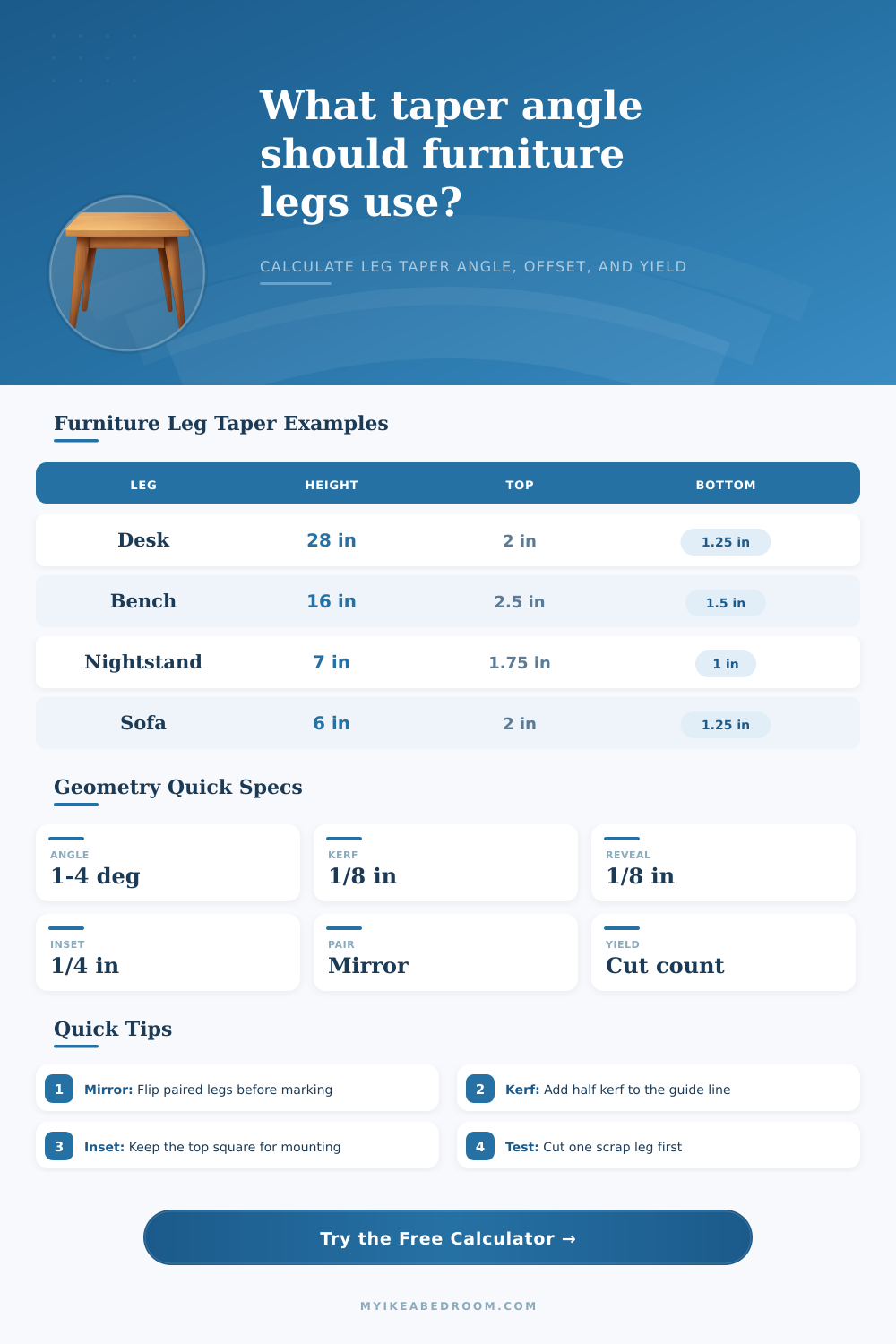
| Desk or writing table | 27 to 29 in | 2 in to 1.25 in | Subtle angle that reads modern without weakening the foot. |
| Dining table | 28 to 30 in | 2.75 in to 1.75 in | Moderate reduction; preserve a broad top block for aprons. |
| Bench or low seat | 14 to 18 in | 2.5 in to 1.5 in | Shorter height creates a more visible angle from the same width change. |
| Nightstand or dresser base | 6 to 10 in | 1.75 in to 1 in | Steeper visual taper; use extra reveal only if hardware clears. |
| Sofa or ottoman foot | 4 to 7 in | 2 in to 1.25 in | Compact leg often uses one hidden taper and one visible face. |
| Angle range | What it feels like | Cut setup | Best use |
|---|---|---|---|
| 0.5 to 1.5 degrees | Very subtle, almost square | Long guide line, low risk of wandering | Desk legs, cabinet bases, hidden side tapers. |
| 1.5 to 3 degrees | Clearly tapered but still sturdy | Good table-saw jig or track-saw guide | Tables, benches, stools, nightstands. |
| 3 to 5 degrees | Strong mid-century stance | Clamp carefully; leave a wider top shoulder | Short legs, accent furniture, sofa feet. |
| Over 5 degrees | Very dramatic taper | Prototype first and check fastener depth | Decorative pegs or legs with limited load. |
| Kerf and marking item | Typical value | Formula use | Workshop note |
|---|---|---|---|
| Thin-kerf table saw blade | 3/32 in | Add 1/2 kerf to keeper-side guide offset | Use the same blade for test and final legs. |
| Standard table saw blade | 1/8 in | Add 1/16 in guide compensation | Most furniture shop taper jigs assume this range. |
| Track saw kerf | 2 to 3 mm | Convert to project units before marking | Keep the rail on the waste side of the line. |
| Planing cleanup | 1/64 to 1/32 in | Add only for oversize rough cuts | Useful for hardwood tearout or paired visible faces. |
| Preset project | Loaded dimensions | Approx angle | Symmetry cue |
|---|---|---|---|
| MALM desk leg | 28 in, 2 in top, 1.25 in foot | About 0.8 degrees | Two mirrored left legs and two mirrored right legs. |
| LISABO table leg | 29 in, 2.5 in top, 1.5 in foot | About 1.0 degree | Four-face taper keeps the foot centered on all sides. |
| Tapered bench leg | 16 in, 2.5 in top, 1.5 in foot | About 1.9 degrees | Mark front pair together, then flip the rear pair. |
| Nightstand leg | 7 in, 1.75 in top, 1 in foot | About 3.3 degrees | Short legs need extra attention to equal reveals. |
| Console table leg | 31 in, 1.75 in top, 1.1 in foot | About 0.6 degrees | Keep the narrow face forward for a lighter look. |
When you stand back and look at a square block of hardwood and envision it as a tapered leg, there’s one moment where you question whether or not you’ll ever pull it off. Yes, you see it in your head: you want this thing to be elegant. But in your mind, all that geometry is just a trap waiting to spring shut. It could cost you a fraction of an inch in kerf from your saw or a few degrees off the mark in alignment. Suddenly, what was going to be a sleek desk leg look amateurish and wobbly before you’ve even added it to apron.
Once you enter dimensions you’re aiming for, the calculator above do the rest, sparing you the guesswork on conversions and coefficients and preserving your sanity through the planning stages. What is hard to grasp about tapers, and really the entire point of them, is that the angle is completely determined by the ratio between height and width reduction. So if you’re making a tall leg for a dining table, you have a lot of leeway to reduce top more (since there’s a lot of wood there) until it gets narrow at base before it becomes too steep (and possibly shaky). But short legs is much more unforgiving. You are reducing the same amount of width over a much shorter length. This means the remaining angle will be sharper, making it difficult to cut cleanly. It also make them less stable when bearing weight.
Why Planning is Important for Making Table Legs
That is why tool prompts you for the final dimensions of the height of each leg as well as the width at top and bottom. The tool then computes the exact angle for you, which you can use to set your bevel gauge or jig correctly, instead of eyeballing it and crossing your fingers.
The hastily calculated numbers also do not include the square shoulder on the upper portion of legs. Why? That inset space there has no taper and gives you a stable base to fasten hanger bolts or join pieces together where aprons meet. Screws will slip off or split such a slender piece of wood if you taper all the way to outer edge. The shoulder height is factored into calculation. This tells you how much to cut back (the true taper). It also tells you how deep to make your cutting angle so it matches what realy tapers. It is a small point, but it is important for structural strength.
Kerf, the narrow amount of wood your saw blade slices off when cutting, is another key factor. If your blade is standard eighth inch most shop tools use, and you’re not paying attention, then every time you make a cut, you’ll have lost some wood on either side of your layout line. To account for this, the jig shifts the cut-line so that you lay out a little inside the ideal edge. Otherwise, when you finish the final foot, it’ll be smaller than intended, which can cause the leg to appear lopsided or otherwise weaker than the others.
The type of material you’re using also affects how forgiving the cut will be. Overshoot the line with softwoods such as pine and its no big deal: just keep on planing until you’re back on track (and yes, it dents). Hardwoods such as ash and oak retain their sharp corners nicely, but they will tear out if your blades arent sharp or if you feed them to heavily.
The calculator also gives an estimated yield, which tells you approximately how many leg you’ll extract from a typical-sized board. This allows you to plan ahead when ordering your lumber so you know how much you need. It also helps you determine the cutting order to maximize blanks and reduce waste. Nothing sucks more then being halfway through a set of four legs and realizing your board ran out three inches shy.
Finally, there is symmetry. Mirror image legs don’t get marked as if they were exactly alike. They’re not! On a table or desk with legs on both ends, one side would slope inward while the other slopes out. This is visually distracting and makes the piece seem warped. The tool will give you pairing notes reminding you to mirror your pattern on each side. This can be easy to miss when you are in a hurry cutting up a bunch of legs. But double checking each leg to its twin avoid expensive do-overs.
The takeaway: Perfect isn’t as important as good planning. If you know the math behind it, how a joint or taper is built, and what your tools can handle, you should of not had to be a machinist to make perfect cuts. Just run the numbers ahead of time and use them to guide your intuition when cutting. In this case, running the numbers means you end up with a stack of legs that look like they were intended, stand up straight, and bear weight without calling attention to how they’re made.