Stair carpet quantity planner
Carpet Stair Tread Quantity Calculator
Estimate individual carpet stair treads, cut carpet area, runner length, landing pieces, tape strips, nosing wrap allowance, waste, and metric equivalents from real stair measurements.
Load a realistic stair layout, then refine tread count, width, depth, nosing wrap, landing pieces, backing type, waste, and fastening method.
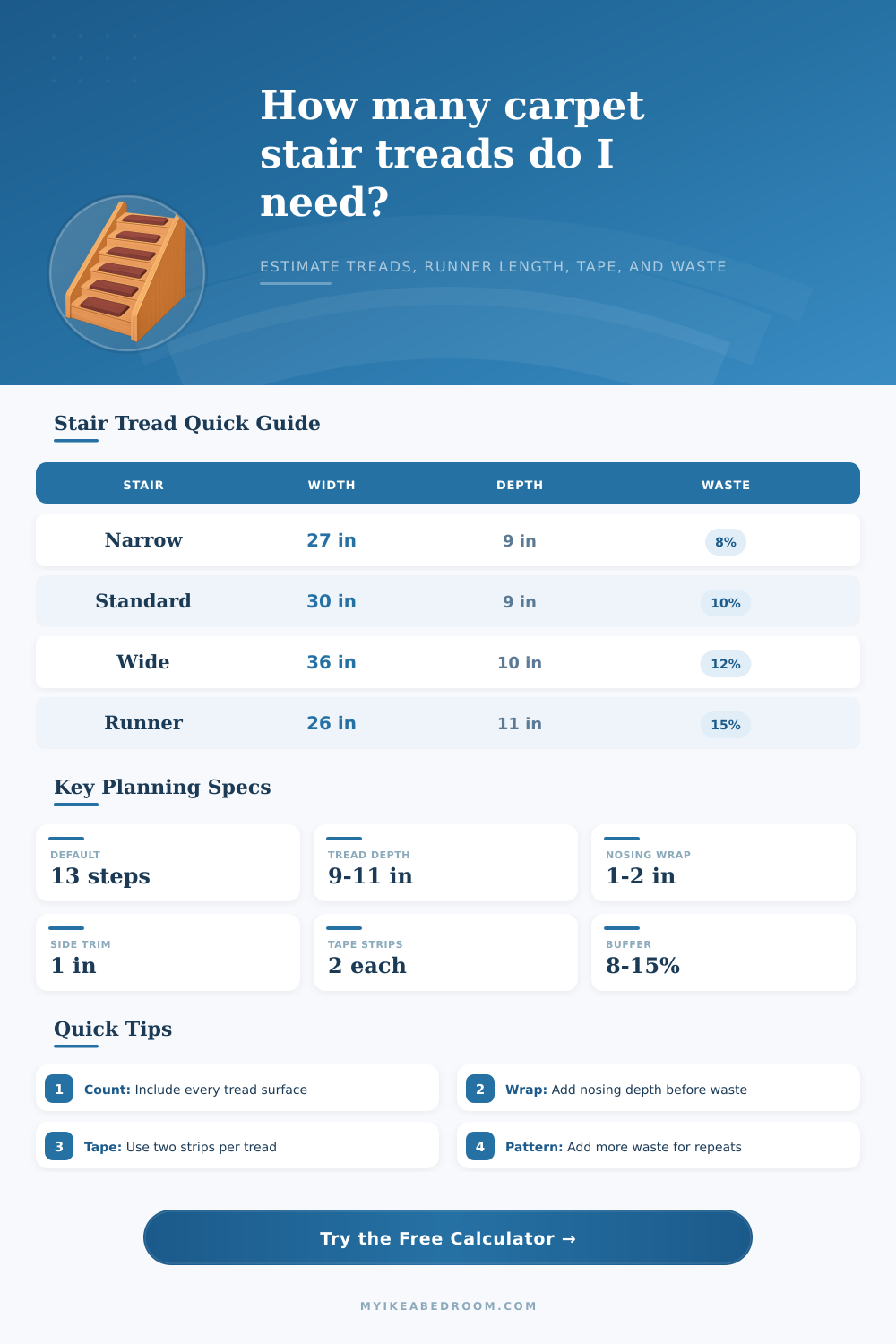
| Precut Tread Size | Area Each | Best Stair Type | Planning Note |
|---|---|---|---|
| 27 x 9 in | 1.69 sq ft | Narrow townhouse stairs | Leaves wood exposed at sides. |
| 30 x 9 in | 1.88 sq ft | Standard closed stair | Common ready-made tread size. |
| 31 x 10 in | 2.15 sq ft | Deeper residential tread | Good for rounded front edges. |
| 36 x 10 in | 2.50 sq ft | Wide stair or open stringer | Check side reveal consistency. |
| 26 x 11 in | 1.99 sq ft | Runner-style centered tread | Add waste for pattern alignment. |
| Flight Type | Typical Treads | Waste Range | Extra Items To Count |
|---|---|---|---|
| Short condo flight | 9 to 11 | 5% to 8% | One spare piece and threshold edge. |
| Standard house flight | 12 to 14 | 8% to 10% | One spare tread and side trimming. |
| Split landing stair | 13 to 16 | 10% to 15% | Landing rectangles and repeat match. |
| Open riser stair | 11 to 15 | 12% to 15% | Front wrap and visible back edge. |
| Patterned runner cuts | 12 to 16 | 15% to 20% | Repeat depth on each cut. |
| Fastening Method | Calculator Basis | Typical Use | Output Meaning |
|---|---|---|---|
| Double-sided tape | Two strips per tread | Precut treads and mats | Total linear tape length. |
| Adhesive tabs | Four tabs per tread | Removable stair tread pads | Total tab count. |
| Spray adhesive | 60 sq ft per can | Cut carpet with backing | Rounded can count. |
| Tackless strips | Two widths per tread | Runner-style stair installs | Linear strip length. |
| Loose non-slip backing | No fastener add | Rubber-backed tread mats | Only piece count is shown. |
| Scenario | Dimensions | Base Area | Suggested Buffer |
|---|---|---|---|
| Basement utility stair | 12 x 29 x 9 in | 21.8 sq ft | 8% for simple trimming. |
| Standard closed stair | 13 x 30 x 9.5 in | 25.7 sq ft | 10% with one spare tread. |
| Wide oak stair | 15 x 36 x 10 in | 39.1 sq ft | 12% plus visible side cuts. |
| Split landing flight | 14 treads + landings | 44.6 sq ft | 15% for landing layout. |
| Runner-style pattern | 14 x 26 x 11 in | 31.6 sq ft | 15% to align pattern. |
Homeowners view carpeting stairs like most linear problems. They measures each step, multiply by the width, and buy enough carpet to cover length. Often times, this results in either too much carpet (you didn’t account for it bending) or too little (and there’s always waste). A well-done carpet install isn’t about carpet quality; its about knowing to add extra material for the side edges, the front edge (nose), and trimming mistakes.
Once you input the dimensions and number of stairs, the calculator up top do the work for you. You no longer have to measure in inches by hand and then convert to square footage. But here’s where the “tread depth” comes into play, don’t blindly rely on the results without knowing this definition. Tread depth isn’t just the horizontal piece of the stair. That’s why you have to include those 2 inches as an allowance for the wrap around the front edge (the nosing) plus the drop down the riser. Without that extra space, your carpet will be stretched snug to the stringer. And it’ll probably tear at the seam in a few weeks. Details like this matter; they’re important for long-lasting results.
Tips for Measuring Stair Carpet
What about buying precut treads versus cutting your own? Buying precut treads can be very handy; they conveniently fit standard stair widths without much fuss. The downside is that you typically end up purchasing slightly more tread than necessary. Chances are you’ll want some as spares (in case you stain them), or maybe just for pattern matching purposes. By allowing you to specify a number of spares, the tool takes this into account. This is a good idea if you have heavy foot traffic or pets.
If you choose to go with a continuous runner, things gets trickier. You’re no longer working with discrete rectangles, but rather feeding a continuous strip of carpet down the stairs and turning it over at each nosing. One quarter inch of error at step one result in a two inch gap at step twelve. This explains why waste percentage gets so much higher for runner-style installations. Similarly, your error allowance depends on the type of carpet as well: thin commercial carpet cut cleanly and doesn’t go far. Wooly plush types tend to fray, stretch, and even compress at the cut line. They require a larger error allowance because any excess must be trimmed off and will look ragged if not given enough space. These trade-offs are reflected in the tool’s reference tables, which show where plush is nice (but expensive to install in terms of both material and labor) compared to where berber/loop pile works well on steep stairs (with minimal waste). Is it worth the extra effort and material for plush to make the stairs comfortabley? Or would the family prefer that the steps holds up best?
Another area of complication that most DIYers don’t consider until they’re up on a ladder is fastening options. For individual treads, double sided tape is great. Just use one strip per tread. Otherwise, the ends will eventually curl up. If you want something removable (in case you frequently switch decor), then adhesive tabs work great. Finally, spray adhesive creates the strongest hold when used with cut carpet. But just be sure to apply it carefuly so it doesn’t soak all the way through to the surface of the material. Based off your selected method, this calculator will estimate how much you’ll need. That way, you won’t run out of tape mid-install.
You need to measure several times across the length of the stair flight. Remember that walls aren’t necessarily straight and a staircase will often get wider or narrower as it ascends. Don’t take one measurement at the base and apply it across all your stairs (this is a recipe for disaster). If possible, measure out each tread. If not, then measure the bottom, middle, and top of the run and go with the biggest number. This way the carpet covers the widest portion of the stair without bunching on the smaller section.
To conclude, Stair carpeting is both a science (a lot of measuring) and an art (patience). The tool provides you with a good starting place; it’s the number. But it could of not factor in the oddities of your own staircase nor the level of experience of the person installing it. Select a profile based off traffic. Provide yourself some wiggle room for error. And don’t forget: the nosing wrap is not optional. Nail down those details and you’ll have stairs that are sharp from top to bottom.