Rubber Gym Flooring Calculator
Estimate rubber tiles, rolls, mats, adjusted coverage, delivered weight, seam tape, and door transitions for a home gym, garage gym, studio, or weight room.
📌Quick Gym Flooring Presets
📐Floor Area and Rubber Product
Your Rubber Flooring Estimate
⚖Rubber Thickness Weight Grid
📊Reference Tables
| Thickness | Common Gym Use | Approx. lb/sq ft | Metric Weight |
|---|---|---|---|
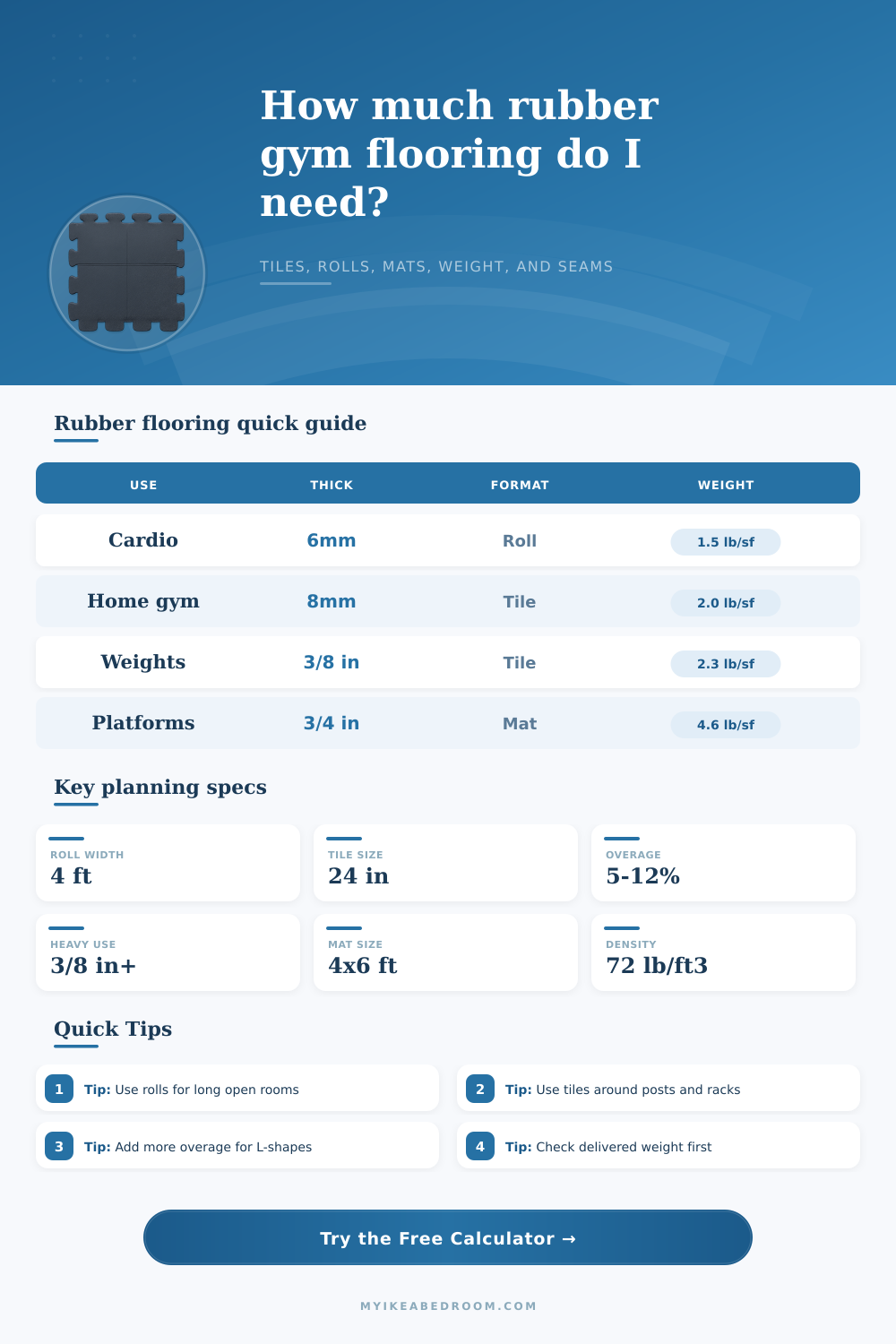
| 6 mm | Cardio, bikes, machines | 1.5 | 7.3 kg/m² |
| 8 mm | General home gym flooring | 2.0 | 9.5 kg/m² |
| 3/8 in | Dumbbells and mixed training | 2.3 | 11.2 kg/m² |
| 1/2 in | Free-weight areas | 3.1 | 14.9 kg/m² |
| 3/4 in | Platforms and heavy mats | 4.6 | 22.5 kg/m² |
| 1 in | Impact tiles and drop zones | 6.1 | 29.8 kg/m² |
| Product Format | Piece Size | Area Each | Best Fit |
|---|---|---|---|
| 24 x 24 in tile | 2 ft x 2 ft | 4 sq ft | Small rooms and many cuts |
| 36 x 36 in tile | 3 ft x 3 ft | 9 sq ft | Medium rooms with fewer seams |
| 3 x 3 ft interlocking | 3 ft x 3 ft | 9 sq ft | Floating floors and rentals |
| 4 x 6 ft mat | 4 ft x 6 ft | 24 sq ft | Rack bays and platforms |
| 4 x 25 ft roll | 4 ft x 25 ft | 100 sq ft | Home gyms and studios |
| 4 x 50 ft roll | 4 ft x 50 ft | 200 sq ft | Open rooms with long runs |
| 6 x 50 ft roll | 6 ft x 50 ft | 300 sq ft | Large training spaces |
| Room Area | 24 in Tiles | 4 x 6 Mats | 4 x 25 Rolls |
|---|---|---|---|
| 100 sq ft | 25 tiles before overage | 5 mats before overage | 1 roll before overage |
| 200 sq ft | 50 tiles before overage | 9 mats before overage | 2 rolls before overage |
| 400 sq ft | 100 tiles before overage | 17 mats before overage | 4 rolls before overage |
| 800 sq ft | 200 tiles before overage | 34 mats before overage | 8 rolls before overage |
| Gym Scenario | Typical Size | Suggested Thickness | Format Note |
|---|---|---|---|
| Power rack platform | 8 x 8 ft | 3/4 in | Use dense mats or tiles |
| Spare bedroom gym | 10 x 12 ft | 8 mm | Tiles reduce trimming |
| Garage gym bay | 20 x 20 ft | 3/8 in | Rolls reduce seams |
| Cardio studio | 24 x 36 ft | 6-8 mm | Long rolls align cleanly |
| Free-weight zone | 30 x 40 ft | 1/2 in | Check freight weight |
🧩Format Comparison Grid
Square Tiles
Best when the room has posts, racks, closets, or many wall cuts.
- Easy spot replacement
- More visible seams
- Good for DIY handling
Interlocking Tiles
Useful for floating layouts where adhesive is not desired.
- Locks edges together
- Fast dry layout
- Edge trim may be needed
Rubber Rolls
Best for open gym floors where long runs reduce seam count.
- Fewer seams
- Heavy to move
- Careful measuring matters
Large Mats
Best under racks, deadlift zones, and compact training bays.
- High impact mass
- Simple rectangles
- Limited fine fitting
💡Planning Tips
Calculations use standard area formulas, exact metric conversions, rounded-up product counts, and rubber weight based on common recycled gym flooring density ranges.
When you drop those weights onto a concrete floor, the impact shoots straight back through your spine to make you regret every squat. For a serious home gym, that require some rubber flooring. Many folks look at their space and divide it by their tile size which doesn’t take into account weight limit and waste factors. But it also doesn’t factor in real-world logistics like how much rubber do you think is manageable to move into your garage/basement? Get those thing sorted out first before you buy, and the difference between a clean install versus a pricey headache.
Once you enter in your own dimensions, it crunch the numbers and deals with tricky geometric shapes. You no longer have to manually add cutouts for wall outlets and pillars. Also, it will make you face reality of how much rubber weighs. Rubber is heavy (about seventy-two pounds per cubic foot). So your average four-hundred square-foot garage gym can weigh upwards of half a ton. That’s a lot of weight for an elevator or stairwell to bear. Before the truck pulls up to your driveway, you better be sure yours can support it.
How to Choose Rubber Flooring for Your Home Gym
Do you want rolls or tiles? The answer depends on your space’s shape and your tolerance for cutouts. Rolls is cleaner looking since they have fewer seams (unless your room is also perfectly rectangular). But with columns or a weird L-shape, the waste factor go up rapidly. For example, you may be forced to purchase 12-15% additional material just to account for jutting edges.
With tight spaces, tiles can be more forgiving. Tiles are more forgiving in tight spaces, allowing you to fill odd corners without buying an entire extra roll just for one off-cut piece. Ultimately, it is a trade-off: looks versus practicality which changes depending on your unique floor plan.
Not only is material important but so is the thickness. Cardio machines like treadmills and bikes creates rhythmic vibration instead of impact shock. You want enough cushion to feel comfortabley but not so much that it feels like walking on sponges. 6 or 8 millimeters is plenty of padding while still allowing proper foot placement. These machine are usually in cardio zones.
In heavy zones, you drop a barbell off your shoulders. How can a piece of rubber be thick enough to absorb all that kinetic energy? Half inch interlocking tiles or three quarter inch stall mats are the minimum standards for powerlifting platforms. Thin rubber will do nothing for protecting your floor, nor will it help quiet the clatter rattling around your ears. To avoid buying more than what you need (or less when it matters), the page has thickness-to-activity reference tables that correspond with commonly trained exercises.
While you’d be tempted to believe “more is more,” in fact too much cushion will throw off Olympic lifts if your rubber is so thick or soft that it doesn’t match the footwork required. For the average gym which does a little bit of everything, eight millimeters hit the sweet spot. It is firm enough to hold up during side-to-side movement, yet still comfortable against joints.
First-time builders underestimate installation logistics: laying two hundred square feet of rubber isn’t like dropping a carpet runner. You need some prep work, a little patience and, more likely than not, a second set of hands to get the edges lining up as the adhesive sets (or when the interlocking clicks into place). Plan ahead for transitions at doors and seams and you’ll have a professional-looking finished product instead of something that appears cobbled together.
Rubber is not cheap, so it’s best to add some buffer for any cut gone awry. You should of planned more carefully. A gym floor has as much to do with expectation management as it does square footage coverage.
What should you order? Your eyes will tell you once it’s down, but the numbers will guide you on what to get. Measure correctly, then estimate what you can move around. Get a thickness that matches your level of actualy training. Build in a plan and expect a floor that holds up under pressure over time. Provide yourself with a solid foundation for years of lifting to come.