Metallic Leaf Wall Coverage Calculator
Estimate metallic leaf sheets, books, adhesive size, sealer, waste, and ready-to-order coverage for accent walls, panels, alcoves, and room sections.
✨Project presets
📏Wall and leaf inputs
Estimate updates as you edit the wall and leaf inputs.
🧾Metal leaf comparison grid
📐Leaf coverage reference
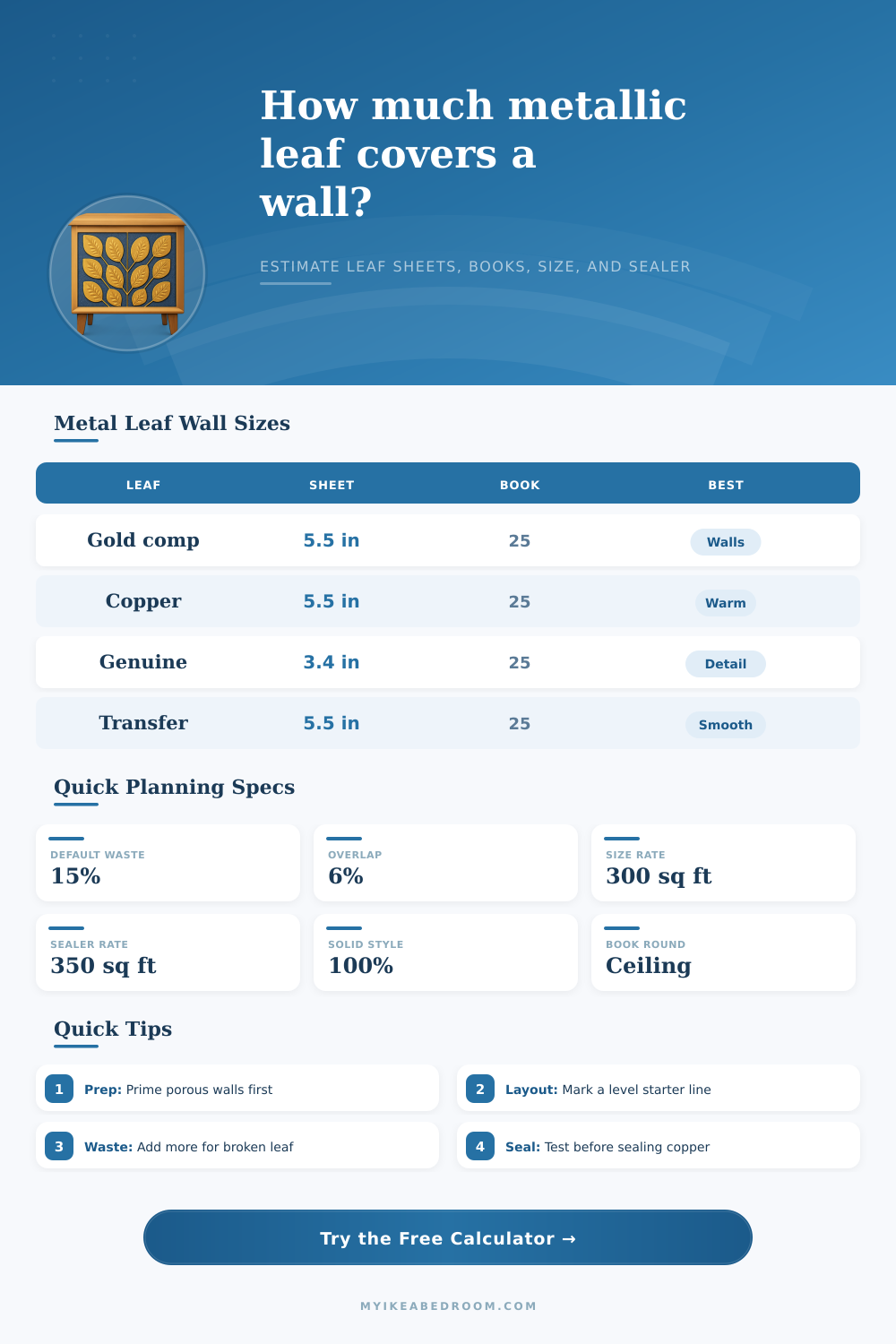
| Leaf profile | Sheet size | Sheet area | 25-leaf book covers |
|---|---|---|---|
| Composition gold, silver, copper, aluminum | 5.5 x 5.5 in | 0.210 sq ft | 5.25 sq ft before overlap |
| Transfer leaf for vertical walls | 5.5 x 5.5 in | 0.210 sq ft | 5.25 sq ft before overlap |
| Genuine gold small loose leaf | 3.375 x 3.375 in | 0.079 sq ft | 1.98 sq ft before overlap |
| Metric genuine leaf | 80 x 80 mm | 0.069 sq ft | 1.72 sq ft before overlap |
🎨Style and waste factors
| Wall finish style | Leaf area used | Good starting waste | Planning note |
|---|---|---|---|
| Solid continuous metallic field | 100% of net wall | 10% to 15% | Use level rows and consistent overlaps. |
| Soft antique field | 90% of net wall | 15% | Leaves small breaks and patina gaps. |
| Broken clouded wall | 75% of net wall | 20% | Torn leaf creates more handling loss. |
| Sparse gilded wash | 55% of net wall | 20% to 25% | Useful over painted texture or plaster. |
🧴Size coat and sealer guide
| Coating profile | Coverage rate used | Best wall condition | Calculator behavior |
|---|---|---|---|
| Water-based gilding size | 300 sq ft per quart | Most sealed painted walls | Default adhesive size estimate. |
| Oil-based gilding size | 250 sq ft per quart | Longer open time or detailed work | Uses a lower coverage rate. |
| Spray size | 200 sq ft per can | Small panels and quick accents | Rounds to whole cans. |
| Clear topcoat sealer | User-entered sq ft per quart | Touch zones, copper, and humidity | Multiplies by selected sealer coats. |
🏠Common metallic leaf wall checks
| Project area | Example size | Solid 5.5 in sheets | Approx. books |
|---|---|---|---|
| Small vanity splash wall | 30 sq ft | About 170 sheets | 7 books |
| Headboard feature wall | 96 sq ft | About 545 sheets | 22 books |
| Fireplace chimney breast | 64 sq ft | About 365 sheets | 15 books |
| Dining feature wall | 144 sq ft | About 815 sheets | 33 books |
💡Wall leaf planning tips
So when it comes to figuring out how much gold leaf you’ll require, simply input the walls’ measurements and calculator does the rest. No more guessing when ordering supplies! Simply input square footage and what kind of metal you’re covering and let calculator do all the conversions. Confusion becomes a number.
One thing that need explanation is the effect of varying leaf type on the final tally. For example, a composition gold sheet are larger and takes up more space than genuine silver or copper sheet. Therefore, fewer sheets is needed to cover the same amount of surface area. The calculator accounts for this variation in sheet size. Also note that you can’t purchase half of a book, so it will round up your final tally to full books. That way you’ll have enough material to complete task and not run short at the end of project.
How to Use the Calculator
The estimator does this by considering waste. No estimate consider it, but you’ll have waste… You’re going to tear some up while figuring out how to apply it. So add some to total! To adjust for that, we adds in extra waste depending on type of style you pick. If you want solid fields of color like gold, there won’t be much waste since all the cuts are predictable and straight. If you want clouds or other looks where you tear at edge by hand, then there is more waste. More complicated styles also tend to result in handling errors, so the tool adjust the percentage to reflect that too. That way you don’t end up having to go back to store for more.
Now the sealer and adhesive are not the same as leaf itself. So even though we just applied metal to a portion of wall, whole wall must be primed. The calculator estimates how much size you need for entire surface so that every square inch is ready to recieve the metal. This way each square inch is ready to receive the metal and that’s what the size is figured off in the calculator.
The sealer is what seals and keeps your finish from being damaged or tarnishing. If you leave copper exposed, it will darken fast. All metals should be sealed. Silver should be too but it doesn’t oxidize as fast. The amount of times you want to do the sealer coat depends on how much traffic the space get and/or humidity. In other words, an entry with a lot of activity, like a dining hall, would get more sealer than a powder room.
Can you see flaws better in direct sun? Or do they gets hidden by soft lighting? Experience: Over time, you learn to deal with what you can see. Tip: If you’re using the calculator, add another book (to be your test leaf). Before applying it to actual surface, experiment with it on some scrap first. That will train your fingers just how hard to push down. This helps you tell if it is sticky enough for metal to stick.
Water-based sizes stay open longer than oil-based ones, giving you more time to position sheets. So, you have more time to position sheets. Adhesive: As important as knowing how many sheets to purchase is understanding which type of glue work best for your skill level.
Finally, consider corners vs. Outlets different. They’re tricky surfaces. They are high-waste zones where precision is difficult. This means they creates more waste. If you choose to have an allowance for corners/outlets, then tool will account for this. In a typical home, walls aren’t perfect rectangles. Carefully measure, make a smart choice about which leaf profiles to use and follow the math. Good planning are needed to get a shiny metallic wall. Patience (to work carefully with every thin layer) and some cushion (for errors) is required. Magazines don’t feature shiny metallic walls due to their photography skills; it’s all prep work.