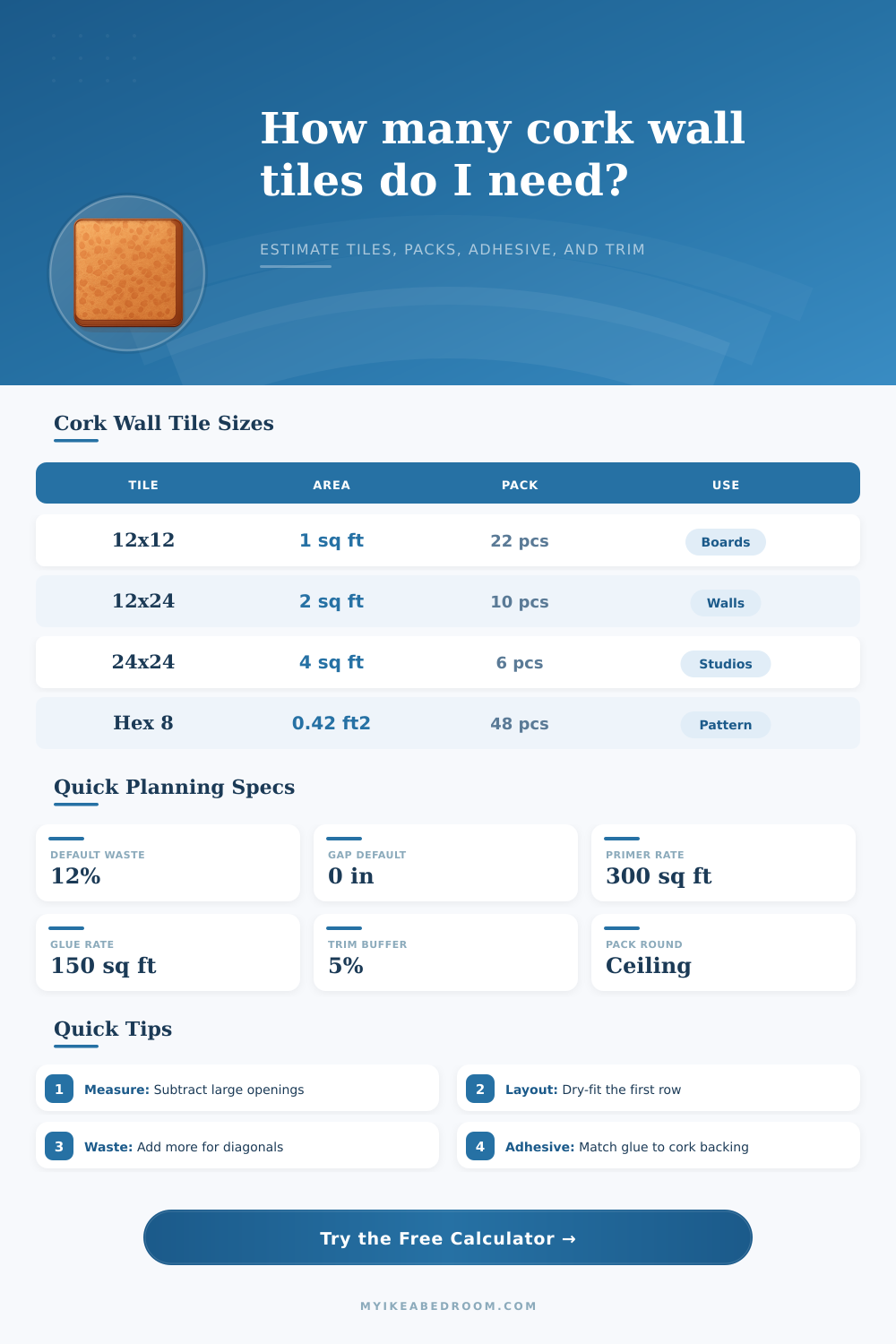
Cork Wall Tile Calculator
Estimate cork wall tiles, packs, adhesive, primer, edge trim, net wall coverage, seam spacing, and waste for bulletin walls, acoustic panels, backsplash strips, and room accents.
Full cork wall tile breakdown
| Profile | Nominal tile size | Tile area | Typical pack model |
|---|---|---|---|
| Square cork tile | 12 in x 12 in | 1.00 sq ft | 22 pieces, 22 sq ft |
| Cork plank tile | 12 in x 24 in | 2.00 sq ft | 10 pieces, 20 sq ft |
| Large acoustic panel | 24 in x 24 in | 4.00 sq ft | 6 pieces, 24 sq ft |
| Narrow strip plank | 6 in x 24 in | 1.00 sq ft | 20 pieces, 20 sq ft |
| Metric square tile | 300 mm x 300 mm | 0.97 sq ft | 11 pieces, 10.66 sq ft |
| Metric rectangle panel | 600 mm x 300 mm | 1.94 sq ft | 10 pieces, 19.38 sq ft |
| Hexagon accent tile | 8 in face diameter | 0.42 sq ft | 48 pieces, 20.2 sq ft |
| Layout condition | Suggested waste | Why it changes | Best use |
|---|---|---|---|
| Flat rectangle, square grid | 5% to 10% | Few cuts and reusable offcuts | Bulletin walls and memo boards |
| Staggered plank layout | 10% to 12% | End cuts shift row by row | Bedroom and office accent walls |
| Diagonal cork layout | 15% to 20% | Perimeter triangles create waste | Decorative feature sections |
| Hexagon or shaped tile | 15% to 25% | Edge clipping and direction matter | Small focal walls and art panels |
| Many outlets or shelves | 12% to 20% | Small cuts break more easily | Kitchen strips and studio walls |
| Adhesive type | Modeled coverage | Calculator output | Planning note |
|---|---|---|---|
| Peel-and-stick cork | Factory backing | No glue gallons | Primer is still useful on dusty drywall |
| Water-based contact adhesive | 150 sq ft per gallon | Gallons rounded up | Often used when both surfaces are coated |
| Trowel cork tile adhesive | 125 sq ft per gallon | Gallons rounded up | Good for thicker wall cork panels |
| Spray adhesive | 60 sq ft per can | Cans rounded up | Better for small framed inserts |
| Wall primer or sealer | 300 sq ft per gallon | Gallons rounded up | Helps cork bond evenly on porous walls |
| Project | Typical area | Tile profile | Approx packs before custom waste |
|---|---|---|---|
| Desk bulletin strip | 16 to 28 sq ft | 12 in x 12 in cork tile | 1 to 2 packs |
| Bedroom headboard wall | 72 to 120 sq ft | 12 in x 24 in cork planks | 4 to 7 packs |
| Home studio acoustic wall | 80 to 160 sq ft | 24 in x 24 in panels | 4 to 8 packs |
| Kids playroom lower wall | 90 to 150 sq ft | 300 mm square tiles | 10 to 16 packs |
| Full craft room walls | 300 to 450 sq ft | 12 in x 12 in tiles | 16 to 24 packs |
12x12 Tiles
Simple grid math, easy outlet cuts, and strong choice for bulletin boards or small office walls.
12x24 Planks
Fewer seams and a more wall-panel look, but staggered layouts need extra end-cut waste.
24x24 Panels
Fast coverage for acoustic cork walls; pack rounding can leave larger spare pieces.
Hex Tiles
Best for decorative feature zones; edge cuts and orientation make the waste factor important.
First, there’s the wall: Flat. Painted an unchanging eggshell white, and oh boy, have you been sick of staring at it lately? A friend mentions something about using cork in this room. It could serve as some sort of sound treatment behind a gaming rig or as a bulletin board in your home office. Sounds good to you… right up until you remember that purchasing cork isn’t much like painting a wall… It’s more akin to installing flooring.
Instead of gallons, you’re thinking of packs. Instead of measuring by area covered, you’re accounting for waste. You’re also considering the number of pieces needed and whether your wall is actualy flat. And here’s when the math starts to get complicated. Here’s where you break out the calculator and plan ahead instead of guessing your way through the process.
How to Calculate How Much Cork You Need
The typical person measures their wall in square feet and assumes that’s the end of the story: they calculate the area, divide by the coverage of one tile, and order exactly that amount. They figure out total area, divide by how many square feet each tile covers, and just get that number, but it never go as planned. There are outlets, windows, doors, and odd corners that gobble up full tiles in tiny pieces that you can’t use again.
The calculation accounts for this by asking you for your net wall area (minus all the big holes), but also requires you to consider how complicated the layout will be. The more complex the layout, the more waste there will be; the more wasteful, it’s more expensive. Then there’s diagonal… Which looks beautiful, until you remember that it means cutting off triangles from every tile around the edges! So the tool takes into account how complex your layout is and adds some sort of cut buffer for all those tiles that will end up in the trash. It is a small detail, but it makes a difference if you are trying to stick to a budget.
There’s no such thing as buying one sheet of cork. You get it in packs, or at least boxes, that say they’ll cover so many square feet. And the packs generally come in 20- or 22-square-foot increments. So if you have 23 square feet to cover, and the packs covers 22, you can’t buy half a pack, you’re going to end up buying two. That’s where the calculator kicks in. It rounds up for you. It has to. That’s the way the real world works too. I know it is annoying to see it rounded up on the screen, but it is more accurate then rounding down.
It also calculates adhesive. Some products are peel and stick. Others require gluing the thicker acoustic panels into place. Some types of glue require a particular rate of spreading. Peel-and-stick needs primer if your wall is dusty. It all gets covered nicely on the page itself. A reference table lets you know exactly how much of the liquid stuff you’ll be working with, so you don’t run out halfway up the wall.
The tool helps people compare the different tile types side by side to see how the room will change depending on what kind you select. Plank (12×24) covers up small imperfections in walls slightly better than square (12×12), but takes more care to make sure it’s installed level. If you’re new at tiling, it can be nice to start with square tiles since it’s fairly easy to cut around outlets. 24 inch wide panels cover area quickly and work well if you want as few seams as possible in studios. Hexagon tiles provide a more decorative honeycomb look that feels natural, though there is also more waste because you have to cut more shapes for the edges.
And then there’s the whole deal with seams. Do you want no gap at all (tiles touch) or do you want some gap so you can see the edge line between them (like a small reveal)? Depending on who does the installation, they may lean toward either option, or maybe both. Enter that into the calculator as well. It seems insignificant. But when it comes to something like a big wall, adding an eighth of an inch for every single joint makes those additional tiles add up. It is one of those things that looks like nothing until you have done five rows and discover you are out of tiles.
This is a primer on the unsung hero. Cork is a porous material and adhesion might vary depending on whether you are applying it to new drywall or unevenly painted surfaces. Laying it directly over fresh dry wall can lead to uneven sticking and areas where glue bonds more effectively than others. The tool calculates the normal per square foot coverage rate for primer. It lets you know when your surface is prepped properly before you install something with a larger price tag. Better to have an additional gallon of sealer than pulling up unadhered tiles.
Lastly: Think about future repairs. Cork takes dents. Pins last for years before pulling them out leaves pin-sized holes. Buy exactly as many tiles as you need, no more and no less. The moment you accidently ding one of those tiles, it is game over. You will have no spares left from the same box to cover up the blemish.
That number you entered for waste on the calculator isn’t only for cut-offs; it’s insurance against the future. Round up to the nearest full package, tack on that extra ten or fifteen percent and rest easy knowing you’ve got a back-up tile in reserve in the closet.
You were staring at a dead wall, and now? Now you’ve got a plan. One that factors in every cut, every gap, every spilled drop, and you’re able to go from vague idea to actual finished project without losing your cool.