Fabric Wall Covering Yardage Calculator
Estimate wall fabric yardage by room size, usable bolt width, vertical drops, pattern repeat, trim allowance, seam overlap, openings, roll length, and waste reserve.
🧵Real Fabric Wall Covering Presets
⚙Project Inputs
Fabric Yardage Results
Full yardage breakdown
📏Fabric Width and Weight Reference
📘Usable Width Coverage Table
| Usable width | Sq ft per linear yard | Sq m per linear meter | Typical fabric wall use |
|---|---|---|---|
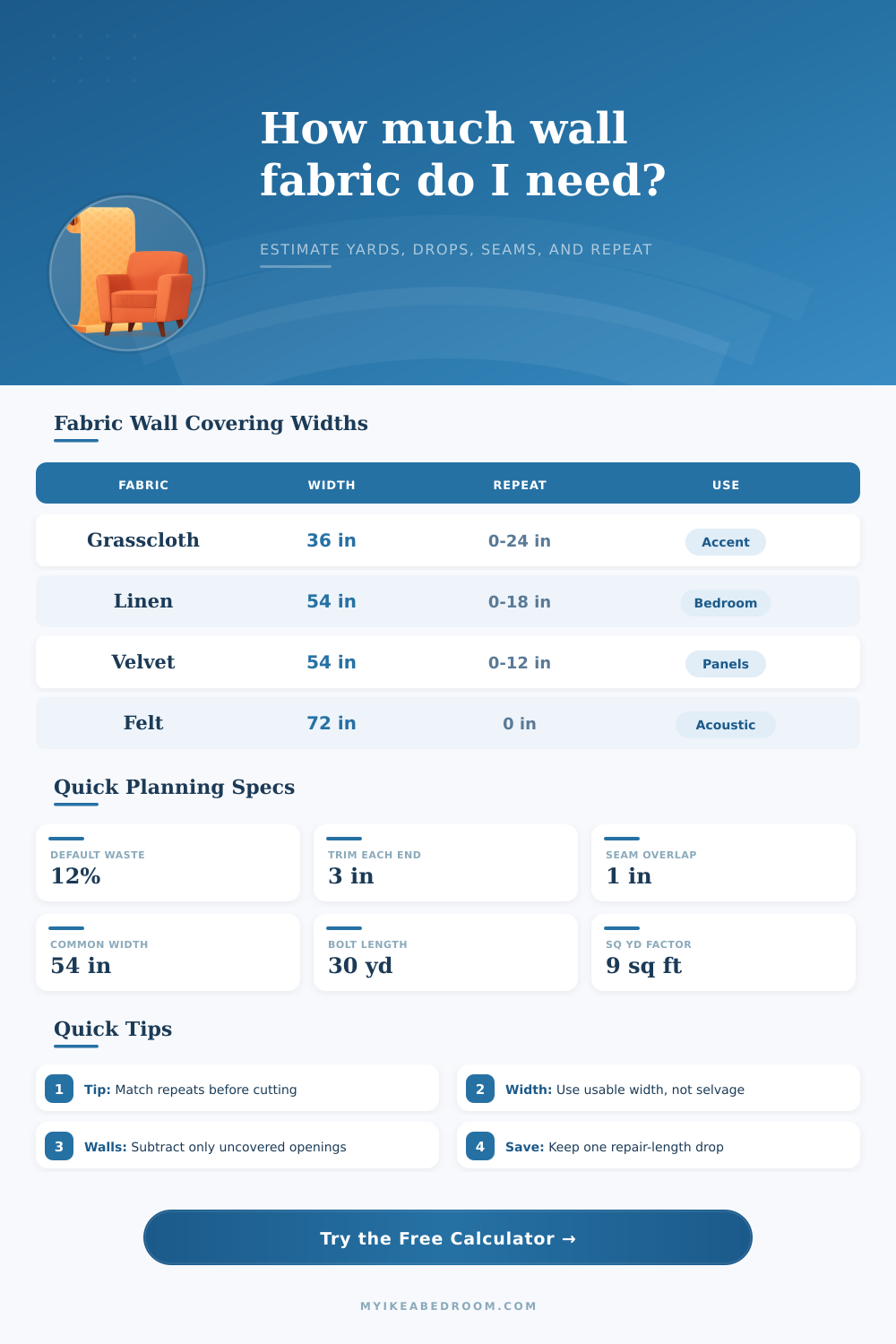
| 34 in after trimming | 8.5 sq ft per yd | 0.86 sq m per m | Grasscloth, sisal, narrow specialty goods |
| 52 in after trimming | 13.0 sq ft per yd | 1.32 sq m per m | Most 54 in decorator fabrics |
| 58 in after trimming | 14.5 sq ft per yd | 1.47 sq m per m | Canvas murals and wide upholstery cloth |
| 70 in after trimming | 17.5 sq ft per yd | 1.78 sq m per m | Acoustic felt and wide panel fabrics |
| Railroaded 54 in fabric | 13.5 sq ft per yd before height checks | 1.37 sq m per m | Horizontal bands where fabric width covers wall height |
📐Repeat and Drop Planning Table
| Pattern repeat | Cut length behavior | Best buffer | Planning note |
|---|---|---|---|
| No repeat or random weave | Wall height plus trim only | 5% to 10% | Good for felt, plain linen, and solid velvet. |
| 6 to 12 in repeat | Round each drop up to next repeat | 10% to 12% | Common for small damask, herringbone, or stripe. |
| 13 to 24 in repeat | Each drop may lose nearly one repeat | 12% to 20% | Use for grasscloth panels or medium motifs. |
| 25 in plus repeat | Lay out drops before ordering | 20% to 25% | Large scenic or mural fabrics need extra review. |
📦Bolt and Cut Conversion Table
| Order unit | Linear measure | Coverage at 52 in usable | Best use |
|---|---|---|---|
| 1 linear yard | 36 in long | 13.0 sq ft before repeat | Small repairs, samples, and one short band |
| 5 linear yards | 15 ft long | 65.0 sq ft before repeat | Headboard wall panels or alcove backs |
| 10 linear yards | 30 ft long | 130.0 sq ft before repeat | One bedroom feature wall in many layouts |
| 30 yard bolt | 90 ft long | 390.0 sq ft before repeat | Full bedroom or living room accent run |
🏦Common Fabric Wall Project Sizes
| Project | Typical covered area | Fabric width | Approx yardage before repeat |
|---|---|---|---|
| 12 ft by 8 ft bedroom feature wall | 96 sq ft | 54 in bolt, 52 in usable | About 8 yd plus trim and reserve |
| 15 ft by 9 ft living room accent wall | 135 sq ft | 36 in grasscloth, 34 in usable | About 16 yd plus repeat |
| 10 ft by 8 ft home office acoustic wall | 80 sq ft | 72 in felt, 70 in usable | About 5 yd plus reserve |
| Four framed wall panels | 84 sq ft | 54 in velvet, 52 in usable | About 9 yd when cut as drops |
| Small powder room, three-quarter walls | 175 sq ft | 54 in textile-backed vinyl | About 18 yd plus openings and repeat |
🔍Fabric Comparison Grid
Grasscloth and Sisal
Narrow widths and natural panel shading make drop counts more important than raw square footage.
Linen and Canvas
Plain weave fabrics are forgiving, but selvage trimming can remove useful width from every drop.
Velvet and Suede
Nap direction should stay consistent, so avoid flipping drops just to save yardage.
Silk and Damask
Motif repeats and delicate edges call for a higher buffer and a repair-length reserve.
💡Fabric Wall Covering Tips
It’s like this: One day, you have a certain bolt of linen in mind for your living room and a picture-perfect idea of what it will look like. Then you get to the checkout page and suddenly don’t have a clue how many linear yards to buy. Too few and you’ll be waiting weeks for another one to ship. Perhaps from a different batch of dyes, which change by nature. Too many and you’re out more money than you need to be (plus left with odd scraps). Guessing or doing math tends to make all the difference between a seamless install and headaches.
This isn’t a geometry problem; it’s a logistical one. Unlike paint or drywall, fabric come in set lengths; for example, standard decorator cloth is 54 inches wide. It often has repeating patterns that must line up vertically. You also cannot cut it into fractions of yards based off your square footage alone.
How to Order the Right Amount of Fabric
The trick is to calculate in terms of drops, each vertical section from floor to ceiling plus whatever additional length might be necessary to hide behind trim or baseboards at the top. After you input your fabric specs and wall dimensions into the calculator above it will crunch the numbers for you. But knowing what you’re putting in makes a difference when you go shopping.
Perhaps the single most important thing that everyone forget is the usable width. If something says 54 inches wide, that doesn’t mean you’ll have 54 inches to play with. It’s got to allow for selvage edges (which are unfinished and rough) and for whatever flaws may be within an inch or so on either side. So if you trim a full inch from both sides, now you’ve only got 52 inches or less to work with. This tiny change will cause more drops… which means more yards, overall.
There’s also the matter of the repeat. For a random weave such as felt or a solid color, it’s easy: Add your desired wall height plus your trim allowance and you’re good to go. For something with a large scale, such as a mural print or damask silk, there’s a vertical rhythm to consider: Every seam needs to line up exactly with its counterpart. This means you might need extra length for each drop to reach the next point where the pattern matches up. An apparent simple 12-inch repeat starts to look daunting when multiplied by seven seams across a large wall. Those little bits adds up quickly. The chart on the page explains it all, and makes clear why the bigger the repeat, the more necessary those high waste buffers are.
The texture is another detail. Panels made from natural fabrics such as grass cloth or sisal will have varying colors. Plan on ordering some extras… Not only for mistakes when cutting, but also so you can be sure you has enough of similar-looking material to do a feature wall. What about velvet? Well, velvet is even trickier, since you want the nap of the fabric running in one direction. You cannot turn over your drop to save fabric. If the fibers is running at an angle, they will cast different shadows when the light hits them and mess up the uniform appearance.
Bolts come in sizes; most suppliers sell them in 30 yard lengths. Great. So if you calculate out to 12 yards, no problemo. But what happens when it’s 32? Well, then you’re going to need TWO full bolts. There’s nothing worse than coming up a little short on your roll so err on the side of extra. Plus, it is always good to save yourself a bit more (a yard) for some later repair job or another. Moving boxes, door handles, and furnitures can scuff up the walls! That spare fabric from the starting bolt will make for seamless touch ups way into the future.
Fabric wall covering is an investment in atmosphere. Knowing how many yards you need helps protect that investment. It keeps the seams lined up. To match the pattern. To stay on budget. Because if you don’t get the number right, what will be all that’s visible when you walk into that completed room? You will see just the texture you selected. Not the voids left by the lack of mathematical skill.
Respect the repeat, take your measurements and follow the numbers on what to order. Should of followed it closer!