Wallpaper Liner Calculator
Estimate wallpaper liner rolls, strip counts, seams, waste reserve, and wall coverage for lining paper, non-woven liner, heavy grade liner, or thermal liner.
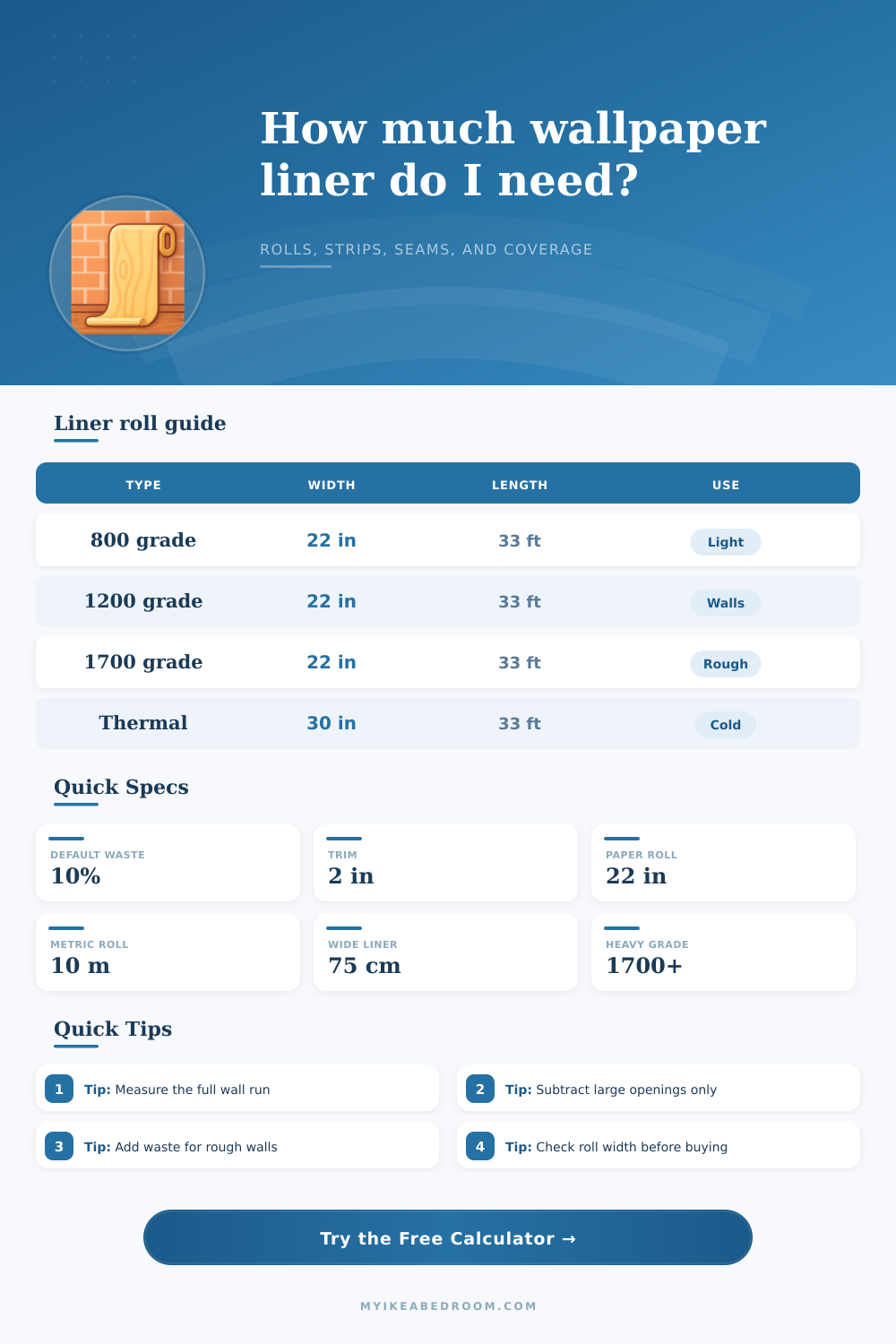
| Liner preset | Common roll size | Nominal area | Best planning use |
|---|---|---|---|
| 800 grade lining paper | 22 in x 33 ft | 60.5 sq ft / 5.6 sq m | Smooth walls and light color-change prep. |
| 1200 grade lining paper | 22 in x 33 ft | 60.5 sq ft / 5.6 sq m | General rooms before painting or wallpaper. |
| 1700 to 2000 grade lining paper | 22 in x 33 ft | 60.5 sq ft / 5.6 sq m | Older plaster, patched walls, and rougher surfaces. |
| Non-woven liner | 20.5 in x 33 ft | 56.4 sq ft / 5.2 sq m | Paste-the-wall work and easier handling. |
| Fibre reinforced liner | 55 cm x 10 m | 59.2 sq ft / 5.5 sq m | Crack bridging and stable wall preparation. |
| Thermal wall liner | 75 cm x 10 m | 80.7 sq ft / 7.5 sq m | Cold walls, alcoves, and feature sections. |
| Roll width | Vertical coverage per 8 ft drop | Drops from 33 ft roll | Approx wall run per roll |
|---|---|---|---|
| 20.5 in / 52 cm | 13.7 sq ft before trim | 4 drops with short trim | 6.8 ft / 2.1 m |
| 22 in / 56 cm | 14.7 sq ft before trim | 4 drops with short trim | 7.3 ft / 2.2 m |
| 55 cm / 21.7 in | 14.4 sq ft before trim | 3 to 4 drops by ceiling height | 7.2 ft / 2.2 m |
| 75 cm / 29.5 in | 19.7 sq ft before trim | 3 to 4 drops by ceiling height | 9.8 ft / 3.0 m |
| Wall condition | Calculator factor | What it covers | When to increase reserve |
|---|---|---|---|
| Smooth primed wall | 0.98x | Cleaner layout with fewer damaged drops. | Increase if corners are out of square. |
| Normal drywall or plaster | 1.00x | Standard cuts, trim, and normal offcuts. | Use 10% waste for most rooms. |
| Patched wall | 1.05x | Extra roll area for repairs and recuts. | Increase for many small repair zones. |
| Light texture or skim work | 1.10x | Allowance for handling and surface variation. | Choose heavier grades where needed. |
| Old plaster and uneven corners | 1.12x | Extra reserve for awkward alignment. | Stairwells and long drops often need more. |
| Scenario | Typical wall run | Wall height | Useful liner choice |
|---|---|---|---|
| Feature wall behind bed | 12 to 16 ft | 8 to 9 ft | Non-woven or 1000 to 1200 grade. |
| Small bedroom | 42 to 52 ft | 8 ft | 1200 grade with 10% reserve. |
| Living room | 60 to 80 ft | 8.5 to 10 ft | 1400 grade when walls are patched. |
| Stairwell | 28 to 45 ft | 10 to 16 ft | 1700 grade with higher trim reserve. |
| Cold alcove | 12 to 28 ft | 7 to 9 ft | Wide thermal liner for fewer seams. |
The problem is this: You pick out a pattern or color, take out your tape measure, and stand at the end of the room with high hopes for a straight line. Then, you realize there is an empty space on the wall staring back at you. It turns out you miscalculated how much extra material you needed.
Seams and trim are important: They’re necessary for a perfect installation, and it’s something far too many people don’t plan for. Homeowners think about wallpaper liner much like drywall… Just divide the total wall space by the roll dimensions and go from there. That approach doesn’t work well at all.
How to Measure and Choose Wallpaper Liner
Liner is applied vertically and must match ceiling and floor. This results in useless scraps at each corner and around windows. To do that, you’ll plug your wall height and perimeter into the calculator above. It does all the math for you, so you don’t have to guess at conversions or coefficients. This forces you to consider the geometry of thing you’re doing.
For instance, since liner runs along the edge of the walls, not within the middle space, you input the overall length of the wall run, not surface area of floors. In fact, every little return like the alcove around a closet means more linear feet of wall to add into the calculation, requiring more drops. A “drop” is a single vertical strip from top to bottom.
How many of those can you get across the wall? The calculator assumes a certain width for paper because it overlaps slightly at the seams. It then determines how many strips goes across. Why should this matter? Because a 22 inch roll isn’t going to cover 22 inches of wall!
But then there’s strategy in picking your liner grade. For example, if you’re working with smooth, primed drywall, which would benefit from one solid base coat before paint goes on, standard 800-grade paper is sufficient. Lightweight and simple to use, but older houses aren’t always so straightforward.
When you’ve got plaster walls with lots of little patches on them from past repair work (or textured plaster) you’ll want a heavier grade because a lighter grade will telegraph all those tiny flaws through the topcoat. That is why heavy liners such as 2000 or 1700 exist. These has more body to them and will cover over any slight cracks without bubbling and showing up later. And here’s where the paper weight-to-wall-condition chart on the page comes in handy.
This is really just a matter of picking between durability vs. It is easy to install. Heavy liner is stiffer and less forgiving when it comes to sneaking into a tight corner, but it also spares you having to look at a patchwork job you did underneath several months later.
Intuition won’t help with another thing: waste factors. At least a 10 percent reserve accounts for typical top and bottom waste from all those snips, as well as a couple of badly aligned cuts. That’s assuming you’ve measured honestly (your tape isn’t crooked) and your walls aren’t crazy wonky. If you’re covering a really lumpy surface, say, or using cross-liner, hung horizontally, to even it out, you’d better increase that percentage a lot.
Or what if you have a stairwell with super-long continuous runs that go beyond standard roll lengths? Those can be cruel: They require splicing mid-wall to finish, meaning more waste and more seams. Vertical height may not match the 33-foot length of a standard roll, so there’s often more than just the top and bottom waste. With the calculator, you can tweak this reserve up or down for the shape of your wall, or add an extra cushion for old plaster that wants to tear when you try to paste it.
The thermal liner is also a variable. Because it’s wider than standard paper (often 30 inches or 75 centimeters wide), there are fewer seams in tiny cold spots or nooks like behind sofa. That’s more insulating value, sort of, and nicer looking. But the basic math doesn’t change: How do you handle all that trim? Does it matter if you use imperial or metric rolls? The physics of ceiling-level straight-line cutting don’t care.
At each end, you’ll lose a couple of inches. Measure the wall run carefully, taking out only big openings such as full height doors (which won’t be lined). Don’t take out little windows or electrical cover plates. That breaks up the strip pattern and makes you cut carefuly around each piece, which creates more waste than you save.
Add one spare to the quantity you need, just in case. It’s less expensive to have some leftover liner. This is better than trying to track down another batch of the same once the dye lot has changed in a few months. You want the wall to hide its past and let the finished wallpaper/paint speak for itself: a seamless wall.