Grasscloth Wallpaper Calculator
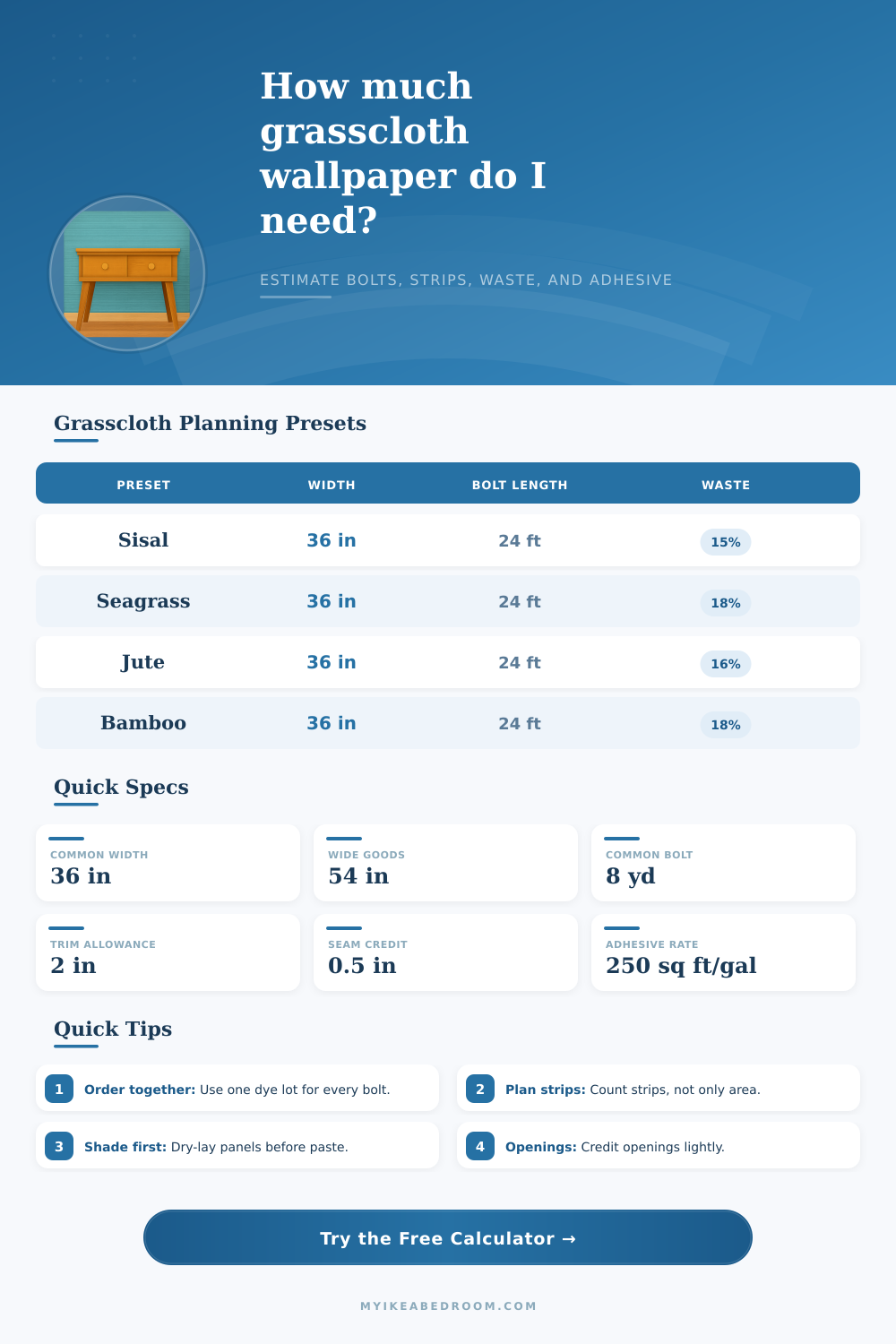
Estimate grasscloth bolts, cut strips, trimmed panel width, opening credit, adhesive, and shade-variation waste from real grasscloth roll styles.
| Grasscloth type | Typical goods | Texture behavior | Suggested waste | Planning note |
|---|---|---|---|---|
| Sisal grasscloth | 36 in x 8 yd bolt | Fine vertical fiber, visible seams | 12% to 18% | Good default for bedrooms and feature walls. |
| Seagrass | 36 in x 8 yd bolt | Chunkier horizontal movement | 15% to 22% | Shade variation can be stronger from panel to panel. |
| Jute weave | 36 in x 8 yd bolt | Softer woven texture | 12% to 18% | Plan gentle handling and avoid over-pasting. |
| Hemp grasscloth | 36 in x 8 yd bolt | Dry, irregular woven face | 14% to 20% | Conservative strip count helps around corners. |
| Bamboo grass | 36 in x 8 yd bolt | Strong linear slub | 16% to 24% | Dry-layout panels to balance strong reeds. |
| Commercial wide goods | 54 in x 30 yd bolt | Fewer seams, heavier handling | 10% to 16% | Often better for corridors or high walls. |
| Roll or bolt style | Width | Length | Approx. area | Best use |
|---|---|---|---|---|
| Residential grasscloth bolt | 36 in | 8 yd / 24 ft | 72 sq ft gross | Bedrooms, powder rooms, accent walls. |
| Metric natural bolt | 91 cm | 5.5 m | 54 sq ft gross | Imported wallcoverings with shorter bolts. |
| Wide commercial goods | 54 in | 30 yd / 90 ft | 405 sq ft gross | Long runs, corridors, hospitality walls. |
| Paperweave grasscloth roll | 36 in | 8 yd / 24 ft | 72 sq ft gross | Similar strip logic with slightly easier trimming. |
| Specialty panel goods | Variable | Variable | Use label | Enter the exact width and length from the label. |
| Project condition | Strip impact | Waste add | Why it matters | Installer check |
|---|---|---|---|---|
| Simple accent wall | Few corners | 5% to 10% | Shorter sequencing path and fewer cuts. | Verify wall is plumb at both ends. |
| Full bedroom | Four corners | 12% to 18% | Inside corners and openings break strip reuse. | Keep panels in bolt order when possible. |
| Powder room | Many obstacles | 18% to 25% | Vanity, mirror, toilet, and door cuts reduce reuse. | Do not count every opening as full savings. |
| Stair wall | Long drops | 20% to 30% | Tall cuts may reduce strips per bolt. | Measure top, bottom, and landing heights. |
| Commercial corridor | Long sequence | 10% to 16% | Wide goods lower seam count but need handling space. | Confirm fire rating and wallcovering primer. |
| Supply item | Typical allowance | Calculator use | Buy note |
|---|---|---|---|
| Heavy-duty clear adhesive | 200 to 280 sq ft/gal | User-entered coverage rate | Natural fibers may stain with the wrong paste. |
| Wallcovering primer | 250 to 350 sq ft/gal | Adhesive reserve increases when selected | Primer helps future removal and evens suction. |
| Razor blades | Change often | Not included in cost | Dull blades tear woven fibers at seams. |
| Smoothing brush | One clean brush | Install note only | Avoid aggressive plastic tools on delicate weave. |
| Repair reserve | 1 to 2 bolts | Added to final order | Later dye lots may not match the original wall. |
Every time you work with grass cloth there’s one of these moments: measuring the walls, loving the texture, then realizing that something isn’t adding up. That’s because real grass cloth on your wall doesn’t behave like wallpaper (or even regular paper). There are numbers here to calculate for you but the reason behind how that number works is the key so you don’t end up shorting yourself on material. It’s knowing why the calculator will give you the number it gives you.
Weavers use what’s readily available and make grasscloth. Because of this, there will be shade variations between each strip. Sometimes these variations are dramatic; other times they’re more subtle. There isn’t any pattern repeat to hide those variations. So you have to hang them sequentially and embrace the variation rather than trying to cover it up. Hanging them at random creates a chaotic feeling in the room. Hanging them in the order as shown on the bolt make the variations seem intentional.
Why Grass Cloth Is Different From Normal Wallpaper
This means that calculating your material requirements should take into account the fact that there is no way to patch holes with scraps. You cannot just divide square footage by roll size because that formula assumes you can patch any gap with a leftover scrap. For main wall installations, your scrap are useless. You want full height, sequential strips. That’s why the tool requests both the bolt length and wall height as separate inputs.
Twenty-four feet is a standard length for a bolt used in residences. With an eight-foot ceiling and some extra trimming allowance, you can get exactly two cuts on that length of bolt. Sounds easy, right? This changes when you take width limitations into account. You need to trim off the selvedge, add some seam allowance for a double-cut seam, and suddenly your usable strip width has gotten smaller. Each half-inch of overlap become significant, since that subtracts another strip from every roll. Less strips = more bolts = higher price, but also guarantees matching the weave with sufficient material. There are no repeats in a dye lot, so there is no room for running short.
Here are the parameters for all of these material types; they’re outlined on the reference table. Bamboo or seagrass will have a chunky texture that needs more waste buffer and careful trimming. Sisal is generally finer, which can leave narrower margins. Inside corners, windows & doors will add to offcuts rapidly, though straight walls may not require as much reserve material. Little bits never seem to combine into an entire full section of wall so it goes to waste.
The calculator accounts for this by giving you a way to adjust the opening credit. Be conservative here; it’s always nice to have a spare bolt stashed away rather than discovering that your exact color was discontinued 6 months from now. Another item that is frequently overlooked until it’s too late is adhesive. Natural fibers drink paste different than vinyl or paper. Typically it’s a heavy-duty clear adhesive, but how much area will it cover? If you ballpark your glue purchases, you’ll end up with some areas dry and others oversaturated, causing distortion and stretching on those panels. Enter adhesive coverage as a setting in the tool and purchase what you need from the beginning. There is nothing worse than pausing an installation because you are out of paste.
The adhesives are important but so too are primers. To get grass cloth to stick well, there has to be something solid for it to grab onto and it must also be able to breathe. A good primer for walls seals the drywall but allows some moisture to escape. Otherwise, bubbles might forms behind the weave. Save yourself that headache and apply primer. It’s not worth risking doing it twice.
So when you go to look at the final estimate look not at the square feet, but how many bolts it will take. The number of bolts is what will make it work and the square foot number will give you some frame of reference. If possible order all your stuff from the same dye lot. Store any extra bolts flat in a dry, cool place. These will come in handy someday for an expansion project or repair.
It’s tedious to plan…until one day you find yourself staring at a completed wall that looks seamless and all of a sudden you know that the math was only part of making this material shine. You should of used more caution with the measurements, but it works out fine in the end. It’s a luxurios feeling when it is done.