Door finish and can planner
Door Paint Quantity Calculator
Estimate door paint, primer, can count, and working area from door size, quantity, faces, panel detail, glass lites, edges, hardware masking, coats, finish type, and waste buffer.
Full door paint breakdown
| Door size | One face | Both faces | Common use |
|---|---|---|---|
| 24 x 80 in | 13.3 sq ft | 26.7 sq ft | Small closet, utility, narrow bath door |
| 28 x 80 in | 15.6 sq ft | 31.1 sq ft | Older interior room door |
| 30 x 80 in | 16.7 sq ft | 33.3 sq ft | Typical bedroom or hall door |
| 32 x 80 in | 17.8 sq ft | 35.6 sq ft | Primary interior door size |
| 36 x 80 in | 20.0 sq ft | 40.0 sq ft | Entry, accessible, or exterior door |
| 36 x 96 in | 24.0 sq ft | 48.0 sq ft | Tall front, pantry, or modern slab door |
| Paint system | Base coverage | Best door use | Planning note |
|---|---|---|---|
| Interior trim enamel | 300 sq ft/gal | Bedroom, hall, closet, and pocket doors | Good default for brush and foam roller work. |
| Premium door and trim paint | 340 sq ft/gal | Smooth slabs and high-quality repaints | Can stretch farther on sealed, flat surfaces. |
| Exterior door paint | 275 sq ft/gal | Front, side, porch, and service doors | Weathered texture and edges reduce coverage. |
| Cabinet enamel | 285 sq ft/gal | Wardrobe, cabinet, and built-in doors | Detail grooves and sanding loss matter. |
| Spray enamel | 240 sq ft/gal | Detached doors sprayed flat | Overspray and transfer loss are built in. |
| Primer | 275 sq ft/gal | Raw wood, metal, dark color changes | Estimated separately from finish paint. |
| Door condition | Factor | Why it changes quantity | Primer cue |
|---|---|---|---|
| Previously painted smooth door | 1.00x | Sealed surface spreads predictably. | Usually none for same-color repaint. |
| Factory primed door | 1.04x | Primer is even but still slightly absorbent. | Often finish paint only. |
| Raw or sanded wood | 1.18x | Open grain and edges drink paint. | One full primer coat. |
| Steel or fiberglass door | 1.08x | Bonding and brushing drag can lower spread rate. | Bonding primer if bare or glossy. |
| Laminate or melamine door | 1.14x | Slick surface needs careful adhesion prep. | Bonding primer strongly recommended. |
| Weathered exterior door | 1.22x | Sun, checking, and old film texture add demand. | Spot or full primer depending on damage. |
| Project | Setup | Typical finish paint | Can choice |
|---|---|---|---|
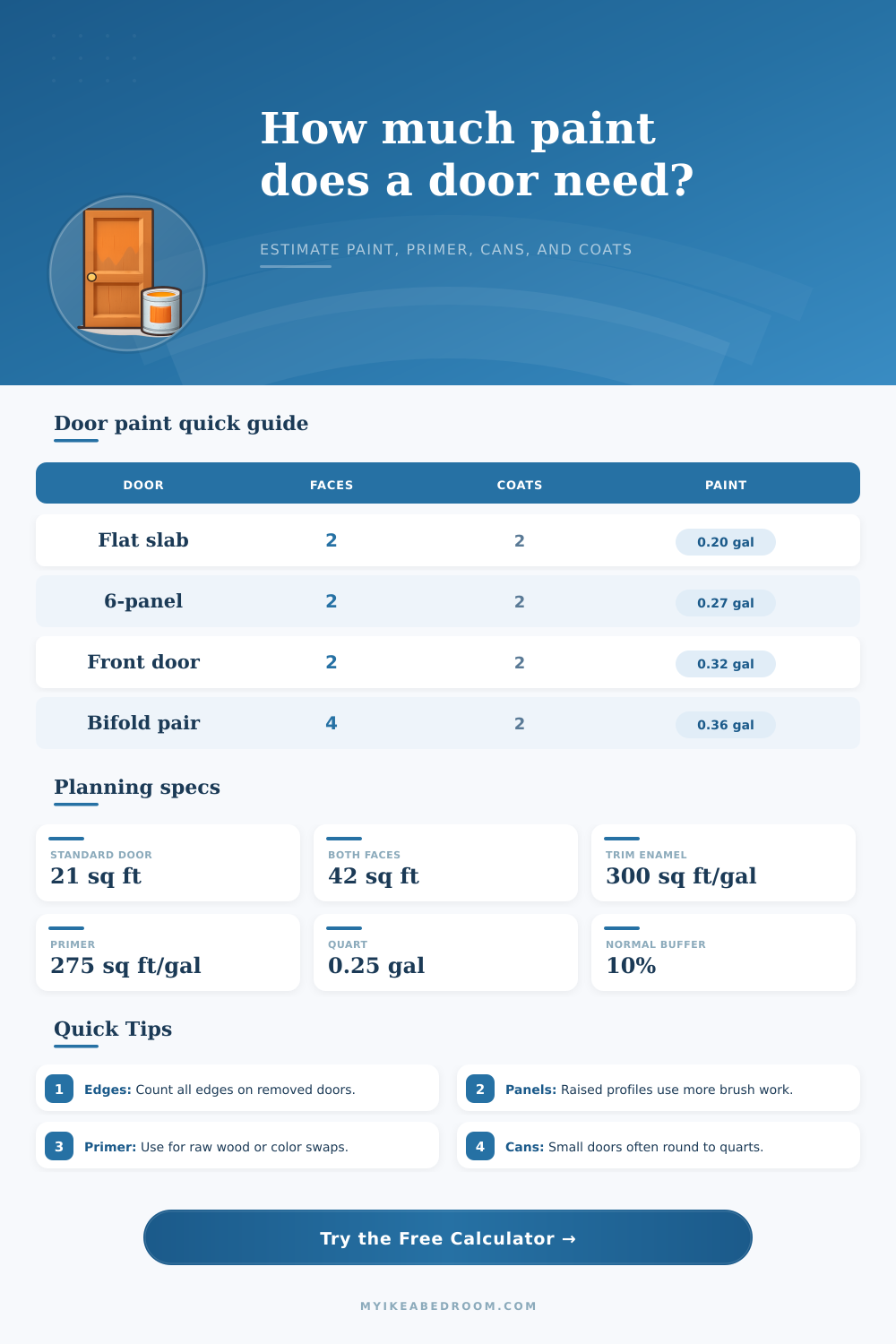
| Single flat bedroom door | 30 x 80 in, both faces, two coats | About 0.20 gal | 1 quart |
| Six-panel interior door | 30 x 80 in, both faces, panel factor | About 0.25 to 0.30 gal | 2 quarts or 1 gallon with reserve |
| Exterior front door | 36 x 80 in, both faces, edges, exterior paint | About 0.30 to 0.40 gal | 2 quarts or 1 gallon |
| Closet bifold pair | Two 24 x 80 in doors, both faces | About 0.35 to 0.45 gal | 2 quarts or 1 gallon |
| Four interior doors | 30 x 80 in, two coats, same color | About 0.75 to 1.05 gal | 1 gallon plus quart if detailed |
The DIYer buys a gallon of paint for repainting one door, feels ready, applies it, and by the end has three-quarters of the can left on the shelf. That’s not usually because their application technique was poor; it’s because their estimation logic were poor. We’re attempting to translate a three-dimensional object (with edges and panels and maybe glass inserts) into a flat square footage number, and human brains are not wired for that kind of mental geometry.
Enter your best friend on the project site: a specially designed calculator. Once you enter your door size and condition into the calculator, the math get done for you. You do not need to guess at conversion rates and coefficients.
How to Estimate Paint for Your Door
You’ll still get a number at the end but that is only half the battle. It’s equally important to understand what the inputs represent so you can provide accurate values.
First, there’s the face area. For example, the standard thirty-by-eighty inch interior door has approximately sixteen square feet of paintable surface (on each side). If you’re planning to paint both sides, then that becomes a total of thirty-three square feet before we factor in the edges.
The edges are something most people completely forget. When you remove a door from the hinges in order to paint it correctly, you reveal four more narrow area. There’s the bottom, top, lock edge and hinge edge which collectively contribute. Collectively, those areas is small enough to be overlooked separately, but when you’ve got five or six doors in house, they matter.
And then there’s the texture factor. Flat slab doors spread paint out predictably; you know what to expect in terms of coverage. Change that to an ornate moulded entryway piece or even just a six-panel raised door and voila! You’ve got a dramatic increase in surface area without any corresponding change in height or width. Those grooves drink up paint and slow down the brush work. To deal with this, the calculator multiplies your base area by a detail factor. It recognizes that texture absorbs more than smoothness. This isn’t a huge variable. However, it helps explain how your neighbor could of got away with half a quart on their flat closet doors when you required two quarts for the same amount of paneled bedroom door.
The rest is material. Want to paint over existing, sealed, gloss finish? A different color, sure, but similar? You’re at the high end of expected coverage. A different color, sure, but similar? You’re at the high end of expect coverage. Want to paint new, raw wood? Old, sanded-up surfaces? Weathered exterior doors that’ve been cracking and checking over the years? Absorption rate goes up quickly… Which is where the primer comes in, beyond simply adhering. Because you want a solid baseline for your finish coat(s) not to vanish into the grain. That’s what the tool accounts for, providing two separate primer estimates: one for each type of surface you might be applying it to. So you know you won’t run out of base before the topcoat even reaches the wall.
Another one is glass. Subtract the glass from any sidelight windows, or even if one of the French doors has large panes. The stuff inside the glass won’t get painted, so don’t count it, otherwise you’ll overestimate by 10-15%. This is especially important if you’re down to the wire, debating whether to buy a quart vs a gallon. It’s wasteful to buy a whole gallon just for two doors (unless you think you’ll be touching up baseboards)…so many small jobs round up to quarts.
This leaves the waste buffer. A 10-percent cushion is normal for small splatters, over-saturation of trays, and uneven strokes. If you’re spraying, doing very fine trim work, or working in dusty conditions that force you to sand between coats, bump it up to 15-20. Overspray isn’t obvious but costly.
When it comes to purchasing paint, it’s not so much about the swatch as it is about the strategy of volume. How much paint do I need? What if there’s too little (or too much)? Can I account for absorption, edges, texture, etc.? Do I have time before the leftovers expire while sitting in my garage?
Painting is not just about getting another coat on the wall. It’s about getting an accurate coat on the wall. And accuracy typically begins by recognizing that a door is more than just a rectangle.