Two Coat Paint Calculator
Estimate paintable surface area, two-coat gallons, quart add-ons, primer guidance, and a room-by-room paint breakdown.
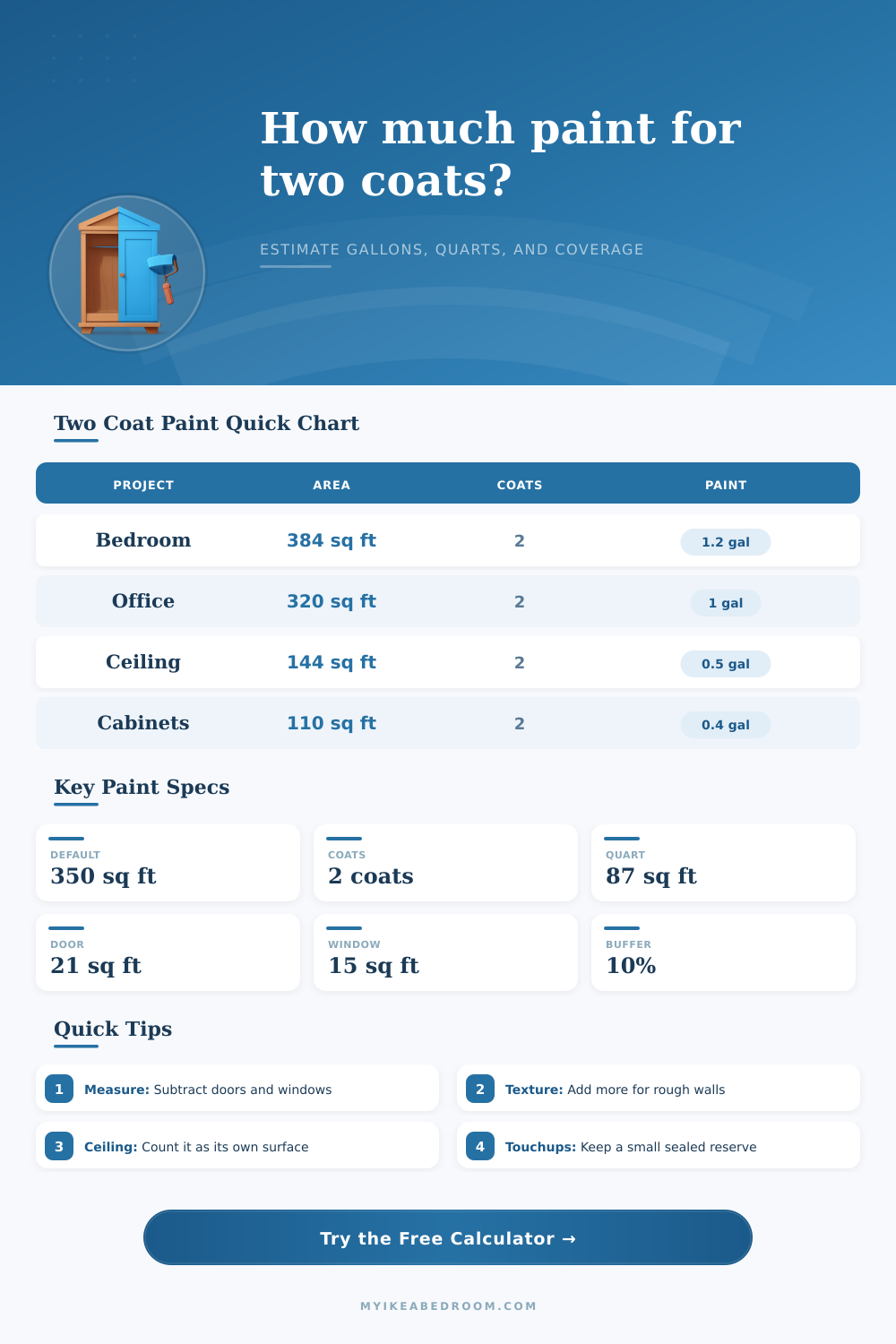
Door subtraction uses 21 sq ft per door and window subtraction uses 15 sq ft per window. Door painting adds both faces by default.
Paint Estimate
| Paint type | Typical coverage | Two-coat coverage per gallon | Best use |
|---|---|---|---|
| Standard interior latex | 350 sq ft/gal | 175 sq ft | Most walls |
| Premium wall paint | 400 sq ft/gal | 200 sq ft | Smooth bedrooms and offices |
| Flat ceiling paint | 325 sq ft/gal | 162 sq ft | Ceilings and low sheen areas |
| Semi-gloss trim enamel | 300 sq ft/gal | 150 sq ft | Doors, casing, baseboards |
| Primer or bonding coat | 275 sq ft/gal | One primer pass | New drywall, stains, raw wood |
| Item | Area used | Metric equivalent | How calculator uses it |
|---|---|---|---|
| Standard interior door opening | 21 sq ft | 1.95 sq m | Subtract from wall area |
| Painted door, both faces | 42 sq ft | 3.90 sq m | Add when door faces are painted |
| Average window opening | 15 sq ft | 1.39 sq m | Subtract from wall area |
| Baseboard, 3.5 inches wide | 0.29 sq ft per ft | 0.027 sq m per ft | Used for trim mode |
| Project | Dimensions | Approx wall area | Typical two-coat paint |
|---|---|---|---|
| Small bedroom | 10 ft x 12 ft x 8 ft | 352 sq ft | 1.1 to 1.3 gal |
| Bedroom | 12 ft x 14 ft x 8 ft | 416 sq ft | 1.3 to 1.6 gal |
| Living room | 15 ft x 20 ft x 9 ft | 630 sq ft | 2.0 to 2.4 gal |
| Home office | 10 ft x 10 ft x 8 ft | 320 sq ft | 1.0 to 1.2 gal |
| Single accent wall | 12 ft x 9 ft | 108 sq ft | 0.35 to 0.45 gal |
Exact Math
Uses measured net area, selected coats, coverage per gallon, and no reserve. Best for checking a known leftover amount.
Normal Room Plan
Uses two coats plus 10% reserve for roller loading, tray loss, and later touchups. Best for bedrooms and offices.
High-Demand Surface
Adds texture and porosity factors for new drywall, dark color changes, trim profiles, cabinets, and rougher walls.
I’m sure you’ve been there. You are standing at the paint store in front of wall of gallons, panicking! Do I really need this? What if it’s not enough? You’ve measured out your walls and calculated how much is needed minus windows. But let’s be honest, we don’t work in perfect geometry when doing home improvement jobs. Our walls aren’t flat surfaces. There is texture to them, they suck up moisture. Eventually, when you move all the furnitures back in, you’ll probably end up touching them up again.
This two coat paint calculator helps bridge the gap between what you think you need, vs. The real life of drywall. It lets you worry less about the math and more about picking the right color. It also makes you think about variables most people skip over until their roller runs empty.
Why Use This Paint Calculator?
Measuring the walls is a natural first step, so you’re right on track if that’s where you begin. But then what? That’s when most folks quit. Surface condition matter, a lot! Previously painted walls of comparable sheen will drink up far less paint then new drywall or plaster (think: sponge). The calculator accounts for these factors through texture and surface condition multipliers. In the interface, these tweaks appear slight. But they count. A lot. They can be the difference between a smooth application and one riddled with patches. Leaving yourself short halfway down the wall look bad. Failing to account for porosity is like rolling the dice on your own funds.
Two coats is a standard concept, but with good reason. Most people aim to save money by skipping that second pass. One heavy layer should of be all they need, they think. More often then not, that’s a bad idea. A first coat covers surface and seals it. A second layer gives the same amount of sheen throughout, plus an even color tone. The calculator takes into account that you’re doing it right, it multiplies your net paintable area by two and applies the coverage rate to that. It also accounts for adjustments for darker colors, which often need a third pass, or at least their own primer coat.
Here it matters what kind of paint you pick in the menu… Products vary widely in how far they go. Standard interior latex might cover three hundred and fifty square feet per gallon, but premium formulations can stretch further. A basic interior latex may only reach that. Knowing what you’ll purchase before you calculate helps ensure you don’t buy too little.
Another mistake people make? These are windows and doors. You can use the tool to remove those. If you’re just painting the walls, you don’t paint window frame. If you have a previously painted door, you don’t paint over it either. But if you’re going to repaint the door faces, you can add that space back into your total. Failing to account for openings means you’ll over-estimate a room treated as a single block. Failing to factor in trim work will under-estimate it. The pre-set buttons shows you what most rooms look like, a hallway, a typical bedroom, etc. It gives you a starting point before diving into your own custom measurements.
But what about primer? Oh yeah, primer is always an afterthought … until it’s needed. Are you painting over a dark color or patching holes in your wall? Use the two coat paint calculator to estimate your primer needs. Based off whether you want to spot prime (just target problem spots) or go all out, it’ll give you a sense of how much primer you’ll need. It splits things up so you’re only buying what you actualy need. No more wondering “Will one gallon be enough primer?” You know exactly what 20% of your walls look like.
The result is broken down into quarts and gallons. It is not a bare bones decimal, but something you can use as a realistic grocery list for your paint store run. Plus, there’s a reserve section for those inevitable touch ups. I’d say this is the most useful section of the estimate. Nothing beats having a sealed quart of matching paint for any future scuffs. Because when you buy just enough today, in six months you don’t want to have to go hunting for a discontinued color. The tool allows you to buy a little extra today (which is good for your peace of mind later) and turns what would be a guessing game into something you can plan.