Paint Sheen Coverage Difference Calculator
Compare flat, matte, eggshell, satin, semi-gloss, and gloss finishes by real coverage factor, coats, wall area, openings, surface condition, and application method.
Full Formula Breakdown
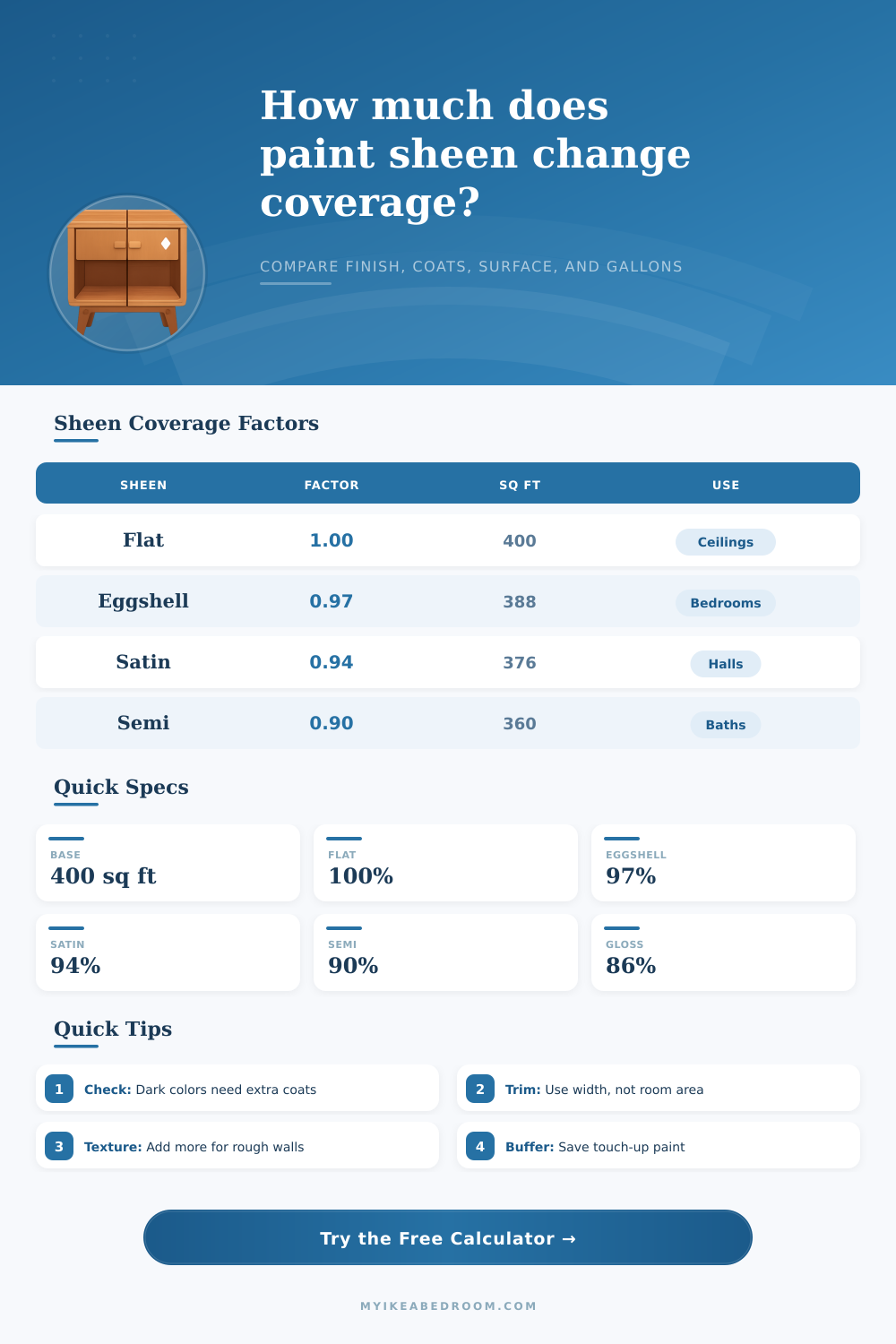
| Paint sheen | Coverage factor | Effective sq ft from 400 label | Typical bedroom use |
|---|---|---|---|
| Flat | 1.00 | 400 sq ft/gal | Ceilings and low-traffic walls |
| Matte | 0.98 | 392 sq ft/gal | Adult bedrooms, soft wall finish |
| Eggshell | 0.97 | 388 sq ft/gal | Bedroom walls and rental repaints |
| Satin | 0.94 | 376 sq ft/gal | Kids rooms, halls, wardrobes |
| Semi-gloss | 0.90 | 360 sq ft/gal | Doors, bath walls, baseboards |
| High-gloss | 0.86 | 344 sq ft/gal | Trim, doors, furniture accents |
| Cabinet enamel gloss | 0.84 | 336 sq ft/gal | Cabinet fronts and detailed panels |
| Surface condition | Coverage multiplier | Why it changes | Practical planning note |
|---|---|---|---|
| Smooth sealed repaint | 1.03 | Paint spreads easily over a sealed film | Often closest to label coverage |
| Average painted wall | 1.00 | Normal absorption and roller texture | Use as the default planning case |
| Patched wall | 0.94 | Joint compound and repairs drink paint | Spot prime before finish coats |
| New drywall | 0.82 | Paper and compound absorb heavily | Primer strongly affects final coverage |
| Textured wall | 0.80 | Peaks and valleys add surface area | Use thicker nap and larger buffer |
| Dark color change | 0.88 | Extra film is needed for hiding | Expect primer or an extra coat |
| Bare wood trim | 0.78 | End grain and sanding scratches absorb | Primer and sanding sealer help |
| Cabinet detail grooves | 0.74 | Edges, profiles, and brushing loss add up | Small projects can still need more paint |
| Container | Volume | Best for | Planning behavior |
|---|---|---|---|
| 1 pint | 0.125 gal | Samples, tiny repairs, trim touch-ups | Rounds up quickly for real projects |
| 1 quart | 0.25 gal | Doors, one accent wall, small furniture | Useful when gallons would leave too much |
| 1 gallon | 1.00 gal | Bedrooms, offices, most wall projects | Default for finish paint planning |
| 5 gallon pail | 5.00 gal | Large rooms, rentals, repeated color | Only sensible when total gallons are high |
| Comparison project | Paintable area | Sheen choice | Approx finish paint |
|---|---|---|---|
| 12 x 14 bedroom, 8 ft walls, 2 coats | 376 sq ft before openings | Eggshell | About 2.0 gal with buffer |
| 10 x 12 kids room, 8 ft walls, 2 coats | 352 sq ft before openings | Satin | About 2.1 gal with buffer |
| Single 12 x 8 accent wall, 3 coats | 96 sq ft | Matte deep color | About 0.9 gal with buffer |
| 180 ft baseboard, 5.5 in, two faces | 165 sq ft | High-gloss | About 1.1 gal with buffer |
| Textured hallway, 210 sq ft, 2 coats | 210 sq ft | Satin | About 1.5 gal with buffer |
If there’s one thing we all expect when we go to a paint store, it’s easy decisions. Instead, most people finds themselves confused (and maybe even anxious) about what to purchase. All they wanted was some white paint for their living room wall. But then they walked out with three cans, having been unable to decide whether to get an eggshell or flat finish.
The problem is these guys on the back of the can: “Coverage.” That number are optimistic. It takes into account perfect conditions, smooth walls, and a mistake-free painter. In real life, nothing like that exist. Sheen actualy does make a difference, contrary to what it might say on the can. For example, if you change from flat to semi-gloss, it will affects your coverage. It’ll change how much product you need.
Why Real Life Painting Is Harder Than The Can Says
Simply enter the size of your rooms and their surface condition into the calculator (above) and it crunches the numbers for you. It takes into account that matte paints is typically covered more per gallon than their higher-gloss cousins. No trick. Flat paints has more pigment per volume. This helps them cover more area then glossy paints. Glossy paints are shinier because they have less pigment and more binder.
You’ll end up using more paint then what’s labeled on the can. But the tool compensates if you swap out your old flat paint for something more durable (like satin) on your ceiling or your walls. So you don’t order a quart of the wrong stuff at 4:30pm on a Saturday afternoon.
Estimates assume perfect surface prep. In real life, no one has ever lived in a house where every surface was as perfect as the sample walls found at the paint store. Patches, cracks, and texture will all soak up paint. All those variables stack against each other, see the table on the page. So when you choose “textured wall” or “new drywall” from the inputs, we apply a multiplier based off experience. Paint applied over joint compound drinks it right out of the finish coat. Go ahead, test yourself… Try applying satin straight onto new drywall without priming first. You just bought yourself a rather pricey wallboard stain there, buddy.
It’s not that people don’t understand coverage in terms of square feet. They do. What they get confused about is that coverage is also relative to surface area and how porous it is. The other thing that most homeowners overlook: application method does play a role. You might think spraying it on is an efficient way to go. However, about half of your paint gets wasted because of over-spray. If you roll it on, there’s more paint in each “stipple.” This means there is more wet material being applied than if you were using a nice smooth brush stroke.
Enter the calculator which allows you to account for spraying vs. Rolling vs. Using a foam roller to do your trim. Each has a waste factor. If you’re dealing with something like cabinets with a shiny enamel finish, you really need to pay attention to the buffer percentage. Cabinet doors are complex shapes with lots of edge detail that absorbs paint when you’re trying to cut-in, so don’t treat cabinet painting as though it’s just like painting walls. It’s not like that; the area is small, but the detail in the work makes it take much longer.
Separate out Primer. You should treat primer like its own category within the budget. Topcoats behave one way, primer another. Primer must adhere and seal. It doesn’t have to deliver any final sheen or color. Because primer has a different purpose from finish paint, the calculator treats them separately in terms of volume. When you patch things or stain wood, it’s tempting to skip primer and use flat paint instead. But flat paint isn’t as good at sealing as a true primer.
For darker colors or for changing between wildly different colors, the hiding power will start to limit how many coats can be applied. To account for that, the calculator ups the estimated number of coats if you choose high-contrast situations.
Container planning is where theory meets the cash register. You may think you need 1.2 gallons of eggshell, for example. But most hardware stores don’t sell 0.2 of a gallon. Do you mix up a gallon and a quart? Or do you buy two gallons and save the remainder? Different container planning sizes is included with the tool to help you see what’s involved. Note that paint does lose its thickness as it sits unused. Years later an open can will have lost some of its “oomph”… Skin will form on top, or separate into something you can’t shake back together. You can reduce waste and clutter in your stash by purchasing just what you’ll use.
So what about sheen? It is a battle of beauty versus durability. Flat is forgiving, covers well, but also shows any dirt or staining. Gloss is beautiful but every little dent in the wall shows. Knowing this will help you determine how much to budget to cover things like this.
The calculator gives you a nice side by side look at how many gallons you need vs what containers to purchase. So there is no more guesswork. More like this: You wind up with a plan that honors both the math of it all AND the dirty truth behind painting. How do you run out of paint mid-way through the second coat?