Cord Trim Length for Cushion Calculator
Estimate piping, welt cord, braided trim, or decorative cording for pillows, box cushions, bench pads, round cushions, and bolsters with overlap, waste, repeat matching, and purchase rounding.
Load a real cushion scenario, then adjust the edge style, cushion count, seam overlap, waste, pattern repeat, and purchase unit.
| Placement | Formula | Use when | Watch point |
|---|---|---|---|
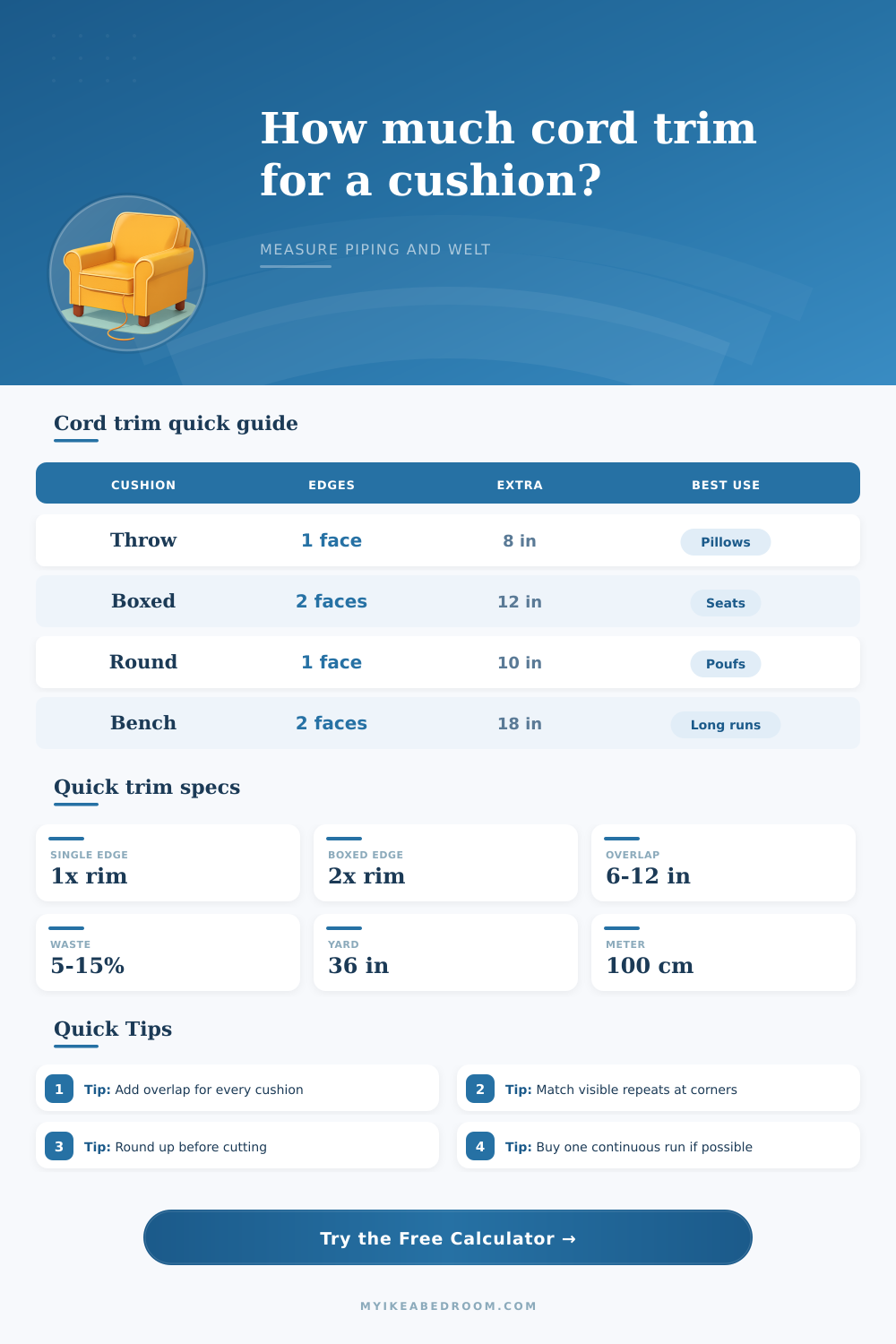
| Single front-face piping | 1 x finished perimeter | Throw pillows, flat chair pads, decorative seat cushions | Add overlap at one hidden edge or corner. |
| Top and bottom welt | 2 x finished perimeter | Box cushions with a boxing strip between panels | Count both top and lower seams, not the cushion thickness. |
| Top/bottom plus vertical corners | 2 x perimeter + 4 x thickness | Tailored cushions with corded vertical boxing corners | Vertical cords are short but easy to forget. |
| Bolster ends and body seam | 2 x circle + body length | Cylindrical bolsters with trimmed round ends | Use diameter for the circles and body length for the seam. |
| Custom measured trim path | Measured path x multiplier | Arches, scallops, shaped cushions, mixed edges | Trace the actual sewing line with a flexible tape. |
| Cushion size | Single edge | Boxed top + bottom | Typical project |
|---|---|---|---|
| 18 x 18 in square | 72 in / 2.0 yd | 144 in / 4.0 yd | Throw pillow or loose back cushion |
| 20 x 20 in square | 80 in / 2.22 yd | 160 in / 4.44 yd | Dining chair cushion |
| 24 x 24 in square | 96 in / 2.67 yd | 192 in / 5.33 yd | Deep lounge cushion |
| 48 x 18 in rectangle | 132 in / 3.67 yd | 264 in / 7.33 yd | Small bench or window pad |
| 72 x 18 in rectangle | 180 in / 5.0 yd | 360 in / 10.0 yd | Long bench cushion |
| 30 in round | 94.25 in / 2.62 yd | 188.5 in / 5.24 yd | Round floor cushion or pouf |
| Trim situation | Overlap | Waste | Why it matters |
|---|---|---|---|
| Straight solid-color cord | 4-6 in | 5% | Simple cuts, minimal matching, easy joining. |
| Standard cushion piping | 6-10 in | 10% | Allows for corner handling and a tucked join. |
| Thick rope or braid | 10-14 in | 15% | Bulky trim needs more working length at joins. |
| Patterned or striped trim | 8-12 in | 15-20% | Repeat matching can add length to each cushion. |
| Long bench cushion | 12-18 in | 10-15% | One continuous run is preferred where visible. |
| Purchase unit | Equivalent | Good for | Rounding advice |
|---|---|---|---|
| 1 foot | 12 in / 30.48 cm | Small repairs or short decorative tails | Useful for exact local cut counters. |
| 1 yard | 36 in / 91.44 cm | Most upholstery trim sold by the yard | Round up to the next whole yard. |
| 5-yard roll | 180 in / 4.57 m | Sets of dining pads or paired pillows | Choose when several cushions match. |
| 10-yard roll | 360 in / 9.14 m | Bench, sectional, or long window cushions | Often reduces visible batch changes. |
| 1 meter | 39.37 in / 100 cm | Metric suppliers and European trim | Round after waste, not before. |
Self-fabric welt
Best when the cord should blend into the cushion fabric. Add more waste if cutting bias strips.
Clean matchCotton piping
Flexible standard upholstery cord for pillows, seats, and slipcovers with normal overlap.
Easy sewingDecorative braid
Visible trim that often needs repeat or motif matching, especially at cushion fronts.
Match repeatsOutdoor piping
Stable acrylic or vinyl-friendly trim for patio pads where corner handling can be stiffer.
Add handlingMark each cushion separately. Even when cushions are identical, cut the first piece, test the corner turn and join, then repeat the confirmed length for the rest.
Hide the join with intent. Place piping joins at the back edge, lower corner, or zipper side when possible, and keep patterned trim facing the same direction on every cushion.
For example, if you sewed up a cushion only to discover that you were three inches short of piping around the last corner, it’s because you measured the finished cushion rather than the route the cord and fabric actualy take. That means you didn’t account for curve of corners. You also forgot about seam allowance and need an extra bit of tail to tuck under at each end.
The calculator figures out numbers for you, sparing you from having to decide whether to leave the join showing or start again from scratch. This knowledge mean that you’ll purchase proper length of cord. How do you know what’s correct? You’re purchasing the distance all the way around your cushion plus the overlap needed to ensure a clean finish at each end.
How to Calculate the Right Length of Cord for Your Cushion
Folks tend to think about the trim as if it lay perfectly flat to the edge. They fail to consider additional material needed to make a corner and avoid pucker. To compensate for this, the tool allow you to input an allowance for your chosen overlap. This closes gap between practical upholstery and geometry. It’s important if you want to make something professional looking like boxy seat for a dining chair or throw pillow.
Simple formulas lack complexity of pattern matching. Decorative braids, stripes on the cord: all of these require that you thinks about how the motif lines up at every corner when cutting fabric into straight lengths. Our calculator features a field for the number of visible repeat times so that the final length gets adjusted so motifs is lined up. No one wants a jarring look from having the seam cut right through a diamond motif simply because you could of saved two inches off the trim. When the repeat matches, it won’t matter if the cushion was made with slightly more material then the absolute minimum, it will look like an intentional design versus a hurried patch job.
The one where your intuition fails is part about waste allowance. I know: we imagine ourselves able to cut surgically. But corners don’t line up perfectly, cords stretches just a bit, fabric move. Adding some percentage as a waste lets you account for those real world variables. A simple cushion may only require an additional ten percent, whereas more complicated rounded edges or thick rope trim might calls for fifteen or even twenty. That’s a waste buffer. It is a little insurance policy in case of any small errors, which are mistakes that could ruin an otherwise perfect project. Remember: you can always bring back unused cord, but you can never sew air.
The way supplies are being sold out there matters too. For example, some items come only in long rolls; others by the meter and yet others by the yard. The calculator will round your estimate to whatever purchase unit you choose. For example, if you need 2 and a half yards but they don’t sell that exact length, total will be rounded. If you’re doing a project that requires continuous runs of fabric (window seat or bench cushion for instance), this can be super important to help keep your cost down. It also helps you plan ahead because you know immediately if you should buy in bulk. Nothing is cheaper then a seam running through the center of a long cushion or other item, and that’s why it’s always best to know at the beginning.
There’s also a touch of cord trim, which adds that special polished layer between something that looks like it came off the rack and something that was sewn by you at home. It also help ensure you’ve got right length. When you do, you can really concentrate on the stitchwork instead of wondering if your project will end up short before you’re done.
And then after you’ve cut out the right length, all that’s left is patience and steady hands. Then when you turn that last corner without a hitch, you’ll understand just how worthwhile every second spent doing the math was.