Window Bench Cushion Size Calculator
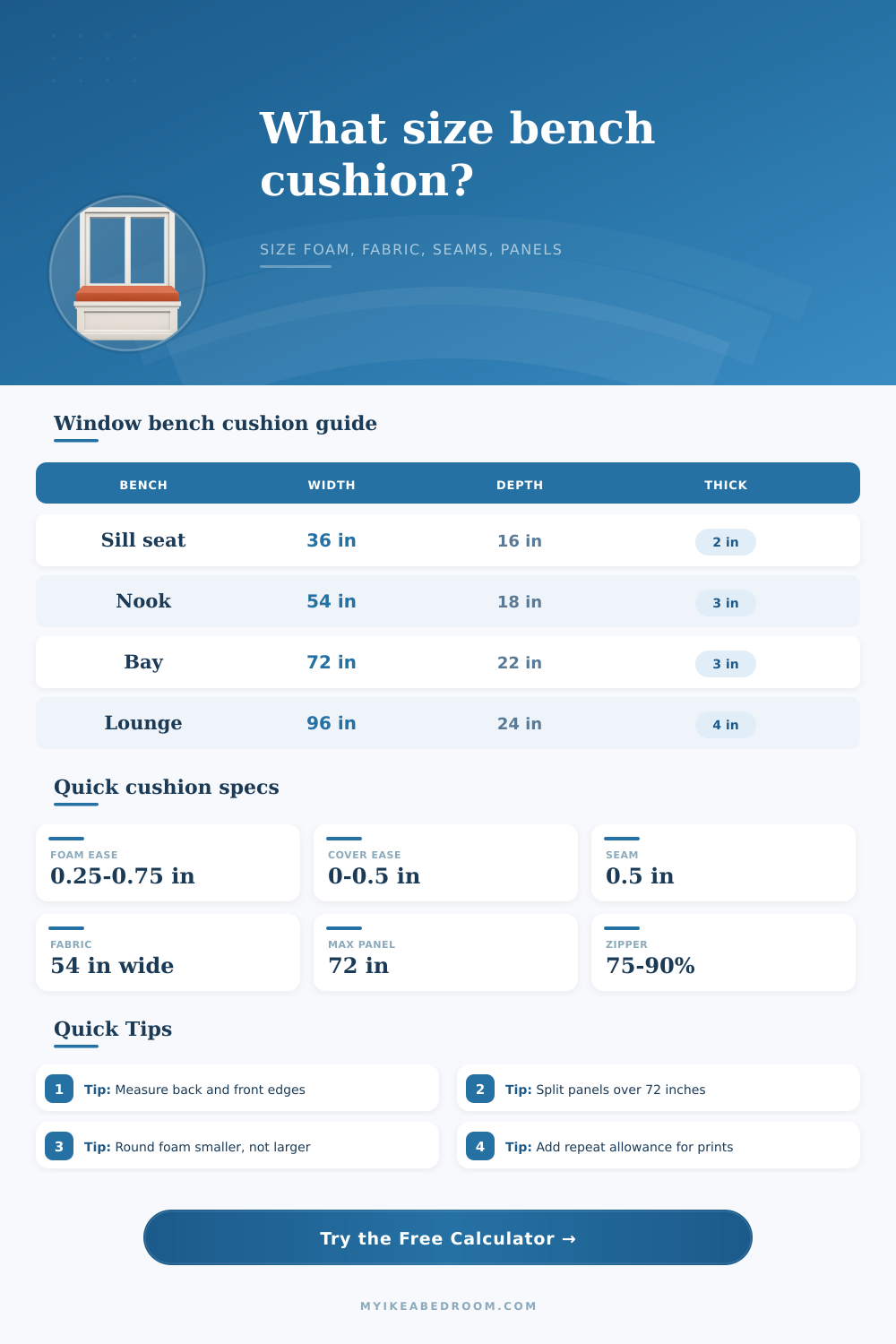
Plan a straight, bay, trapezoid, or split window bench cushion with finished cover dimensions, foam cut size, fabric yardage, boxing strip length, welt cord, zipper length, batting wrap, and panel recommendations.
Pick a common bench style, then adjust the exact front edge, back edge, depth, thickness, seam, easing, fabric, and split details from your own measurements.
Measure these before cutting foam
- Back width along the window wall, where the cushion touches trim or drywall.
- Front width at the visible bench edge; bay seats often differ from the back.
- Left and right depth to catch angled side walls or out-of-square cabinetry.
- Finished thickness after batting, cover fabric, and compression are considered.
- Panel breaks around lids, drawers, outlets, or removable storage sections.
| Cushion use | Typical thickness | Foam feel | When it works best |
|---|---|---|---|
| Decorative sill pad | 1.5 to 2 in | Medium or firm | Shallow ledges, short sitting time, low window trim. |
| Everyday bench | 3 in | Medium high-density | Bedroom, breakfast nook, or storage bench seating. |
| Reading nook | 4 in | Medium-soft wrapped | Deep benches where people lounge for longer periods. |
| Mudroom bench | 2 to 3 in | Firm or extra firm | Boot changes, short sitting, and heavy daily use. |
| Daybed style bench | 4 to 5 in | Layered foam | Wide platforms where the cushion acts more like a small mattress. |
| Cover style | Cover allowance | Foam reduction | Practical note |
|---|---|---|---|
| Tight boxed cover | 0 in | 0.25 to 0.5 in | Clean edges, best with firm foam and a long zipper. |
| Standard removable cover | 0.25 in | 0.5 in | Balanced fit for most window bench cushion projects. |
| Relaxed linen cover | 0.5 in | 0.25 to 0.5 in | Allows casual wrinkles and easier laundering. |
| Wrapped foam without boxing | 0.25 in | 0.5 to 0.75 in | Better for thin pads than thick bench cushions. |
| Outdoor-style firm cushion | 0 in | 0.25 in | Snug cover helps corners stay crisp under firm foam. |
| Fabric width | Best cushion width | Layout approach | Watch point |
|---|---|---|---|
| 45 in | Small pads under 36 in | Top and bottom may stack vertically. | Long benches often need seams. |
| 54 in | Most 18 to 24 in deep benches | Top, bottom, and boxing can fit efficiently. | Pattern matching may add yardage. |
| 60 in | Deep reading benches | Useful for wide depths and generous seam allowance. | Confirm usable width after selvage. |
| Railroaded fabric | Long single cushions | Pattern runs across width for fewer seams. | Check nap and directional designs. |
| Matched print | Bay or split panels | Add repeat allowance for aligned panels. | Buy extra if repeats are large. |
| Bench type | Front width | Depth | Suggested panels |
|---|---|---|---|
| Small bedroom sill | 36 to 48 in | 14 to 17 in | 1 slim pad |
| Kitchen nook bench | 54 to 72 in | 18 to 21 in | 1 boxed cushion |
| Bay window seat | 60 to 84 in | 20 to 24 in | 1 trapezoid or 3 panels |
| Storage bench run | 72 to 108 in | 18 to 22 in | 2 or 3 lift-off panels |
| Deep lounge platform | 78 to 120 in | 24 to 30 in | 2 large panels |
Best for: straight benches under about 72 inches.
Looks clean and continuous, but large covers are harder to wash and turn right side out.
Best for: storage benches and long window runs.
Panels are easier to remove, align with lids, and fit inside a home sewing setup.
Best for: angled window bays.
Uses different front and back widths so the cushion follows the bench shape.
Best for: shallow sill seats.
Uses less foam and fabric, but it feels less tailored than a boxed cushion.
Check the smallest opening. For bay windows, use the narrowest back width and shallowest side depth as the fit limit, then use cover ease for softness rather than forcing oversized foam into the bench pocket.
Plan splits around how the bench is used. Align cushion breaks with storage lids, cabinet doors, or window mullions. A slightly shorter panel that lifts easily is usually better than one impressive but awkward cushion.
When you begin designing your window bench (with fabric and measuring tape in hand), you presume there’s an easy match between those two items. There isnt. Most of your mistakes comes from failing to take into account how much bigger the finished size of your cushion should be than the physical size of the bench it goes on top of. It’s not as simple as length/width/depth. Fabric stretches. Foam compresses. Zippers requires room. Seams use up material. If you forget about them, you end up with a situation where the fit is either too tight to sew a cover or too loose to look good. The tool accounts for all this for you, no more guessing when you’re holding the scissors.
Thickness is the starting point for all later decisions. For instance, if it’s a shallow sill with room for you to rest your feet, then maybe go with a couple inches of foam. But if this is to be a lounge chair with a cushy seat, then four-inches becomes a more comfortabley option. Thick foam feels expensive. And thick foam requires additional structure. Without any side support. Or boxing strips as we call them, those sides will collapse inward. And that’s why the calculator prompt you for how many layers of batting and what type of foam.
How to Make Your Window Bench Fit Perfectly
If you have soft foam, it will squish down over time. In that case, you might want some extra quarter-inch of ease in the cover so that it doesn’t look deflated within a month of sitting on it. Firm foam hold its shape and can be fitted tightly, creating a tailored look instead of something that looks stuffed.
Seams are another consideration. Fifty-four inch width is standard for upholstery fabric, and that sounds sufficient…until it dawns on you that you may have an eighty-inch long bench cushion! There’s no way to cut one uninterrupted length of this top panel, as you will run short off fabric. The calculator helps figure out if you need to divide the cushion into several pieces (often good for other reasons). When splitting a long bench cushion, you can wash the pieces individually; this is easily done in your home washing machine. It also works well with built-in benches where storage lids come off. You can remove lid after lid without having to drag any foam over hard wood surfaces.
Now let’s talk about a bay window. In this case, instead of a rectangle, the seat are going to be a trapezoid. That means the back width differ from the front width. It’s very important to take accurate measurements of each edge. Don’t just measure the widest point in the back where the window is. If you assume the whole width has the same amount of space, the foam won’t fit in the corner by the window. The calculator lets you put in different measurements for the front and back, and it figures out the angled sides for you. It also factors in the fabric estimate because angled panels are harder to plan for than straight rectangles. You need additional yardage so the grain can line up correctly or else the cushion twists on the bench.
And then there’s the zipper and welt cord. I prefer my zipper to be slightly shorter than the back edge of my cushion, and welt cord is nice because it defines the edges in a professional way. But welt cord does add bulk which you don’t want if things are really tight fitting. So all these factors goes into the overall yardage estimation that the tool makes. And depending on what fabric you select, it will give you a buffer percent to include extra fabric needed for repeating patterns compared to a solid color. There is nothing worse than grabbing for the hem and realizing there are only two inches of fabric left!
Planning the cut doesn’t have to be your responsibility anymore, but measuring remains up to you. You want a bit less foam then cover,” he says of the dimensions, “just enough to slip into place and not fight with the fabric. That’s too easy (the cushion looks sloppy); too tight and you’ll rip out a seam attempting to force it in. The page has reference tables with these standard tolerances laid out so you can understand why even slight changes make a difference.
Looking down at the window bench from above, seeing only raw materials, was intimidating. But when I broke it down to dimensions of covers, foam, and lengths of trim, the intimidation went away. And the mystery was removed. The guess work is gone. This isn’t about creating a seat the size you wish you had. It’s about making a seat the size you actualy have. So measure twice, cut once and let the math do its thing.