Oval Tablecloth Size Calculator
Plan an oval tablecloth by tabletop length and width, desired drop, table height, finished cloth size, hem allowance, fabric width, shrinkage, pattern repeat, panel count, and cut yardage.
Start with a common oval table scenario, then adjust the exact measurements and fabric assumptions.
Balanced oval dining fit
Finished size: 96 x 66 inches before hems and shrinkage.
Real drop: 12 inches on both the long and short axes.
Fabric plan: 3 lengthwise panels from 54 inch fabric, about 6.1 yards total.
Cut note: Mark a centerline, quarter the oval, and keep seam joins parallel to the long axis.
| Oval table size | 8 inch drop | 12 inch drop | 18 inch drop |
|---|---|---|---|
| 54 x 36 in breakfast oval | 70 x 52 in | 78 x 60 in | 90 x 72 in |
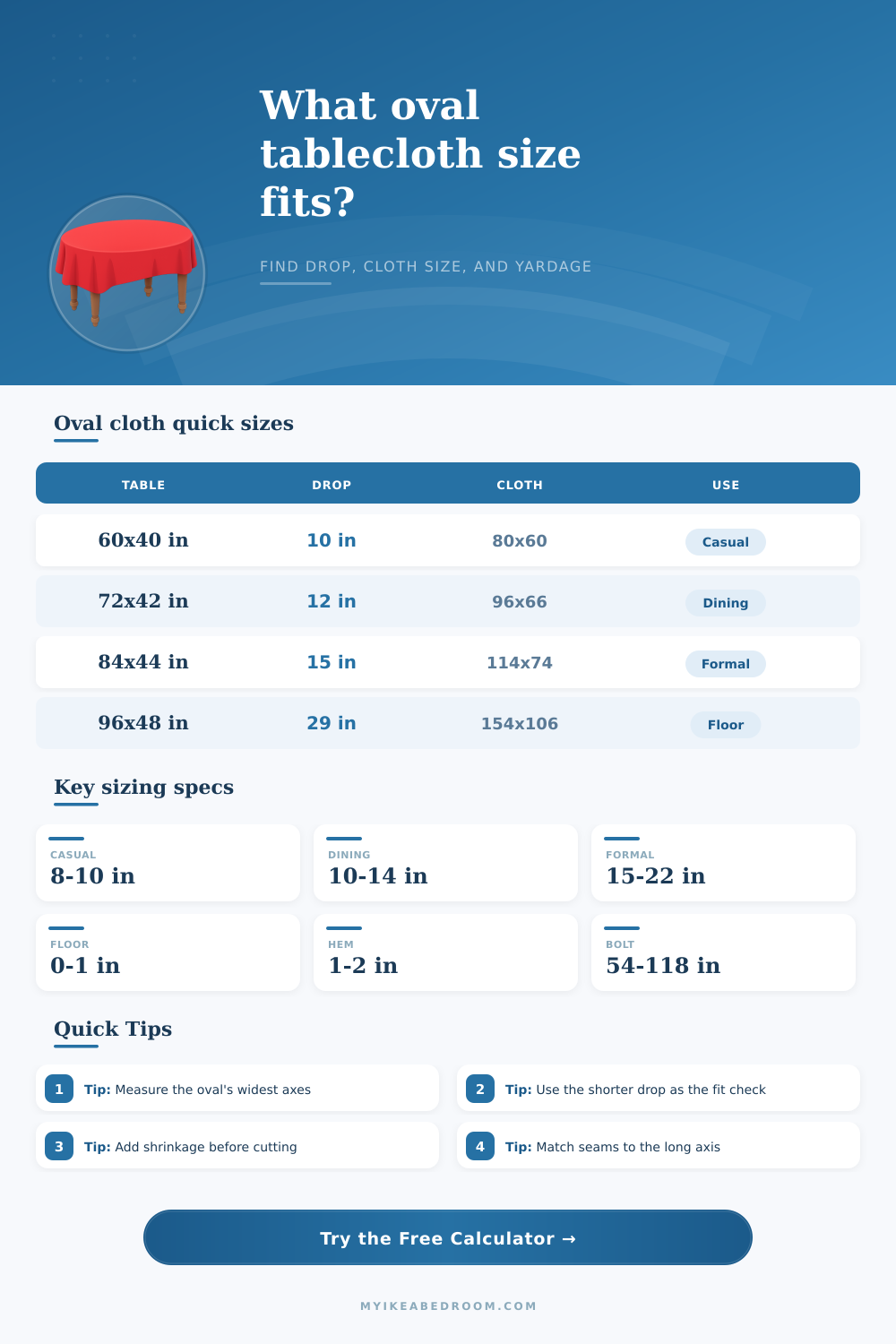
| 72 x 42 in six-seat oval | 88 x 58 in | 96 x 66 in | 108 x 78 in |
| 84 x 44 in extended oval | 100 x 60 in | 108 x 68 in | 120 x 80 in |
| 96 x 48 in eight-seat oval | 112 x 64 in | 120 x 72 in | 132 x 84 in |
| 108 x 54 in holiday oval | 124 x 70 in | 132 x 78 in | 144 x 90 in |
| Drop style | Typical range | Best use | Fit warning |
|---|---|---|---|
| Casual short | 6 to 10 in | Breakfast, kids table, washable cloths | Can show table legs and apron |
| Dining lap | 10 to 14 in | Everyday dining and most oval tables | Short axis should not be much shorter |
| Formal long | 15 to 22 in | Holiday meals and layered place settings | Check chair arms and guest knees |
| Near floor | Table height minus 0 to 1 in | Buffet, display, or event tables | Too long can puddle at the curved ends |
| Fabric width | Usual result | Good for | Panel note |
|---|---|---|---|
| 45 in apparel cotton | Often 2 to 4 panels | Small washable cloths | Visible seams are likely |
| 54 in decor fabric | Often 2 to 3 panels | Most dining ovals | Center the widest panel if possible |
| 60 in linen blend | Often 2 panels | Six-seat oval tables | Allows cleaner long-axis seaming |
| 90 in wide sheeting | Often 1 to 2 panels | Large casual cloths | May avoid side seams |
| 108 to 118 in banquet cloth | Often 1 panel | Formal and floor-length cloths | Best when the width covers the short axis |
| Scenario | Table axes | Suggested cloth | Planning note |
|---|---|---|---|
| Small apartment dining | 60 x 38 in | 80 x 58 in | About 10 inches of drop |
| Family six-seat oval | 72 x 42 in | 96 x 66 in | Balanced 12 inch drop |
| Extended leaf dinner | 84 x 44 in | 114 x 74 in | Formal 15 inch drop |
| Large holiday table | 108 x 54 in | 144 x 90 in | Generous 18 inch drop |
Buy standard oval
Fastest option when your table axes match a listed cloth closely.
Check both long and short drops, not only the longest side.
Fast fitTrim from rectangle
Works when fabric width is generous enough for the short oval axis.
Use the cut size output before rounding the corners into an oval.
FlexiblePiece panels
Useful for large formal cloths or narrow decor fabric bolts.
Keep seams symmetrical around the centerline for a cleaner drape.
Large sizesFloor length
Best for buffet and display use, especially when table legs should disappear.
Set a small floor gap so the curved ends do not drag.
FormalOval measuring tip: Measure the tabletop across the longest and widest points with leaves installed. Oval cloth sizing is based on those two axes, even though the edge itself is curved.
Fabric cutting tip: Cut the rectangle first, mark centerlines, then draw the oval from quarter marks. Add shrinkage and hems before shaping so the finished edge keeps the planned drop.
Interior designers can find themselves faced based off the tricky sizing problem that is posed by the oval dining table. Placing a rectangular piece of fabric on an oval table results in either a gap along one side or in the piece bunching up at each end. There’s nothing wrong with your style, the reason why is simply a matter of mathematics. When the edge of the table isn’t straight but curves around instead, there is no such thing as a “standard” square drop. And, since there are now two different axis to consider (which react differently under tension and gravity), this is no longer a straightforward equation.
When you enter your table’s custom dimensions, the calculator takes over and crunches all the math, no guesswork required for figuring out how curves affects fabric requirements. Knowing how to interpret those measurements will help you make a good buying decision, or know exactly how much fabric you’ll have to sew yourself. The length is the longest dimension of the table top. The width is the largest dimension at right angles to that length.
How to Choose Fabric for an Oval Table
Many people use these measurements accurately, then neglect to factor in the kind of drop they intend. A casual short drop of eight to ten inches keep things functional for daily meals without getting in the way of chair arms. For a more formal appearance, consider a longer drop of 15 inches (or longer) and be sure to double-check the table’s overall height relative to floor clearance. The calculator help you make sure your cloth doesn’t scrape on the rug.
Too many projects go wrong right at the start by selecting the wrong fabric width. Most home decor fabrics is available in 54 or 60-inch widths (standard). Do the math: add the length of your oval’s shortest axis to whatever you want the drop to be. Anything bigger than this and you’re into paneling. The calculator computes the number of panels needed and the overall yardage to piece them all together.
That’s important, since stitching adds weight and can change the way the fabric hang on those rounded off ends. For instance, matching the grain direction properly ensures the cloth falls nicely rather than twisting. Run a narrow width bolt along a wide piece like a big table? You may wind up showing some seam lines running through the middle of your place setting. That’s the thing most forget about til after hems is being sewn.
There’s one other variable that wrecks a lot of first efforts: shrinkage. Cotton and linen (natural fibers) shrink in the wash. The amount they shrink depends on type of weave and the water temperature, but plan on 3-5% shrinkage. Cut your fabric to final dimensions exactly, with no extra room for shrinkage, and there it is: the first time out of the wash, the ideal drop becomes smaller. To accommodate this, there’s a spot for percentage shrinkage on the tool. Pre-stretch your pattern pieces and save yourself from finding out too late that your tablecloth has shrunk to eight inches less then required.
Finally: Should you sew yourself? Or should you purchase a ready-made oval? If your table size is close to what’s available on the market, then the convenience of ready-made makes sense. But most ovals don’t align exactly with off-the-shelf lengths, or even widths if your table has an odd proportion (or if it’s got a unique leaf extension). Sewing lets you make the drop fit perfectly along both axes, while the reference tables in the tool gives you a quick benchmark for common scenarios so that you can determine for yourself whether you can buy, or need to customize.
All in all, though, try for a nice drape that matches the form but doesn’t battle it. Whether it’s for breakfast nook coverage or a holiday feast, proper length on those drops and axes matter. An oval table has a little something extra to think about compared to a straight rectangle. But with some calculations, that lovely fall is totally do-able. Just trust the math, not your gut instinct here.