Square Tablecloth Size Calculator
Size a square tablecloth from the tabletop side, drop style, table height, hem allowance, fabric shrinkage, fabric width, seam plan, and yardage before cutting or buying a cloth.
Choose a common square table plan, then adjust the drop, table height, hem, shrinkage, fabric width, and seam choices for your exact cloth.
Current cloth plan
Finished size: a centered square cloth adds the same drop on all four sides.
Cutting: cut larger than finished size to allow hems and shrinkage.
Yardage: if the cut square is wider than the fabric, the calculator estimates multiple panels.
Fit: the check compares edge drop with table height and chair seat height.
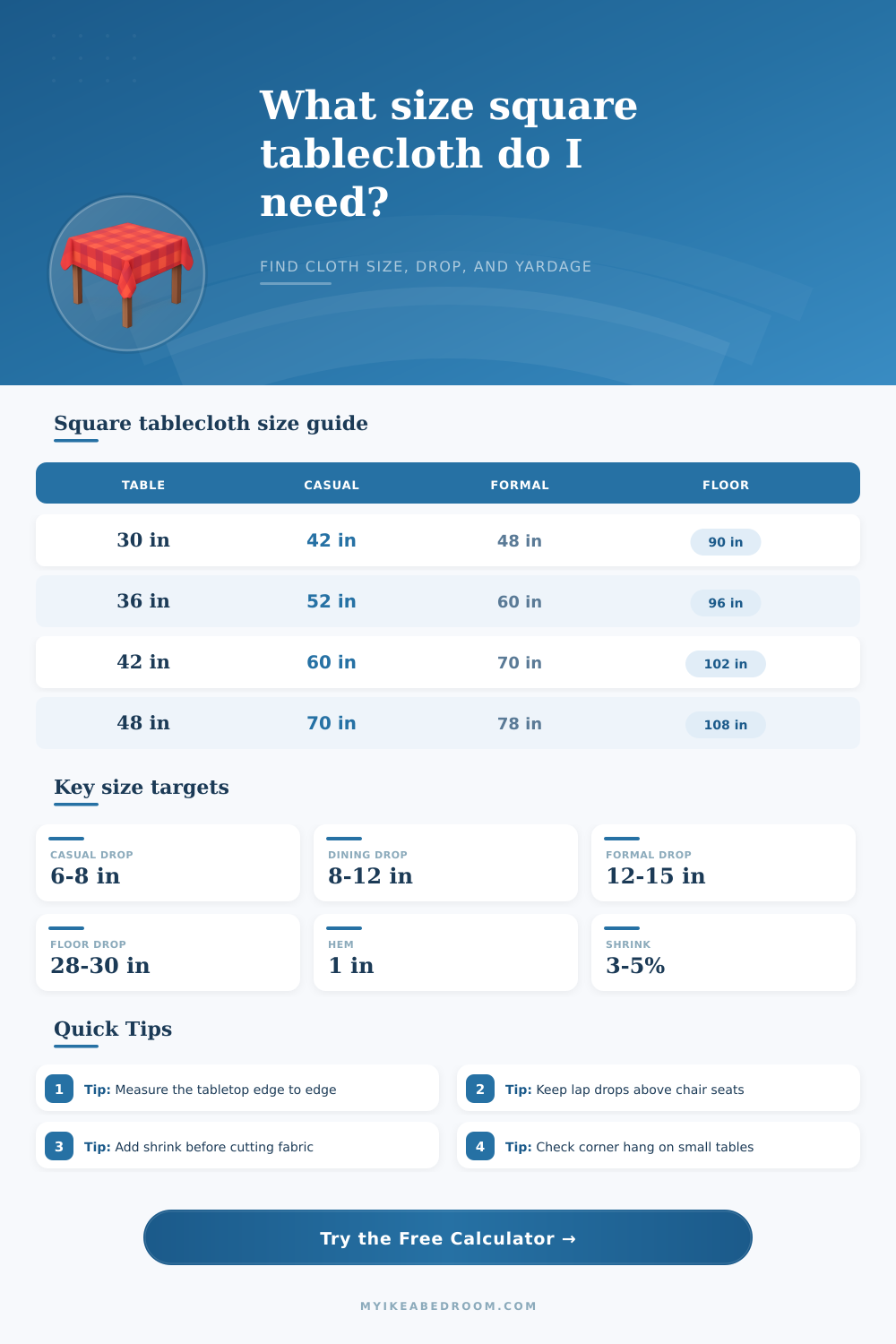
| Square table | Short 6 in drop | Dining 10 in drop | Formal 15 in drop | Floor drop at 30 in high |
|---|---|---|---|---|
| 24 in cafe table | 36 x 36 in | 44 x 44 in | 54 x 54 in | 84 x 84 in |
| 30 in bistro table | 42 x 42 in | 50 x 50 in | 60 x 60 in | 90 x 90 in |
| 34 in card table | 46 x 46 in | 54 x 54 in | 64 x 64 in | 94 x 94 in |
| 36 in breakfast table | 48 x 48 in | 56 x 56 in | 66 x 66 in | 96 x 96 in |
| 42 in compact dining | 54 x 54 in | 62 x 62 in | 72 x 72 in | 102 x 102 in |
| 48 in four-seat table | 60 x 60 in | 68 x 68 in | 78 x 78 in | 108 x 108 in |
| 54 in formal square | 66 x 66 in | 74 x 74 in | 84 x 84 in | 114 x 114 in |
| 60 in large square | 72 x 72 in | 80 x 80 in | 90 x 90 in | 120 x 120 in |
| Drop style | Typical edge drop | Best use | Chair note | Look |
|---|---|---|---|---|
| Short cafe | 6 to 8 in | Small cafe, kids, outdoor tables | Usually clears seats easily | Light and practical |
| Everyday dining | 8 to 12 in | Breakfast tables and family meals | Often best balance for laps | Finished but relaxed |
| Formal dining | 12 to 15 in | Holiday meals and dressed tables | Check low chair seats | Deeper, softer drape |
| Buffet display | 15 to 24 in | Side tables, dessert, display | May interfere with seated guests | Conceals table legs partly |
| Floor length | Table height minus clearance | Events, display, storage cover | Not ideal for seated dining | Full skirted effect |
| Usable fabric width | One-piece cut limit | Common cloth range | Panel approach | Seam planning note |
|---|---|---|---|---|
| 44 to 45 in fabric | Up to about 44 in cut | Small cafe cloths | 2 or 3 panels for dining sizes | Keep main seam away from table edge if possible |
| 54 in decorator fabric | Up to about 54 in cut | Card and small dining cloths | 2 panels for many 60 to 72 in cuts | Trim selvages before measuring usable width |
| 60 in fabric | Up to about 60 in cut | Breakfast and compact dining | 2 panels for larger formal drops | Useful for cotton, linen, and outdoor fabric |
| 90 in sheeting or wide fabric | Up to about 90 in cut | Large square and many floor cloths | Often one piece for standard dining | Check weave skew before cutting square |
| 108 in extra-wide fabric | Up to about 108 in cut | Large formal square cloths | One piece for many event sizes | Best when a seam-free top matters |
| Check | Formula | Comfort target | What it means | Adjustment |
|---|---|---|---|---|
| Edge above floor | Table height minus drop | 1 in or more for dining | Cloth will not drag on the floor | Reduce drop or raise table |
| Edge above seat | Table height minus drop minus seat height | 1 to 6 in for lap use | Enough room for knees and chair movement | Use a shorter drop for daily meals |
| Corner hang | Drop x 1.414 | Check small tables | Square corners visually hang farther than side edges | Round corners or shorten drop |
| Finished side | Table side plus two drops | Equal on all four sides | Centered cloth sits evenly around the table | Re-center before hemming |
Short cafe
Best for compact square tables, outdoor meals, kids tables, and places where chairs tuck in tightly.
6-8 inEveryday dining
A balanced lap drop for breakfast nooks, apartments, small dining rooms, and washable tablecloths.
8-12 inFormal drop
Deeper drape for dressed place settings, layered linens, and tablecloths that should feel generous.
12-15 inFloor length
Useful for event, buffet, display, and storage-cover tables where leg coverage matters more than lap room.
28-30 inCut after squaring: fabric can arrive slightly off grain, so square one corner before marking the final cut side. That keeps all four drops looking even.
Watch the corners: a square cloth corner travels diagonally from the table corner, so it looks longer than the side drop. Use shorter drops on very small tables.
If you’ve ever bought a table cloth that doesn’t fit well on your table, you know what I mean: You panic. Your dining surface isn’t covered by the table cloth. It look bad. It looks unfinished. Many people has had this experience at least once. And it has nothing to do with their vision.
A square doesn’t look the way your eyes expect it to. Add hems and the fact that fabric drapes diagonally, and it gets even trickier. Reverse engineering is necessary before you pick up a pair of scissors. On paper this seems like such an easy equation. Tabletop length + (2 x drop) = desired cloth length.
How to Measure Your Table Cloth
So if your table is 42 inches long and you want a ten inch drop, you just multiply by two and you come up with a sixty-two inch cloth. But wait! That figure doesn’t account for the hem allowance you’ll require when sewing. It doesn’t factor in how much your chosen material will shrink after its initial wash. Linen? Cotton? Yes please, those things happen.
And then there’s the issue of available bolt widths at the fabric store. Often the widest a fabric store sells is 54″ wide. How in the world will I get a sixty-six inch square out of that bolt? I can’t! I’m going to need to panel it. Paneling means using multiple pieces of fabric instead of just one giant piece. This is where many people trip up, not realizing they’ll be purchasing two individual pieces instead of one big sheet.
The correct drop length make all the difference. In a bustling café with a tight arrangement of tables (and tightly tucked-in chairs), a six inch drop is fine for the bistro table. It’s neat and functional. But at an upholstered dining room table, it will send your guests into a tizzy when they try to stand up (the hem will get caught on their knee). Eight to twelve inch drops hits the sweet spot. They cover the back of the chairs enough so that they don’t seem incomplete, yet allow plenty of space for people to move around. For a more formal setting, fifteen inches or longer will have the effect of softening the drape to hide the table structure. The key is knowing what kind of length you desire, rather than how to calculate it.
And then there are the corners. Where both long edges of a rectangle drop uniformly. When you draw a square, the drop of the straight edge is much shorter then the diagonal length from the corner of the table to the corner of the cloth. This is a geometric truth. When somebody pulls out a chair, the corner will dangle lower and swing farther outward. And if your cloth hangs very low on a small folding card table, it can be a problem because the corners hits your shins and drag on the floor. It looks great in pictures. That lasts until you try sitting down to eat at it. To adjust for this, you accept a little less depth at each end, which keeps the corners behaving.
The other thing that determines how you will cut is what kind of fabric it’s made off: natural fibers shrink; synthetics don’t. If you’re buying linen for a summertime breakfast table, account for shrinkage when marking your cut line (i.e., add a bit more). Otherwise, after laundering, your final hem creeps up onto your soup bowl. To deal with these variables, the tool asks for an estimate of shrinkage. And it takes into consideration actual usable width of your bolt of fabric.
After having the selvages trimmed off, standard decorator fabrics measures around fifty-four inches in width. Wanting your finished cloth to be wider than that? You’ll need a seam. The calculator tells you roughly how many panels you might expect and estimates your overall yardage accordingly. You will no longer buy too little material and have to make another run to the store with half-sewn seams sticking out of your bag.
And finally, consider clearance. How tall are your chairs? How high is the table? What’s the drop of the table? Subtract that drop from the table height to see where the cloth edge lands relative to the floor. That leaves plenty of clearance for both knees and feet. To eat comfortabley around the table day after day, we need a clear path up and over the seat.
From there, it’s just math. If you don’t want to type in your own dimensions each time, use the table on the page as a starting point. It spells out typical dimensions so you’ll have a sense of what works for tables set up in standard ways. Ultimately, a good fit isn’t just about covering something. It creates a frame for the meal and sets the stage for the event, all while leaving the people eating undisturbed. The goal is to be invisible: it should look generous, but without any laps.