Table Skirt Length Calculator
Estimate skirt drop, gathered linear length, cut height, fabric yardage, panel count, seam count, and attachment clips for rectangular, square, round, and oval tables.
Load a common table skirt setup, then adjust the table dimensions, drop, fullness, hem, fabric width, and closure overlap.
Tailored Flat
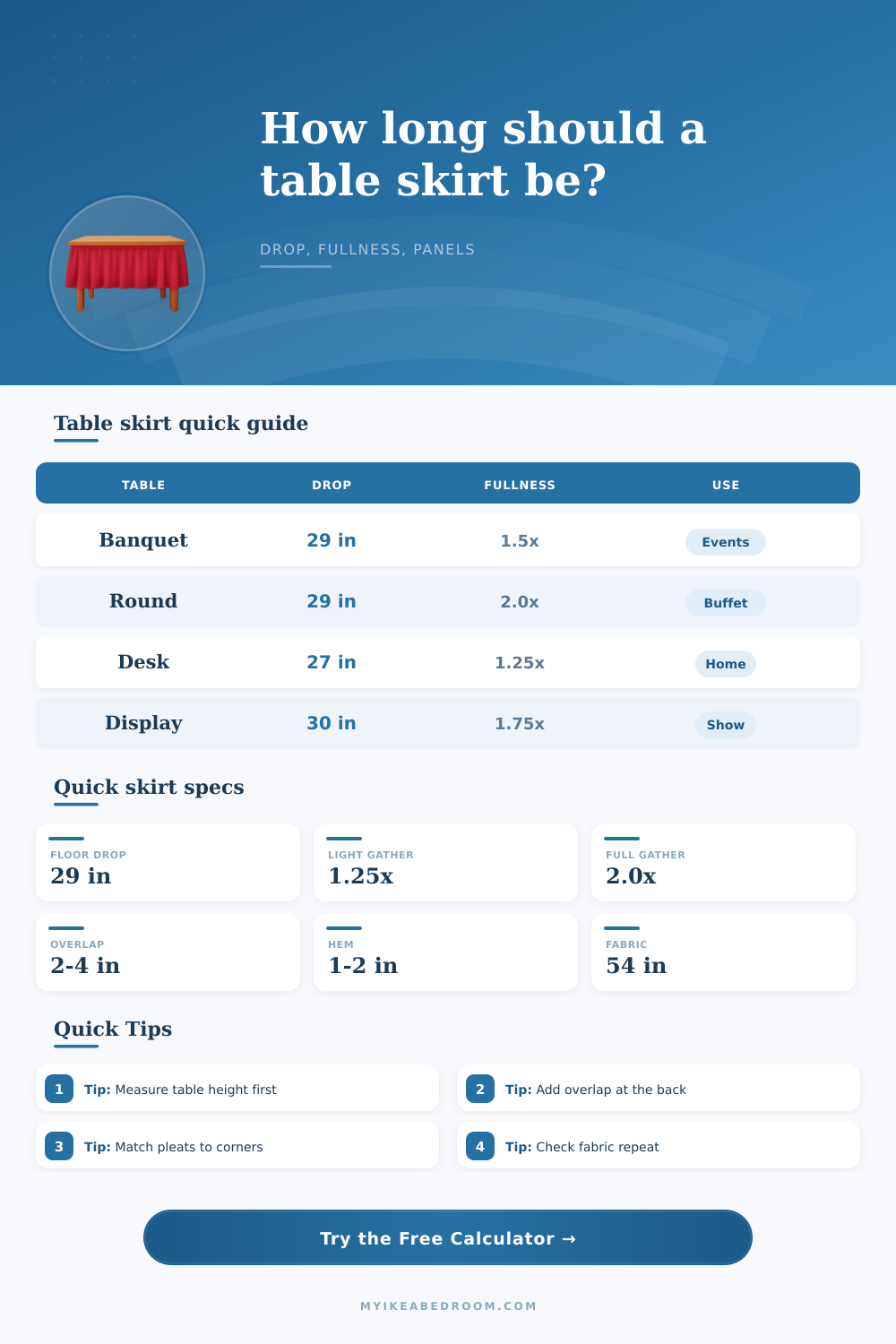
Best for desks, consoles, and clean modern covers. Use about 1.05x fullness with careful corner alignment.
Light Gather
Good for washable cottons and casual storage tables. Use about 1.25x fullness for a soft but not bulky edge.
Box Pleat
Common for banquet and display tables. Use about 1.50x fullness and place pleats at corners or table legs.
Full Gather
Best for lightweight fabric and round tables. Use 2.00x fullness, then check that the header is not too thick.
| Table or use | Typical table height | Skirt drop target | Practical note |
|---|---|---|---|
| Dining or banquet table | 29 to 30 in | 28 to 29 in | Leaves 1 in clearance for a floor-length look. |
| Trade show display | 29 to 30 in | 29 to 30 in | Often touches or nearly touches the floor to hide storage. |
| Home desk skirt | 28 to 30 in | 24 to 27 in | Shorter drop keeps chair movement easier. |
| Cocktail table | 40 to 42 in | 39 to 41 in | Needs longer panels; confirm fabric width before cutting. |
| Console table | 30 to 34 in | 24 to 32 in | Flat or light gather usually looks neater. |
| Skirt style | Multiplier | Visual density | Best fabric behavior |
|---|---|---|---|
| Flat tailored panel | 1.05x | Very low fullness | Works with canvas, linen blends, and crisp cotton. |
| Light gathered skirt | 1.25x | Soft minimal folds | Works with cotton, broadcloth, and lightweight blends. |
| Box pleated skirt | 1.50x | Structured folds | Works with polyester twill, poplin, and decorator fabric. |
| Soft pleated skirt | 1.75x | Richer movement | Works with lighter fabric that presses cleanly. |
| Full gathered skirt | 2.00x | High fullness | Works with voile, light cotton, and thin polyester. |
| Table size | Full perimeter | 3-sided skirt | Front-only skirt |
|---|---|---|---|
| 4 ft x 24 in table | 144 in | 96 in | 48 in |
| 6 ft x 30 in table | 204 in | 132 in | 72 in |
| 8 ft x 30 in table | 252 in | 156 in | 96 in |
| 48 in round table | 151 in | 151 in | 75 in arc |
| 60 in round table | 188 in | 188 in | 94 in arc |
| Fabric width | Useful for skirt cut height | Cutting direction | Planning note |
|---|---|---|---|
| 44 to 45 in | Up to about 38 in | Crosswise panel | Enough for most dining tables, not tall cocktail tables. |
| 54 in decorator | Up to about 47 in | Crosswise panel | Often covers floor-length banquet and cocktail skirts. |
| 60 in fabric | Up to about 53 in | Crosswise panel | Helpful for deep hems, repeats, or taller tables. |
| 90 to 120 in sheeting | Large custom panels | Either direction | Can reduce seams when the grain and pattern allow it. |
Measure the attachment line, not the tabletop label. A clip-on skirt follows the actual outside edge, including rounded corners, trim, or table pads.
Keep the drop slightly above the floor for daily use. A 1 in clearance prevents dragging while still hiding legs, storage bins, and uneven table bases.
For pleats, mark corners before distributing fullness. The calculator gives length, but corner placement decides whether a pleated skirt looks intentional.
Pattern repeats add up panel by panel. If the fabric has a large motif or stripe, add repeat allowance before rounding yardage.
For example, if you’ve tried to add a fabric skirt to a table, only to find that your desk chair can’t be moved without getting snagged underneath, then you have an odd dilemma: Style plus modesty minus good planning equals a tripping hazard (that must be navigated with great care to even get back up!). It’s a tiny detail but a factor of everyday use. And as with most things, knowing the true attachment line makes the difference between a planned design with maybe even a little extra room and a skirt that drags. Typicaly we all measure where our coffee mugs sits, at the top-most edge. But many times this is not accurate.
A clip-on skirt will follow the real-life outermost perimeter, including any rounded edges or heavy trim which extends fabric outward. Enter your table measurements into the calculator above. It will do the math for you so you don’t have to guess how to turn linear yardage into perimeter.
How to Measure Your Table Correctly
Next, understand fullness. How much fabric? But what kind of fold? Do you want something with a crisp 1.05 look on a console table or in your home office where clean lines is important and the fabric needs to lie flat against the legs without bunching up? Or do you like a more dramatic fold that’s perfect on a buffet station or event table (think 2.0 times the perimeter)? With all that extra volume though it needs special attention at install time. That’s where the tool comes in. Adjust the multiplier to show you what it will look like with different amounts of volume, and how much extra fabric it will take. So that design choice becomes a real purchase decision.
Hiding in the seams are other allowances you’ll want to take into account too. It’s easy to assume that adding two inches for a hem is no big deal. But remember, you’re not just adding inches for the hem. There’s also the top attachment allowance (for a casing or hook tape) and the side seam allowance where the panels meets. When you consider all of that, the inches can really start to add up fast!
If you’re using a standard 54-inch wide bolt of fabric, chances are good it will cover height of most dining tables in one panel (meaning less seams and a cleaner look). But keep in mind that if you’ve got a table that’s especially tall or you’re trying to match a large pattern repeat, you’ll want to take that added width into account before cutting. To make this a bit more practical, I created a reference table on the page that shows how width of fabric constrains height of your cut, keeping projects from being an expensive mistake.
Another factor which distinguishes pros’ work from amateurs’ is floor clearance. You want roughly an inch of space between the skirt and floor. That way it won’t get snagged on bumps or drag across messes. It will also provide some room if tables is not quite level. For a trade show display, maybe you’d want no clearance so the skirt hides storage bins. But then expect even more wear & tear. That is totally up to how you use it, whether the table stays still or moves all the time.
With this metric in mind you take the guess work out of purchasing fabric. No more “will this be 3 yards?”. You know exactly how many panels you need so you can plan your seams to meet up at legs or corners. It’s nice to see something take shape when math has you covered. Grab your tape measure. Locate that true outside edge. Let the numbers lead the way.
Right length isn’t just for covering those legs. It’s for breathing room all around them.