Rug Under King Bed Size Calculator
Compare rug sizes under a king bed by side reveal, foot reveal, nightstand span, bench clearance, room walkway, rug pad trim, and door or drawer clearance.
Start with a real king-bed layout, then adjust the bed frame, rug, room, nightstands, and foot-of-bed furniture.
Current layout readout
A 9 x 12 rug is a common full-width choice for many king beds.
Side reveal is checked against the bed frame and, when selected, the nightstand span.
Foot reveal is checked against benches, trunks, and walkway clearance.
Room clearance catches cases where the rug fits the bed but crowds the walls.
These cards update from your bed, room, nightstand, and bench measurements so you can compare the usual king-bed rug sizes quickly.
| Rug size | Best under-bed use | King side reveal | Watch point |
|---|---|---|---|
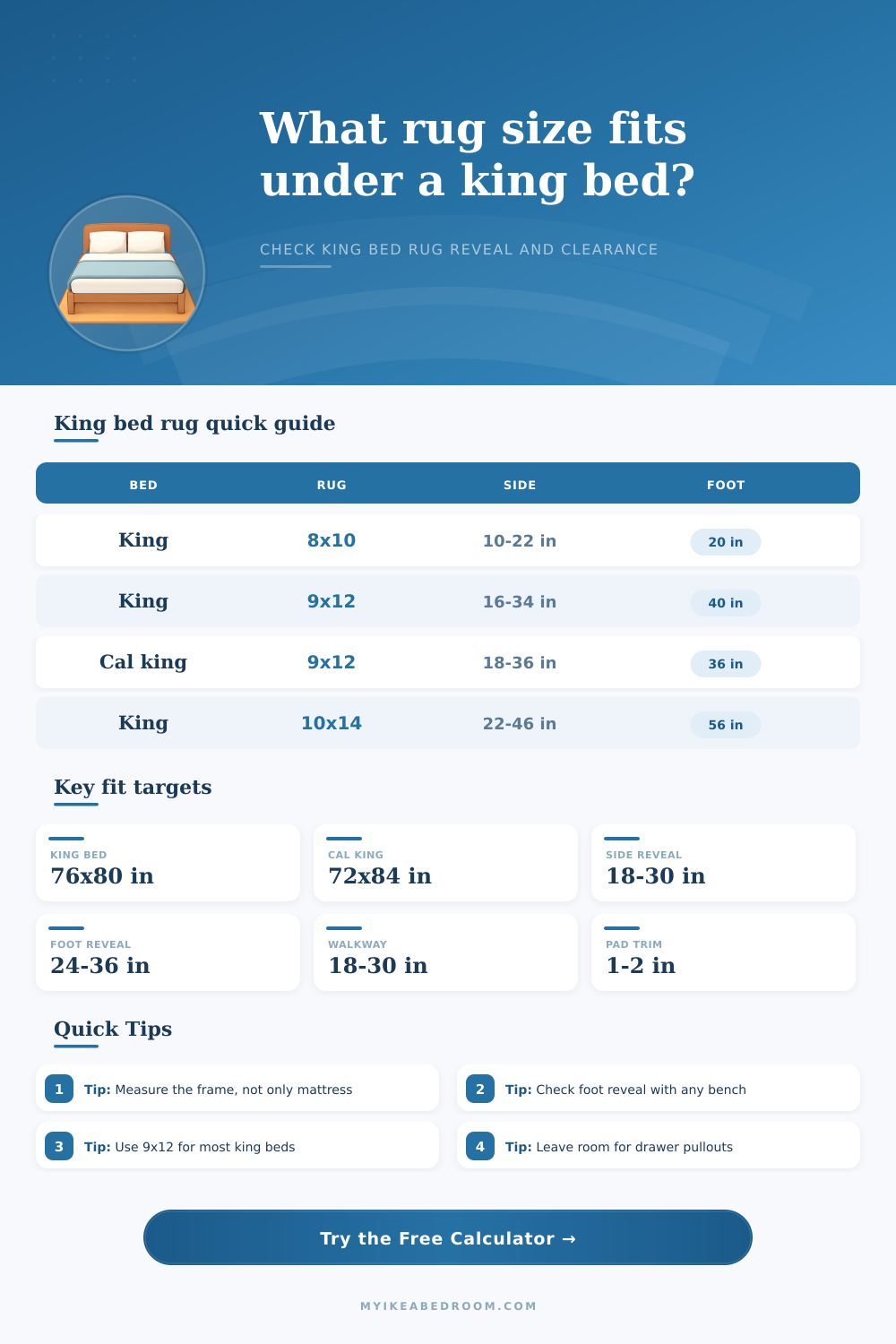
| 8 × 10 ft | Lower two-thirds of bed, smaller rooms | About 8 to 22 in depending on frame | Usually does not include nightstands |
| 9 × 12 ft | Most king rooms and full-width bed layouts | About 14 to 26 in depending on frame | Confirm foot reveal if using a bench |
| 10 × 14 ft | Large king rooms, nightstand visual span | About 20 to 32 in depending on frame | Needs enough side walkway |
| 12 × 15 ft | Oversized suites and very wide bed walls | About 32 to 44 in depending on frame | Can crowd doors in medium rooms |
| Bed type | Mattress size | Typical frame allowance | Use in calculator |
|---|---|---|---|
| Standard king | 76 × 80 in | Add 2 to 8 in total width | Measure frame width and length |
| California king | 72 × 84 in | Narrower but longer than king | Check foot reveal carefully |
| Split king | 76 × 80 in combined | Similar to standard king | Include adjustable-base overhang |
| European king | 180 × 200 cm | Often near 74 × 82 in framed | Metric mode keeps inputs natural |
| Placement | Rug start | Typical reveal target | Works best for |
|---|---|---|---|
| Lower two-thirds | 6 to 18 in behind mattress top | 18 to 30 in sides, 24 to 40 in foot | 8 x 10 or 9 x 12 rugs |
| Under nightstands | Near headboard and nightstands | Rug spans bed plus nightstand width | 10 x 14 rugs or wide rooms |
| Full bed on rug | At or behind headboard | Even reveal around bed frame | Large suites, low-profile beds |
| Foot-only | Starts near lower third of bed | Strong foot reveal, modest side reveal | Benches and narrow bedrooms |
| Check | Comfortable target | Tight but usable | Calculator flag |
|---|---|---|---|
| Side reveal beyond bed | 18 to 30 in per side | 10 to 17 in per side | Low side reveal |
| Foot reveal beyond bed | 24 to 40 in beyond foot | 16 to 23 in beyond foot | Short foot reveal |
| Room walkway beside rug | 24 to 36 in to wall or dresser | 18 to 23 in | Room crowding |
| Pile plus pad under doors | At least 0.125 in below gap | Nearly equal to gap | Door or drawer rub |
Bed-frame tip: A king mattress is usually 76 inches wide, but the rug cares about the visible frame. Measure the widest rail, platform, or upholstered edge before judging side reveal.
Room-clearance tip: A rug can look right under the bed and still fail the room. Check side walkway, dresser drawer swing, bench depth, and the nearest door gap before choosing the larger size.
When you’re purchasing a rug for your king bed, it’s not as simple as choosing a pattern; it’s a space puzzle. There is the mattress: A rectangle made of springs or foam. Then there is the frame which is often forgotten when measuring but adds inches of upholstery or wood. That additional width make a big difference. The rug will appear to small if it’s purchased solely with the mattress size in mind.
The math was actualy slightly off to begin with. All of that is handled for you by this tool (above) when you put in your own measurements, no need to guess at proportions or clearance space. And it doesn’t stop with width. The tool take into account if your foot is on the rug, if your nightstand are next to the rug or on top of it, and if there’s a bench at the foot of the bed that requires walking around.
How to Choose the Right Rug Size for Your King Bed
This is important because a well-balanced layout feel planned, whereas a cramped layout feels like an accident. For example: A 9×12 rug is most commonly used for a king bed. That’s a pretty standard size and should fits nicely underneath about the bottom two thirds of the bed. But “fits” is relative. Should it also go all the way to the end of the nightstands? Or should it pull up a few inches shy? Pulling out will give a more unified look, tying the furnitures together; whereas pulling up leaves the individual pieces separate (which is nice when your room doesn’t have much wall space).
By using the calculator, you can see precisely how many inches of reveal you’ll achieve with either option, allowing you to make an informed decision based off your specific room dimensions, not general tips. And don’t forget: the foot of the bed is where layouts can go wrong. What’s in front? Do you have a trunk, storage bench, etc.? That piece of furniture has to shares somewhere, too. No need to crowd things with a rug that fits the whole bed…but doesn’t leave any place for the bench. These are tripping hazards.
Instead, you want to see some floor, anywhere from 24-30 inches past the footboard if there’s nothing there. And if you’ve got a bench, make sure the rug either tucks neatly underneath (no bunching!)…or clear it by a few inches. This tool takes into account the depth of your bench…and shows whether or not the size rug you’re considering provide enough room for walking around that piece of furniture at the foot.
Another thing that ruins the design is width. Maybe you’ve found the perfect rug to go on the bed. It might look perfect with a luxurius 24-inch side reveal… But then you remember that your room is just 13 feet across. The same rug that looks great on the bed now would be almost touching the walls/dresser at less than eight inches from either side. Yikes! It will make the space feel even tighter and increase the chance you’ll scuff something opening dresser drawers.
Always consider the bed coverage AND the perimeter clearance. The balance between more vs less rug is covered in the tool’s reference tables so you can get the best of both worlds given your floor plan. Last but certainly not least: Measure the frame, not the mattress. A typical king-size mattress is 76 inches across. You are adding four inches of rail on each side. You’re up to an 84-inch footprint.
Which means the difference between seeing plenty of extra carpet around your bed, or having your rug appear glued to the bottoms of its leg. It is a little detail, yes. But it is one that makes all the differance. Get out your measuring tape, enter your numbers into the calculator, and end up with something more grounded than guesstimated. The perfect rug doesn’t compete for attention; it brings everything together.