Ottoman as Coffee Table Size Calculator
Size an ottoman that works as a coffee table by balancing sofa proportion, table height, leg reach, tray space, room depth, and walking clearance.
Start with a real seating layout, then adjust the dimensions to match your sofa, room, and tray needs.
How the calculator sizes the ottoman
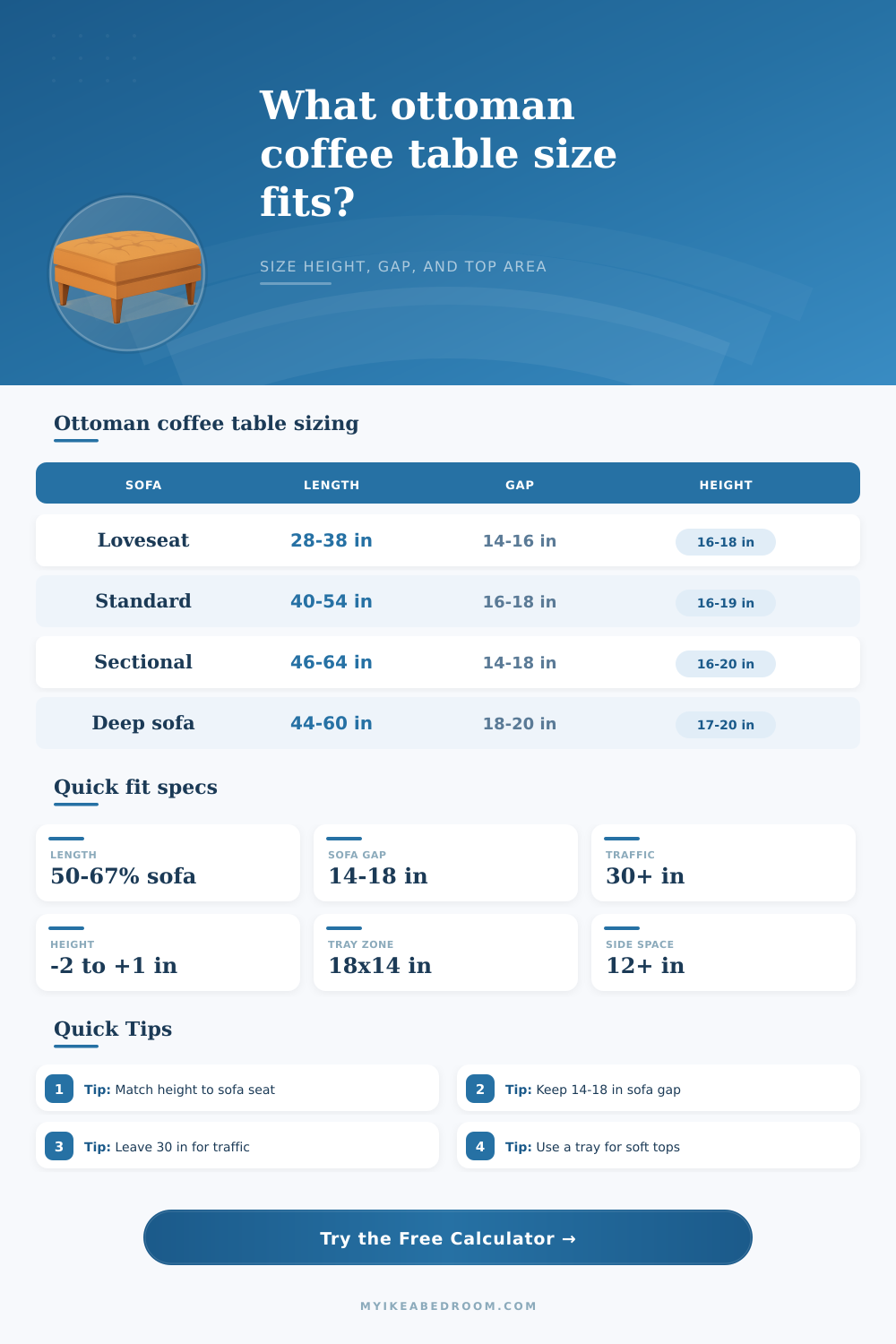
The length starts as a percentage of the sofa, usually 50 to 67 percent, then gets limited by side clearance.
The depth is checked against sofa gap, desired traffic path, tray depth, top firmness, and the room depth available in front of the sofa.
The height target is based on the sofa seat height. For an ottoman coffee table, close to seat height is better than standard dining-table height.
| Sofa type | Sofa length | Ottoman length target | Best shape | Notes |
|---|---|---|---|---|
| Apartment loveseat | 60 to 72 in | 30 to 42 in | Rectangular or round | Keep side clearance generous so the room does not pinch. |
| Standard sofa | 78 to 90 in | 42 to 56 in | Rectangular | A 48 inch ottoman often balances an 84 inch sofa well. |
| Deep lounge sofa | 84 to 96 in | 46 to 60 in | Large rectangular | Use a slightly deeper ottoman when the sofa seat is very deep. |
| Chaise sectional | 90 to 120 in | 48 to 64 in | Rectangular or square | Center the ottoman on the open seating zone, not the full sectional width. |
| U sectional | 110 to 140 in | 54 to 72 in | Square | Oversized square tops serve more seats, but watch inner walkway space. |
| Use case | Height vs sofa seat | Sofa gap | Traffic path | Why it works |
|---|---|---|---|---|
| Footrest first | 1 to 2 in lower | 14 to 16 in | 28 to 32 in | Lower height keeps ankles comfortable and avoids raised knees. |
| Balanced table | Same to 1 in lower | 15 to 18 in | 30 to 36 in | Works for trays, books, feet, and daily sofa reach. |
| Tray first | Same to 1 in higher | 16 to 18 in | 30 to 36 in | Slightly taller tops make drinks and remotes easier to reach. |
| Storage lift top | Same to 2 in higher | 16 to 20 in | 32 to 38 in | Extra room helps lids open without hitting knees. |
| Kids room | 1 to 3 in lower | 14 to 18 in | 30 to 36 in | Lower, soft, rounded forms reduce hard table edges. |
| Shape | Best room | Reach pattern | Tray fit | Clearance behavior |
|---|---|---|---|---|
| Rectangular | Standard sofa or loveseat | Strong front reach | Excellent | Efficient depth, corners need side clearance. |
| Square | Sectional or U seating | Even from many seats | Excellent | Can feel bulky in narrow rooms. |
| Round | Family room or tight traffic | Good from angled seats | Medium | Rounded edge improves movement around it. |
| Oval | Long sofa with softer flow | Good front reach | Good | Less corner conflict than a rectangle. |
| Setup | Typical top | Height | Room depth needed | Secondary check |
|---|---|---|---|---|
| Small apartment sofa | 34 x 22 in | 16 to 18 in | 96 to 108 in | Preserve at least 10 to 12 in at each side. |
| Standard living room | 48 x 28 in | 17 to 19 in | 120 to 138 in | Use a tray zone of about 18 x 14 in. |
| Deep family sofa | 54 x 32 in | 17 to 20 in | 132 to 150 in | Increase sofa gap if knees feel cramped. |
| Sectional lounge | 56 x 36 in | 17 to 20 in | 132 to 156 in | Check access between chaise and opposite seat. |
| Facing sofas | 44 x 30 in | 16 to 19 in | 150 to 180 in | Keep equal gaps on both sofa sides when possible. |
Check the top like a real table. A soft ottoman can be the right size and still feel awkward if the tray zone is too small. Leave a few inches beyond the tray on every side so cups, remotes, and books are not perched at the edge.
Size the gap before the ottoman. The best-looking ottoman is frustrating if knees cannot pass between sofa and top. Tape the sofa gap and traffic path on the floor before choosing the final length and depth.
Replacing a coffee table with an ottoman can go wrong not because of bad taste, but because of bad geometry. To function well, think less about style and more about reach. Measure accordingly using calculator (we’ll explain how the calculations work so you don’t make any buying mistakes).
Size the ottoman in proportion to your sofa. Half width of your loveseat? It look intimate and intentional. Perfectly proportional, if a little small. Next to a big sectional, an ottoman of same size will appear lost. Scale is relative to room. That’s why the percentages is ranges. If you don’t consider ratio, it will look like too much or not enough.
How to Choose the Right Ottoman Size
The other mistake people make is assuming tables always sits at a certain height. But your ottoman cushions will compress with weight. So calculation factors in both the sofa’s seat depth and the firmness of your cushions. You don’t want an ottoman that’s too low (you’ll have to stretch all the way down) or one that’s too high (so things slide right off when you recline). When they’re at a matching compressed seat height, everything stays put.
To achieve a good setup, you want both reach and clearance: Close enough that you can touch it without having to stand up; far enough away that you can stretch your legs out comfortabley. That’s what the calculator is balancing as it uses information about traffic path and gap between piece. It is cozy until you try to stretch out.
You need space in front of your knees so they can cross over and/or spread out without crashing into the piece. Too much space and the ottoman will seem to be unconnected to seating area. What does just right feel like? Measure total depth of sofa back to the closest wall. Until you trip on it, no one thinks about traffic flow.
With this tool, you have to consider walkway behind the piece. In a smallish space, path from the TV to the window may be interrupted by a big ol’ square ottoman. Round/oval shapes gets rid of those sharp corners that break up the traffic flow. It makes it easier for people to move through the space.
Soft surfaces cause stability problems because they do not offer enough grip to keep items in place. That fluffy tufted look is inviting, but it doesn’t grip a mug. The calculator asks about your intended use to determine if you need extra surface area for a stable tray. Putting drinks right on the fabric invites spillage, as well as sliding around. If you’re going to use a heavy serving tray, or add a hard surface zone, those change your usable width. It’s about functional surface area, not cushion volume.
The tool also contains reference tables that provide benchmarks for various types of sofas. For example, a forty-eight-inch ottoman pairs well with an eighty-four-inch sofa, creating a balanced visual weight. Why? Because these dimensions has been tested in actualy people’s homes for decades. They consider typical eye level comfort and arm lengths. Don’t worry, you don’t have to remember it all! It just helps you make sure your custom calculations are reasonable.
In this case, an ottoman needs to know its place. Respect the bounds of the room. Don’t block traffic and don’t make it hard to reach. The size makes all the difference. A decorative cushion is not just for looks but also becomes a reliable daily tool. It provides comfort without sacrifice. Drink upright coffee and have happy feet.