Coffee Table Height to Sofa Calculator
Estimate the best coffee table height from your sofa seat, cushion sink, use case, rug or floor offsets, and the gap between the table and sofa.
Pick a starting point that resembles your room, then fine-tune the measurements before comparing the table to the seated sofa height.
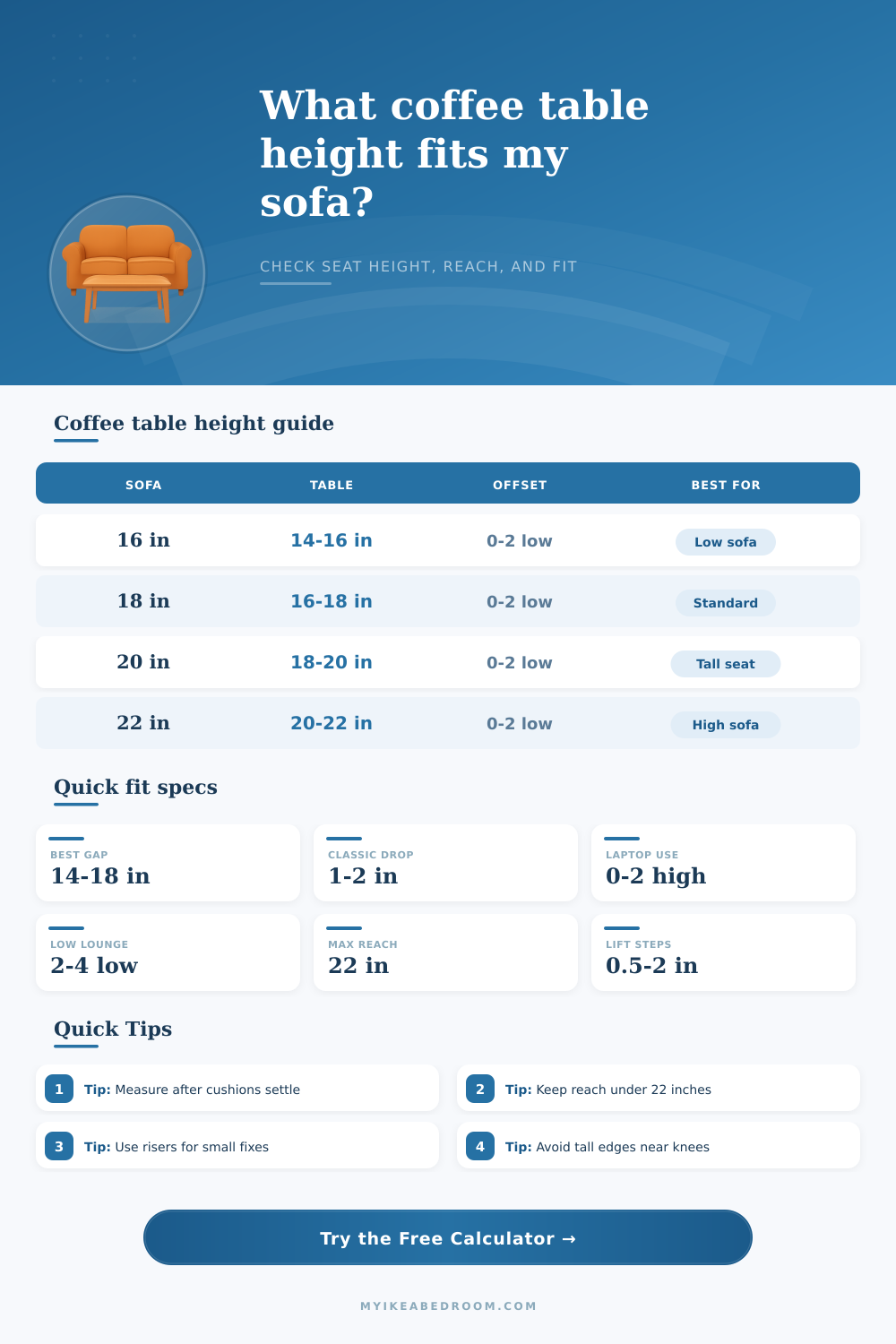
| Sofa seat height | Classic table height | Metric range | Best match |
|---|---|---|---|
| 15 to 16 in low sofa | 13 to 16 in | 33 to 41 cm | Low modern, platform, lounge seating |
| 17 to 18 in standard sofa | 15 to 18 in | 38 to 46 cm | Most apartment and family sofas |
| 19 to 20 in tall sofa | 17 to 20 in | 43 to 51 cm | Sleeper sofas, firm seats, upright arms |
| 21 to 22 in high seat | 19 to 22 in | 48 to 56 cm | High deck frames and accessibility-focused seating |
| Use case | Target offset | Reach priority | Notes |
|---|---|---|---|
| Classic drinks and remotes | 0 to 2 in lower | 14 to 18 in | Works for most living rooms and sectionals. |
| Low lounge look | 2 to 4 in lower | 12 to 16 in | Best when the sofa is deep and informal. |
| Snacks and board games | 1 in lower to level | 14 to 18 in | Keeps trays usable without feeling tall. |
| Laptop or work surface | 0 to 2 in higher | 12 to 16 in | Short sessions only; lift-top is better for work. |
| Books and display | 1 to 3 in lower | 16 to 20 in | Visual balance can matter more than task height. |
| Adjustment | Typical change | Best for | Check before using |
|---|---|---|---|
| Felt pads or small glides | 0.1 to 0.5 in | Fine tuning a nearly right table | All legs must remain stable and even. |
| Furniture risers or taller feet | 0.5 to 2 in | Fixed tables that are slightly low | Do not narrow the footprint or create wobble. |
| Remove casters or change feet | 0.5 to 2 in lower | Tables that feel too tall | Protect floors and keep clearance under storage drawers. |
| Use a tray on ottoman table | 0.5 to 1.5 in higher | Soft upholstered table surfaces | Tray should be wide and flat enough for drinks. |
| Choose a lift-top table | 4 to 10 in raise | Laptop, meals, craft, or work use | Measure both closed and raised positions. |
| Room setup | Seated sofa height | Table target | Secondary check |
|---|---|---|---|
| Compact loveseat in small apartment | 15.5 to 17 in | 14 to 16.5 in | Keep gap near 14 in for reach. |
| Standard three-seat sofa | 16.5 to 18.5 in | 15.5 to 18 in | Works with rectangular or oval tables. |
| Deep sectional lounge | 14.5 to 17 in | 13 to 16 in | Lower table can look balanced with deep cushions. |
| Firm formal sofa | 18 to 20 in | 17 to 20 in | Level height often feels polished and usable. |
| Lift-top work table | 16 to 19 in | 17 to 21 in in use | Also check closed height for daily appearance. |
Measure the real seated height. Sit on the sofa for a moment, allow the cushion to settle, then measure the usable cushion height. A soft sofa can make a perfect-looking table feel too high once someone sits down.
Check height and reach together. A table at the perfect height still fails if it is too far away. Keep the edge close enough for a drink, but far enough for knees and walking past the sofa.
You find an amazing-looking sofa at the store. You bring it home and plop yourself onto it. But wait! Your coffee table doesn’t look right there. Is it too tall? Does it knock into your knee? Is it too short? Do you have to stretch to reach your drink?
Height relationships are one of those elements of room design that isn’t clear until you experience sitting in the space, That’s why this is a top complaint about interior design regrets.
How to Choose the Right Coffee Table Height
With the sofa seat height and how far the cushions sink below that as inputs, the calculator figure out the rest (no need to fumble with trying to understand the ergonomics or visual weight balance factors). It’s not meant to be “the correct answer” for everybody; only that which suits you given your own furnitures and body type.
A common error is people measure from floor to the top of an uncompressed cushion. But the cushion will compress as soon as you sit on it. Depending on the softness of foam, the cushion may compress 2″ or even more once you’re sitting. Our calculator does take this into consideration. It measures a higher number then normal to compensate for the depth you’ll sink into the seat when you sit down. Without this variable, a table that looks like it is at a comfortable height in pictures might turn out to be much too high when you actualy sit down.
Understanding exactly what’s getting measured (where does my body end and piece of furniture begin) is the key. Typically, designers recommend having the coffee table sits about an inch or two below the sofa seat level. That way it looks like there’s a deliberate layering of heights, and you can still see over the table.
But what if you’re snuggling into a comfy lounge-style sectional? Following the old-school guideline means stretching for the remote control all evening long. By choosing how you want to use it (casual snacking versus laptop time), the tool will adjust its suggestions to match: One type of table works well as a work surface, but may not look right visually; another is better for relaxing and snacking. And when working at a desk-type table, you want it higher so you can maintain good posture, which may mean busting the traditional height hierarchy.
It’s not just about vertical alignment, it’s also about reach distance. Sure, you could nail your ideal height offset, but if the table sits twenty inches beyond edge of the sofa, there’s no way you’ll use it comfortabley. Ideally, keep this distance between fourteen and eighteen inches. This is roughly the width of an average person’s arms, with enough room for their natural reach zone. Beyond that, you’ll be forced to lean in, which defeats the purpose of relaxing on the couch.
These are the sweet spots shown by the reference tables in the tool, which demonstrate how varying room scales affect the best spacing. In a small apartment, you may need to squeeze things a bit closer together, but in a big living space, you can give everything some breathing room without compromising on accessibility.
When something needs adjustment, you often do not need a new piece of furniture; you only need minor fixes. To adjust things up: Add a 1/2″-2″ riser under a table to meet you in your seat. Or add some felt pads, if it’s not quite too low. To adjust things down, remove the legs or casters if a piece is too tall. No one will notice these changes except you. But they’ll make a big difference day-to-day.
What else? The most overlooked element is floor itself. A nice thick rug lifts up both the table and the sofa! But what happens if you have one piece resting on the rug, while the other isn’t? Suddenly their heights changes relative to each other.
The bottom line: Form follows function. The best coffee table will become invisible in the context of your living space, it’s there to support what you do in front of it, not how it looks from above. If you’re going for a minimalist aesthetic, a slim low-profile style will work, but if you want to host family game night, you need a sturdy surface, too.
Size matter. Measure with all cushions in place. Test the distance between furniture points with your (firmly planted) feet. Follow your gut when measuring by the fit score as opposed to arbitrary rules. It’s your sofa; treat it like home, not photo backdrop. Let comfort be the ultimate judge of height.