Writing Desk Size Calculator
Plan a writing desk that fits your wall, chair, knees, papers, laptop, monitor distance, drawer apron, side buffers, and walking clearance before rearranging the room.
Start with a real writing, studying, or bedroom-office scenario, then adjust the wall, chair, work surface, and clearance measurements.
What the calculator checks
Wall fit: desktop width plus side buffers, with extra allowance for nook, corner, window, and shared layouts.
Working surface: paper zone, laptop or monitor depth, elbow room, and useful writing width.
Body fit: recommended desktop height, drawer/apron drop, thigh clearance, chair width, and side clearance.
Room flow: total operating depth from wall through desk, pulled-out chair, and walking clearance.
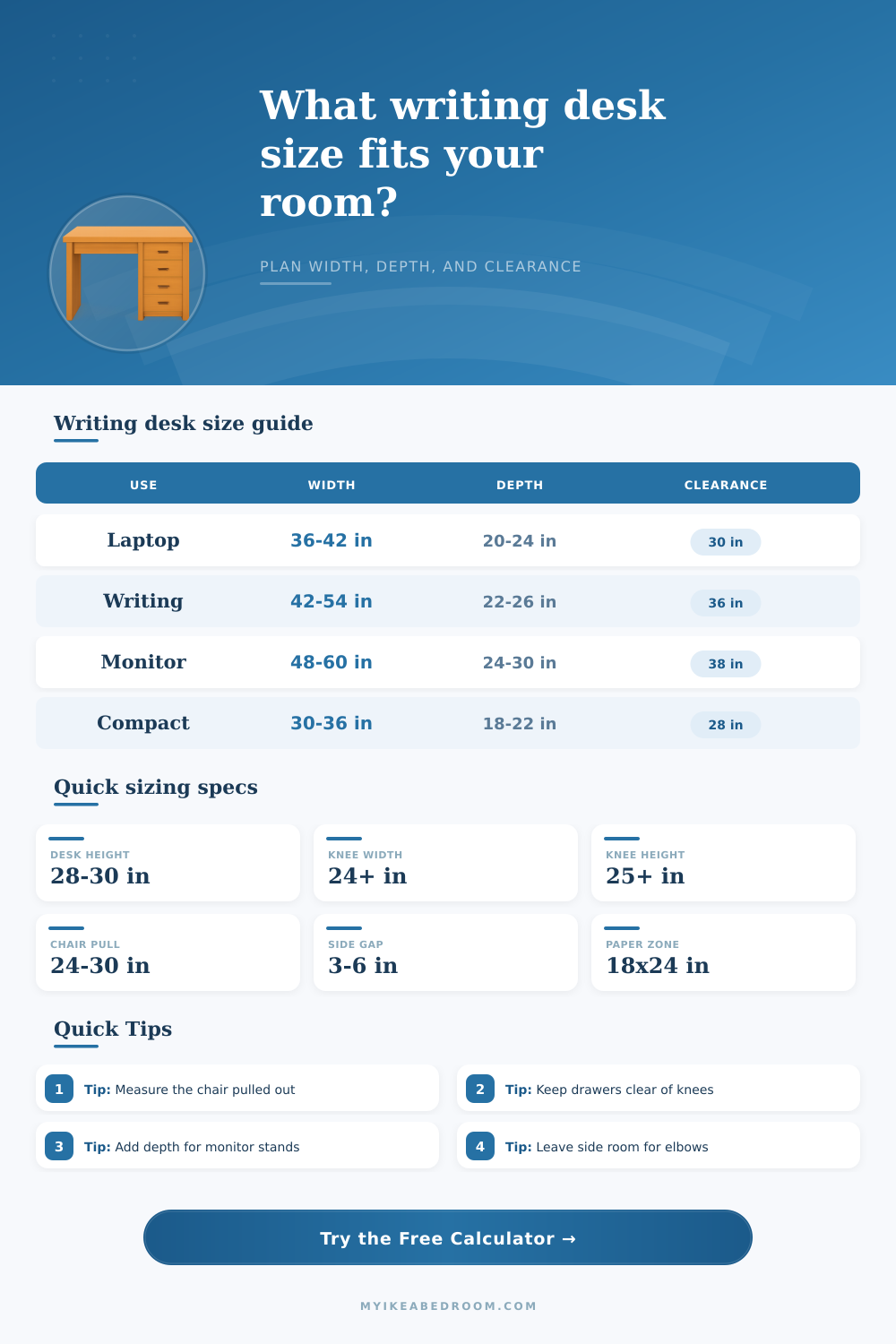
| Desk use | Typical width | Useful depth | Best fit note |
|---|---|---|---|
| Compact laptop writing | 30 to 36 in | 18 to 22 in | Works in a small bedroom nook with a slim chair. |
| Daily writing desk | 42 to 54 in | 22 to 26 in | Allows paper, lamp, notebook, and relaxed elbows. |
| Laptop plus books | 44 to 56 in | 22 to 28 in | Adds book stack and charger space beside the laptop. |
| Single monitor plus writing | 48 to 60 in | 24 to 30 in | Protects viewing distance and a front writing zone. |
| Large paper layout | 54 to 72 in | 26 to 32 in | Better for sketching, planners, mail, or craft writing. |
| Shared homework desk | 72 to 96 in | 24 to 30 in | Needs separate chair widths and a wider wall. |
| Clearance item | Compact target | Comfort target | Calculator use |
|---|---|---|---|
| Chair pull-out | 22 to 24 in | 26 to 30 in | Added behind the desk depth. |
| Pass-by walkway | 24 in | 30 to 36 in | Added after pulled-out chair depth. |
| Side buffer | 2 to 3 in | 4 to 6 in | Subtracted from available wall width. |
| Knee opening width | 22 to 24 in | 26 to 30 in | Compared with chair and elbow room. |
| Knee opening height | 24 to 25 in | 26 to 27 in | Desk height minus drawer apron. |
| Screen distance | 20 to 24 in | 24 to 30 in | Increases target desk depth. |
| Scenario | Wall width | Desk size | Clearance note |
|---|---|---|---|
| Small bedroom wall | 48 to 60 in | 36 x 20 in | Use a slim chair and 24 in pull-out. |
| Student room study zone | 60 to 72 in | 48 x 24 in | Comfortable for laptop and notebook. |
| Window writing desk | 54 to 72 in | 42 x 22 in | Check sill height and curtain movement. |
| Monitor writing station | 66 to 84 in | 54 x 28 in | Needs deeper surface for screen distance. |
| Wide paper layout | 84 to 108 in | 66 x 30 in | Best where walkway depth is generous. |
| Shared homework wall | 96 to 120 in | 84 x 26 in | Leave two chair zones and side buffers. |
Measure the occupied chair: Desk depth alone is not the room-depth requirement. Add chair pull-out and the remaining walkway to test whether drawers, doors, and wardrobe fronts still open.
Check the underside: A writing desk can look tall enough while a drawer apron steals knee space. Compare the apron drop with thigh clearance before choosing storage-heavy desks.
A good office bedroom design leaves you with one moment of regret. You get that perfect looking desk online because it has lots of drawer and a wide work surface. You push it up to the wall and sit in the chair, only to find yourself unable to open the door except by standing up and squeezing over to the handle. Yes, the desk fits the wall; no, it doesn’t fit your life.
Most people make this error: they measure the furnitures rather than measuring the space into which they are trying to fit it. All that math? This page does it for you if you put in your room’s size. (It’ll make you think about depth first, not width, counter-intuitive, I know, but you’ll thank me later.)
Why Your Desk Does Not Fit Your Room
Laptop, paper, whatever; people think about how big their desk should be by looking at its surface area, but forget how much floor space they need to comfortabley sit down without bumping into something else. Or they might block someone’s way. The calculator separates walking clearance from chair pull-out distance for chairs with pull-outs. Chair pull-out distance, since the two are completely different things depending on whether you have a giant study hall or a very tiny room. If there isn’t a lot of space, it will flag desks whose width might cuts off too much knee or elbow room.
The other thing that messes with your posture is the height of the desk. Usually, a standard writing desk sit between twenty-eight and thirty inches high. That sounds harmless until you add drawers underneath, which take up the space meant for your knees. If you’re buying one of those deeper desks with drawers for storage and don’t account for the clear height under there, you’ll find yourself not sinking into your chair but sitting ON IT.
The calculator measure the drawer drop and compares it to both your height and height of your thighs. Small stuff, yes…but if you spend hours each day at this surface, having your legs slide under and not have to brace themselves against the desk is worth consideration.
As for width, that depends entirely on what you are doing with your hands. If you spread out letters or sketchbooks you will need more width then somebody using a laptop. Typing emails? Maybe 36″ is sufficient. Writing notes alongside your monitor? You will need more width so things don’t slide off the edge as you reach for a pen. Check the reference table on the page; it illustrates how different uses trade off width vs.
This refers to depth. For example, a deep desk puts your screen further from your eyes, which is good for eye health, but also means you’ll have to balance that against the room’s narrow footprint, so there’s a tension between visual comfort vs. Physical footprint. Physical footprint. It also takes into account placement context: putting the same desk under a window makes it look great in pictures, but typically the sill will be too high (or too low) to ensure good ergonomics. Two-walled desks like a corner desk double the likelihood of hitting door swings. Whether you put the desk up against a wall, under a window, or in a straight alcove, it matters. And the calculator considers all this, including side buffers to prevent your coffee mug from flying off the edge each time you sit down.
You want to know how much empty space there is. If you design your room around the chair, the desk becomes an accessory to serve you, rather than something to step over or navigate around. You should of run the numbers beforehand, so you don’t have to scoot sideways out of your own office.