Crib Mattress Gap Calculator
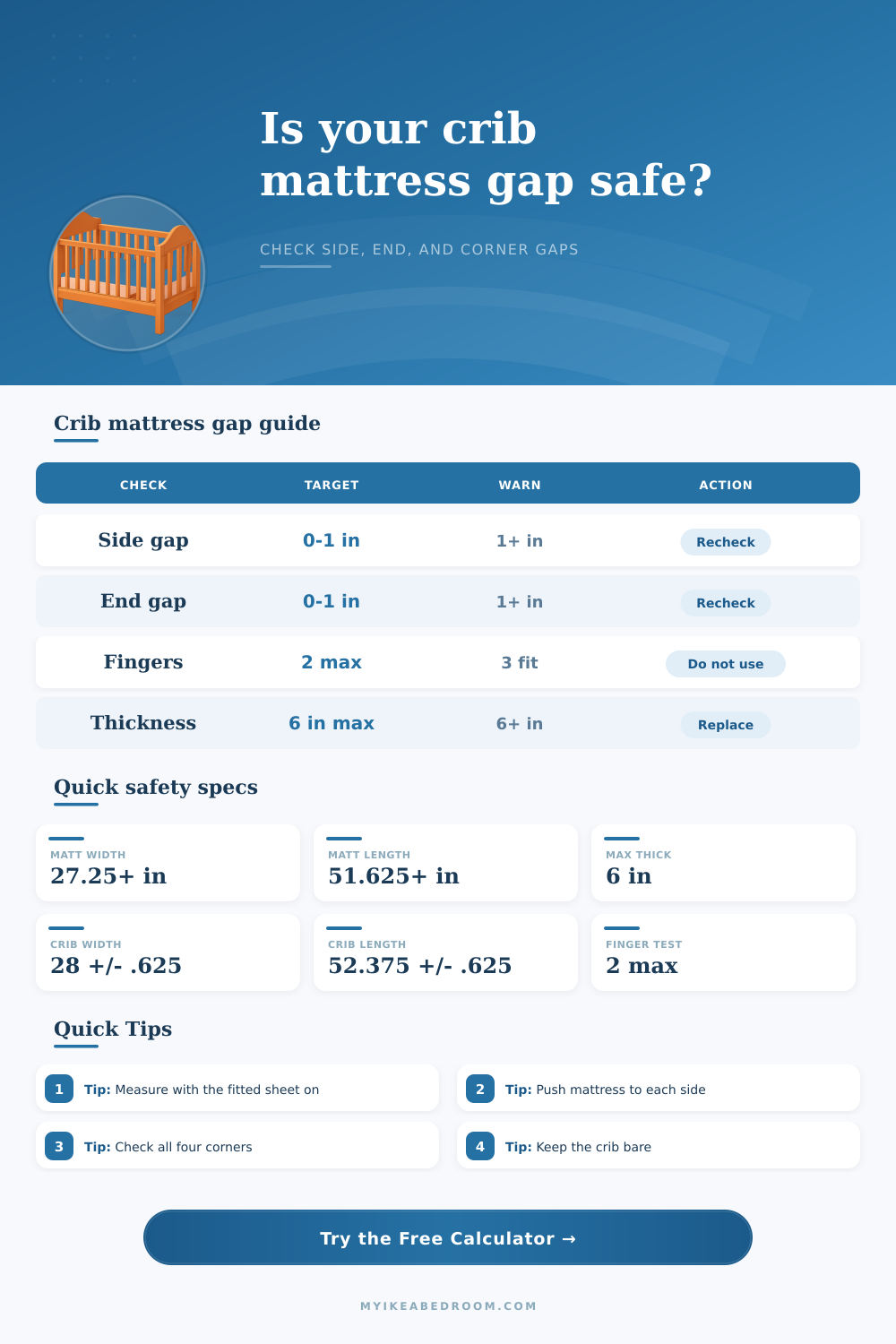
Measure the crib interior, mattress, fitted-sheet compression, largest side gap, largest end gap, and finger-test result to screen for risky crib mattress fit before sleep.
Use a preset as a starting point, then replace every value with your actual tape-measure readings. Safety depends on the real crib and mattress combination.
How the calculator reads the fit
Measured gap wins. If your tape-measured gap is larger than the dimension estimate, the calculator uses the measured value.
Pushed gap matters. A centered mattress can look snug, but infants can shift the mattress toward one rail, exposing the opposite side or end.
Finger test is only a screen. If more than two fingers fit, do not use that crib and mattress combination for sleep.
This is not certification. Follow the crib manual, mattress label, current product recalls, and pediatric safe sleep guidance.
| Item checked | Reference dimension | Calculator field | Why it matters | Action if outside range |
|---|---|---|---|---|
| Full-size crib inside width | 28 +/- 5/8 in | Inside crib width | Oversize interiors can increase side gap | Confirm crib type and manual |
| Full-size crib inside length | 52 3/8 +/- 5/8 in | Inside crib length | Long interiors can expose foot or head gaps | Recheck mattress length |
| Full-size mattress width | At least 27 1/4 in | Mattress width with sheet | Narrow mattresses create side entrapment spaces | Use a correctly sized mattress |
| Full-size mattress length | At least 51 5/8 in | Mattress length with sheet | Short mattresses create end entrapment spaces | Use a correctly sized mattress |
| Full-size mattress thickness | No more than 6 in | Mattress thickness | Thick mattresses can reduce effective rail height | Choose compliant thickness |
| Gap result | Finger-test result | Calculator rating | What to do next | Extra check |
|---|---|---|---|---|
| 0 to 0.5 in | No or one finger | Snug screen | Still check all four corners | Confirm fitted sheet does not bow edges |
| 0.5 to 1.0 in | Two fingers or less | Measure carefully | Repeat after pushing mattress each way | Compare against crib manual |
| More than 1.0 in | Two fingers may fit | Do not use until resolved | Change mattress or crib combination | Do not fill gaps with padding |
| Any gap with 3 fingers | Three or more fingers | Unsafe screen | Do not use for sleep | Check correct mattress model |
| Soft corner gap | Varies by pressure | Needs replacement check | Inspect mattress firmness and shape | Replace sagging or bowed mattresses |
| Step | Measure or inspect | Where to enter it | Common mistake | Better method |
|---|---|---|---|---|
| 1 | Inside crib width and length | Crib dimension fields | Using outside crib dimensions | Measure inside the rails at platform height |
| 2 | Mattress with fitted sheet on | Mattress dimension fields | Measuring bare mattress only | Install the sheet, settle corners, then measure |
| 3 | Largest side and end gaps | Measured gap fields | Only checking centered fit | Push mattress toward each rail and end |
| 4 | Finger-test result | Finger-test dropdown | Forcing fingers into the gap | Use light pressure and stop if edges compress |
| 5 | Bare crib and manual match | Checklist fields | Adding bumpers or towels to fill gaps | Use only the correct mattress and fitted sheet |
Do not solve a mattress gap with padding. Towels, blankets, bumpers, pillows, wedges, and extra bedding can add suffocation and entrapment hazards rather than making the crib safer.
Recheck after every bedding change. A tight fitted sheet, waterproof cover, softened edge, or washed mattress cover can slightly bow the mattress and change the largest gap.
You spend months crafting the ideal nursery and selecting a soothing paint swatch. A matching bassinet is selected; however, then come the crib mattress and its rigid geometric demands. Beyond being inconvenient, any distance between the rail and the mattress pose a possible entrapment hazard. It’s not about the look of the space, it’s about the space itself.
When armed with your trusty tape measure, the calculator below will do the math for you (i.e., it’s all in the numbers). That’s where the true safety occurs. The two-finger rule is familiar to most parent. You try to fit two fingers between the mattress and side of the crib. Three finger means danger.
How to Measure Crib Mattress Gaps for Safety
The problem is that fingers are compressible, so while this works as a quick test, it does not prove if it is safe or dangerous. Frequently when you quickly run two fingers along the mattress edge, it’s stiff enough to keep them from being pushed inward, but when the child starts to squirm, it can be soft enough to bow out. The tool on this page makes up for that difference by asking you to actualy measure your gaps after pushing the mattress all the way against each rail. This mimics what happens as a baby rolls around in his or her sleep.
It displaces the mattress and then opens the opposite end, exposing the edge. Once again: the fitted sheet make all the difference, and a thin/loose sheet may appear flush on center. But a thick waterproof cover pulls the edges inward, and this compression create space where there was none before. You cannot measure the naked foam, then assume that’s true for the sleep surface you will use every night.
The sheet matters; it must be measured with the sheet on, which is why the calculator prompts you for that number. This variance is often how we catch people who think their gap is okay until they add the sheet. At that point, the gap becomes larger. The sheet adds danger if your gap seems tight without it but looser than it.
Federal guidelines establish certain dimensions of what can go inside standard full-size cribs, including how wide the mattress is. These measurements make sense. All manufacturers’ mattresses should fits into other manufacturers’ cribs as expected. Also, when you purchase a mattress labeled “standard size,” it should meet a minimum length and width.
So if your mattress is at one end of that spectrum (minimum) and your crib’s interior is at the opposite end (near max), then you don’t really have any room for error. As the reference table on the page details, the allowable ranges become clear, anything outside those limits usually call for replacing or adjusting something.
The size also matters, slightly less than height, but just as much: A really thick mattress might be too tall and bring the bed up higher toward the headboard top. That means there’s less buffer between the baby and the rail top to prevent them from rolling over. For this reason, most folks recommend staying below six inches in thickness. It helps maintain the structural integrity of the sleep space.
The trickiest spots are corners, and if your mattress has shifted a little bit in any direction, then chances are it’s rotated a few inches in the corners too. You might only see a tiny gap on one side, but that actualy creates a larger diagonal space in the corner. Make sure to check each of the four corners by pushing the mattress up against the wall.
And don’t just go by one spot in the center of one side, because the visual map will help you understand where the gaps gets bigger as the mattress comes off-center. Don’t attempt to patch these holes with blankets, bumper pads, or towels, it won’t solve the problem and introduces an added risk of suffocation.
The answer: You must have a properly fitting mattress in your crib for that specific crib frame. Sometimes a used mattress will soften and change over time and even though it was just right when you bought it, the softer corners now makes crevices where there wasn’t one before. Check again every time you change sheets or wash the cover.
“Sleeping safe is really all about eliminating variables that are outside of your control, one variable being which way your baby rolls over in the middle of the night. What’s inside your control is how they’re set up initially. A snug fit eliminates any room for entrapment. If you take the time to properly measure, get the mattress pushed in, check the corners and know that it fits snugly before walking away, then you know there is nothing to worry about.