Daybed Size for Room Calculator
Check whether a daybed frame fits the room as a sofa, sleeping surface, guest bed, storage bed, or trundle-ready layout with practical walkway and door clearances.
Start with a realistic room setup, then adjust the exact frame, wall run, depth, walkways, cushions, drawers, doors, and nearby furniture.
| Daybed size | Typical outside frame | Minimum room depth | Comfort room depth |
|---|---|---|---|
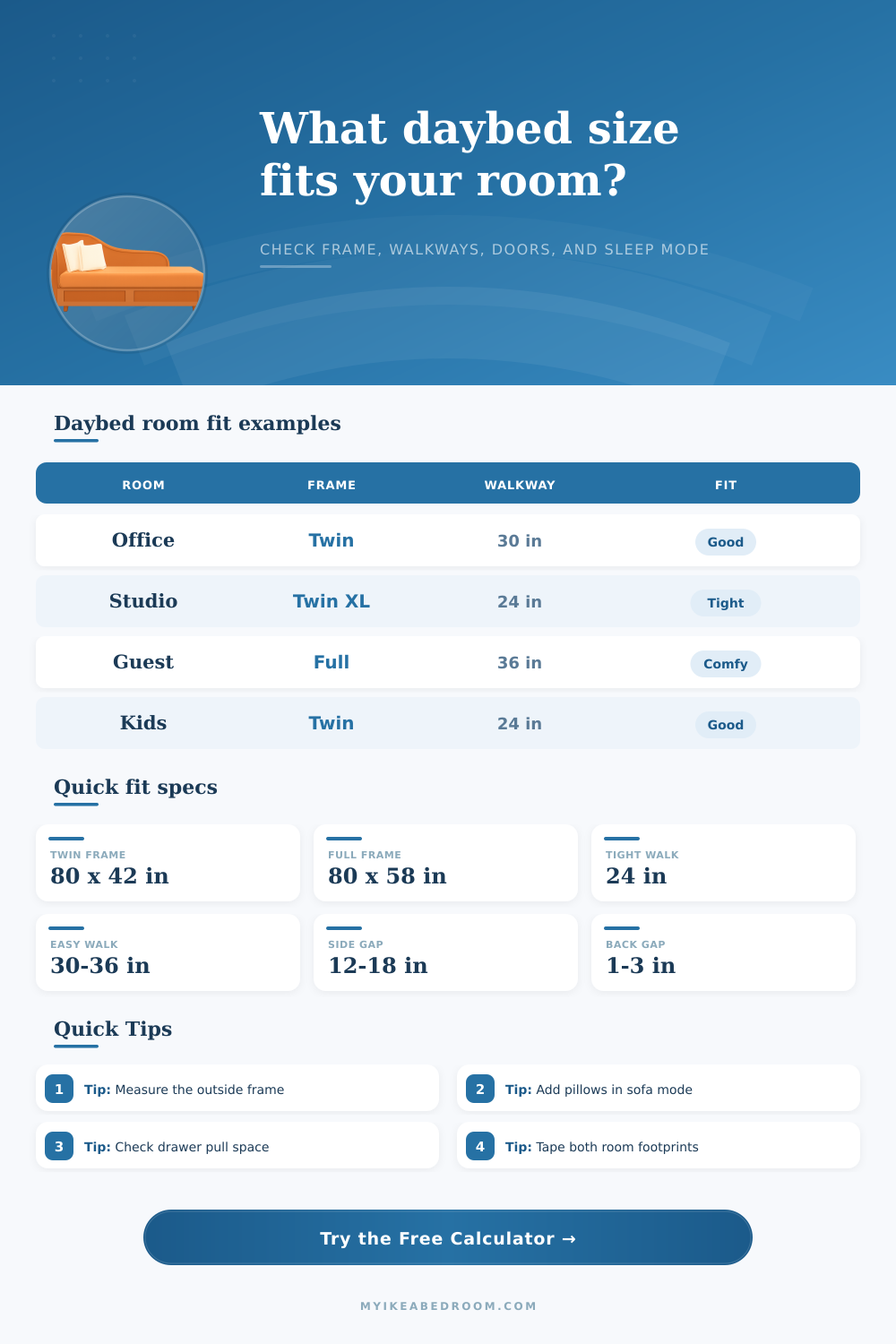
| Twin | 80 x 42 in / 203 x 107 cm | 68 in / 173 cm | 76-82 in / 193-208 cm |
| Twin XL | 84 x 42 in / 213 x 107 cm | 68 in / 173 cm | 76-82 in / 193-208 cm |
| Full | 80 x 58 in / 203 x 147 cm | 84 in / 213 cm | 92-98 in / 234-249 cm |
| Queen platform | 84 x 64 in / 213 x 163 cm | 92 in / 234 cm | 100-106 in / 254-269 cm |
| Use mode | Front walkway | End clearance | Best fit note |
|---|---|---|---|
| Occasional guest | 24-30 in / 61-76 cm | 10-12 in / 25-30 cm | Works if bedding is simple and doors clear. |
| Daily sofa | 30 in / 76 cm | 12-18 in / 30-46 cm | Check pillow depth and coffee table path. |
| Daily sleep | 34-36 in / 86-91 cm | 18-20 in / 46-51 cm | Prioritize easy sheet access on both ends. |
| Kids sleepover | 24-30 in / 61-76 cm | 10-16 in / 25-41 cm | Leave room for bins and toy traffic. |
| Reading lounge | 30-36 in / 76-91 cm | 12-18 in / 30-46 cm | Deep pillows often matter more than frame depth. |
| Storage type | Extra clearance | Measure from | When to add it |
|---|---|---|---|
| No storage | 0 in / 0 cm | Front rail | Use only frame, pillows, and walkway. |
| Side drawers | 18-24 in / 46-61 cm | Drawer face | Add when drawers pull toward the main path. |
| Bins or baskets | 12-18 in / 30-46 cm | Bin handle | Add if storage must be reachable every week. |
| Lift-up storage | 8-12 in / 20-30 cm | Standing zone | Add side or front space to raise the deck. |
| Future trundle | 39-42 in / 99-107 cm | Lower bed front | Add when a pull-out bed may be used later. |
| Room scenario | Usable wall run | Suggested daybed | Watch point |
|---|---|---|---|
| Small office 9 x 10 ft | 108-120 in | Twin | Desk chair movement and closet swing. |
| Guest room 10 x 11 ft | 120-132 in | Twin or full | Nightstand and door clearance at the ends. |
| Studio seating wall | 96-120 in | Twin or twin XL | Sofa pillows can narrow the traffic path. |
| Kids room 10 x 12 ft | 120-144 in | Twin with bins | Leave front room for toy storage. |
| Larger guest room 11 x 13 ft | 132-156 in | Full or queen platform | Check full bed depth before choosing wider. |
The closed footprint is the daybed as it sits most of the time. Include the back gap, arms, side rail, and cushion depth.
Best use: Judge everyday traffic.
The sleep footprint adds space for getting in, making the bed, opening bedding, and clearing the front walkway after pillows move.
Best use: Test guest comfort.
Drawers, bins, and trundle plans can need more front clearance than the daybed itself. Measure the actual pull direction.
Best use: Avoid blocked storage.
End gaps keep the frame from feeling wedged in. They also help with pillows, sheets, lamps, outlets, and moving around the room.
Best use: Improve daily usability.
Use outside dimensions. Mattress sizes do not include daybed arms, back rails, rounded posts, upholstery padding, floor glides, or the small wall gap needed behind the frame.
Measure both modes. A daybed can fit as a sofa but fail as a bed if front walkway, sheet-making room, or pillow storage has nowhere to go.
Open every moving part. Test room doors, closet doors, drawers, bins, desk chairs, and nightstands against the taped footprint before committing to the layout.
Leave a little air. Tight layouts work better when one nearby item can move, such as a rolling chair, lightweight side table, or storage basket.
A daybed is a popular purchase for anyone who wants to have a guest bed disguised as a cool-looking sofa. It is a smart piece of furnitures, except when you attempt to place one in a real room. Chances are the numbers don’t add up the way they do in your mind.
Visualize the frame positioned against the wall. Ignore the space needed for bedding without bending the mattress as well as the pile of pillows you’ll want stacked in front. That’s why having a specialized sizing calculator can eliminate the guess work of squeezing that multi-use piece of furniture into limited square footage.
How to Check if Your Daybed Fits
Don’t Just Measure the Mattress Size Alone This is the biggest mistake. Don’t just get the size of the mattress. Get the outside dimension of the bed frame. Daybeds often comes with back rails, arms, and even decorative finials, which add a few inches to the footprint. So what happens when you only measure for mattress size? You end up getting a bed so large it doesn’t fit through your door or barely gives you any space to move.
This tool asks for the full exterior length and depth so you can account for this. When you enter in these numbers plus your clear wall space, it then lets you know if you have enough margin. It’s a simple check but it would of saved you from having to return a piece of heavy furniture later on.
And then there’s depth, which is generaly what goes wrong. A daybed positioned like a sofa must has some space in front of it: enough for people to walk around. Twenty-four inches would be adequate for infrequent foot traffic. But if someone’s seated on the bed and someone else wants to pass, that seems pretty constricted. A more comfortable amount for everyday living would be around thirty inches. It is easy to maneuver through, with enough space for side lamps or even a coffee table.
The walkway detail in the calculator will show you precisely how much floor space are available once you’ve added your furnishings.
Then there’s the storage challenge. Lots of daybeds includes storage in their base, either a trundle bed below, drawers, etc. There are side drawers. Those can’t be obstructed on one side by a dresser. They require enough space to open all the way without hitting anything.
The storage clearance inputs will show you that obstacle ahead of time so you don’t discover a blockage only after putting something in the drawer. You input the amount it pulls out and the tool will show you how much depth remains after subtracting it. Does your storage work? Or is it always limited by how the room is set up. That’s an easy thing to forget about until the day someone goes to grab a blanket from the drawer…and then hits a wall.
Another quiet killer is door swings. Maybe the closet door bangs open onto where you intended to put a walkway leading to your daybed. Or maybe the bedroom door itself hit when swung open wide. Those intrusions diminish the useable space in a way that static measurements fail to reflect. With the calculator, you can enter those intrusions. This makes you think about how things move in the room, not just where each piece of furniture stay.
You can set the intrusion amount and view the remaining clearance before the door opens on to the bed frame.
It also depends on where you place it. Putting a daybed against a long wall is different than floating it like a sofa or tucking it into a corner. Each position impacts how much space is left at each end for sheets and pillows. The tool has several of these as presets that let you play with different placements easy. What does it look like with a desk beside it in your home office? Or what about having it flanked by nightstands on both sides in your guest room? How does that same frame vary based off its companions in the space?
So, how do I get a daybed that fits? Most importantly, you’re balancing size (how much space can it take up?) and comfort (can it function as a bed at night AND a couch by day?). That’s why the calculator does all the hard math for you: It calculates fit scores and clearance measurements. Basically, it shows you whether or not your dream piece can realy live in your actual walls.
Measure accuratley and double-check the outside frame. Allow some airflow around the piece. Let the calculator confirm your gut instinct. Make sure you don’t have a tight squeeze. Because when your space feels tight, that breathing room makes it all livig.