Canopy Bed Height Clearance Calculator
Check whether a canopy bed frame, top rail, fabric, finials, ceiling fixtures, and seated headroom fit comfortably before moving furniture or drilling hardware.
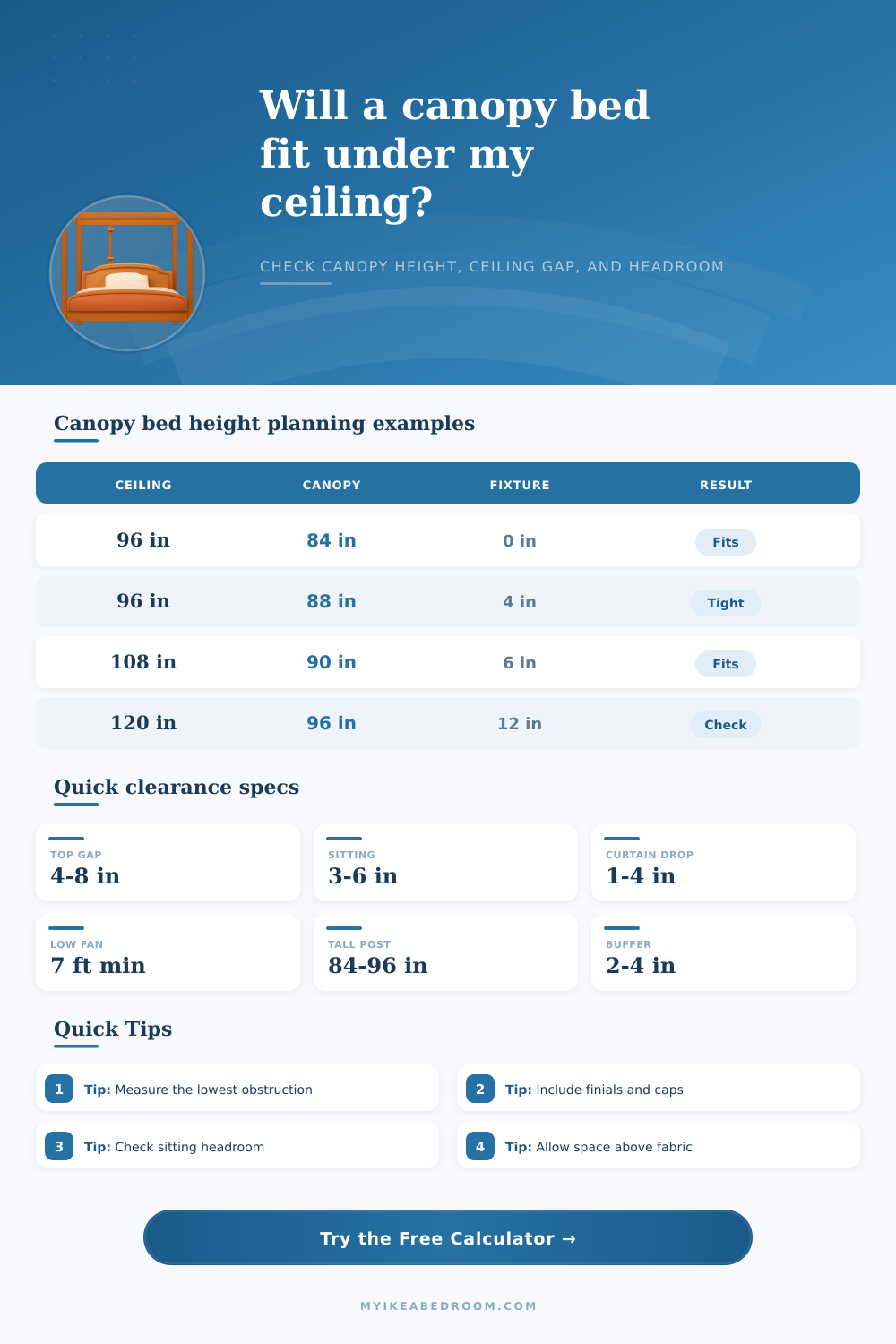
Choose the closest bedroom setup, then adjust ceiling height, canopy height, mattress height, rail thickness, fixture drop, fabric drop, and comfort buffers.
| Ceiling height | With 4 in top buffer | With 6 in top buffer | Metric ceiling |
|---|---|---|---|
| 8 ft / 96 in | 92 in canopy | 90 in canopy | 244 cm ceiling |
| 8 ft 6 in / 102 in | 98 in canopy | 96 in canopy | 259 cm ceiling |
| 9 ft / 108 in | 104 in canopy | 102 in canopy | 274 cm ceiling |
| 10 ft / 120 in | 116 in canopy | 114 in canopy | 305 cm ceiling |
| Canopy style | Typical highest point | Inside rail height | Clearance note |
|---|---|---|---|
| Low rail canopy | 72-78 in | 68-74 in | Best for low rooms |
| Standard canopy frame | 80-88 in | 76-84 in | Works in many 8 ft rooms |
| Tall poster canopy | 90-100 in | 82-92 in | Better with 9 ft ceilings |
| Arched crown canopy | 92-108 in | 78-88 in | Measure the crown peak |
| Draped fabric canopy | 82-96 in | varies by sag | Check rings and fabric dips |
| Obstruction | Input as drop | Planning effect | Best use |
|---|---|---|---|
| No ceiling obstruction | 0 in | Ceiling controls top gap | Open flat ceiling |
| Low pendant shade | 6-18 in | Shade bottom controls fit | Fixture near bed end |
| Ceiling fan zone | 8-14 in | Moving blade clearance matters | Keep bed out of sweep |
| Beam or bulkhead | 4-12 in | Lowest beam height controls | Sloped or framed ceilings |
| Vent or sprinkler | 2-6 in | Maintain access and airflow | Near center ceiling |
Means: the top canopy point clears the lowest ceiling obstruction with your selected buffer.
Sitting headroom also clears the inside rail or sagging fabric allowance.
Means: the bed may fit, but one clearance is below the comfort target.
Confirm the exact canopy peak and fixture location before assembling the frame.
Means: the top rail, finials, fabric, or fixture drop leaves too little overhead space.
Use a lower frame, remove tall caps, or move the bed away from the obstruction.
Means: the inside rail or fabric sag is too close to a seated person.
Raise the rail, reduce mattress height, or choose a canopy with a higher open interior.
Measure at the bed footprint, not only at a wall. Sloped ceilings, fans, pendants, beams, and textured ceilings can reduce the useful clearance above the canopy.
Include soft parts and top details. Finials, crown arches, curtain rings, tiebacks, and fabric sag can make the real high point or inside low point different from the catalog height.
The canopy bed was purchased because it looked dramatic. Those high posts and velvet drapes suggested a romantic escape, like something from a period drama set. And then you place the bed in the space, and discover an issue with your eight foot ceiling. There’s not enough vertical clearance. When you sit upright the curtain sags dangerousy near your face and maybe even hits your head; or perhaps the top rail hits a light fixture. It happens all too often. We tend to only measure the width of a piece of furnitures, forgetting about the height. Which is where this calculator comes in.
Small tweaks make all the difference in the math. When counting a mattress, foundation and frame, a typical queen bed is around twenty-six inches from the ground. That means it takes up about seventy inches of height until it touches the eight-foot ceiling. Add in two posts that are each eighty-four inches high and you’re looking at no clearance over the rail. With this simple tool, you simply enter your own numbers and let the calculator work out whether a four inch gap will accommodate fabric droop or dusting. It makes you consider what’s overhead.
Why You Must Measure Ceiling Height Before Buying a Canopy Bed
Most estimates is also wrong because they assume that the top of the post is the highest point. But that’s usually not true at all. People forget to account for finials, decorative caps, and arches, which collectively add another 2-4 inches. And then there’s the issue of fabric. Heavy drapes don’t just hang straight. Rings slide down the drapery rods, and ties hold the curtain in place by pulling the material lower and lower. Your headroom vanishes… literally, when you make the bed. That’s why the tool requests a sag allowance for fabric, if you ignore this factor, you’ll end up with no room for your head after you actually make the bed. Those inches will dissapears when the curtains drop. It’s a tiny thing that destroys the fit.
Vertical clearance is the silent killer of great furniture purchases. When you read in bed, you don’t stand underneath canopy frame. What really risks a head-bang is the vertical clearance. With an adult at sitting height (about 36 inches above the mattress surface, on average), you want enough clearance above your head to sit up and move around without bumping into the fabric edge or inside rail. Every time you put down or pick up a pillow, if your fabric edge or inside rail is lower then that, you’re going to get bumped. That’s what the calculator compares the dimensions you enter for your seated height against: it checks whether there’s any interior volume you can use, not just see. A high frame with a low rail is a trap.
Things get even more complicated with obstructions. Where does the bed live? Obstructions like a ceiling fan dropping eight inches into the room can change the effective ceiling height from ninety-six inches to eighty-eight inches right where the bed lives. That means instead of a ninety-six inch tall ceiling all around us, we now have an eighty-eight inch high ceiling right where we sleep! A pendant light at the foot of the bed is also something you’ll want to think about (both as an obstruction to your eye level AND possibly your hands if you reach up). This table on the page shows how different the drop of each fixture can reduce your usable space. Don’t assume all ceilings are empty and flat. Measure the lowest point in your footprint.
Another seemingly abstract constraint is how much of the floor must be devoted to walking around the bed. It’s not enough just to have canopy posts. Their thickness also takes up some of the floor. And putting the frame up close against a dresser or nightstand reduces the clearance on either side which makes changing the sheets impossible without banging into the post. You can specify the side clearances for the tool to see whether it remains a usable bedroom or turns into an obstacle course. Quickly losing its charms is a beautiful bed that imprisons you inside.
With those presets, you get an idea of what’s possible in some real world situations, like a tall king set-up. Sure thing. A low profile apartment frame? Easy. A sloping ceiling? Gotcha covered. From there, you can adjust inputs according to your own livig space. To me, that means fitting the wood into the room while leaving enough open space so the room still feels airy and breathable. And in the end, if you’re going to buy a canopy bed, you need to yield to the power of vertical space. The one in the catalog is lit by studio lights that obscure its relation to the ceiling; in your house, it’s about gravity. What will fit.
And running those numbers beforehand saves you from having to return some huge hunk of furniture after you assemble it. It lets you enjoy the romantic aspects of the design without compromising on the practicality of getting any shut-eye at all. So measure twice, prepare for the sag, and honor the headspace. If you want to maintain the drama, it wouldn’t of be in the gap between the ceiling and the bed.