Panel Headboard Width Calculator
Size a paneled headboard by mattress width, desired side overhang, panel count, stile margins, reveal gaps, mounting rails, wall space, and nightstand clearance.
Start with a common bed layout, then tune the panel count, gaps, margins, overhang, and wall clearance for your exact bedroom.
How the width is built
Finished width starts with the wider of the mattress or bed frame, then adds the selected side overhang on both sides.
Panel field width subtracts two outside margins and all reveal gaps, then divides the remaining space by the number of panels.
Wall and nightstand checks compare the finished headboard to the available wall zone and the wider bedroom furniture composition.
Mounting rail length is the finished width minus the rail inset on both sides, useful for cleats, battens, and bracket placement.
| Bed size | Mattress width | Balanced headboard width | Common panel counts |
|---|---|---|---|
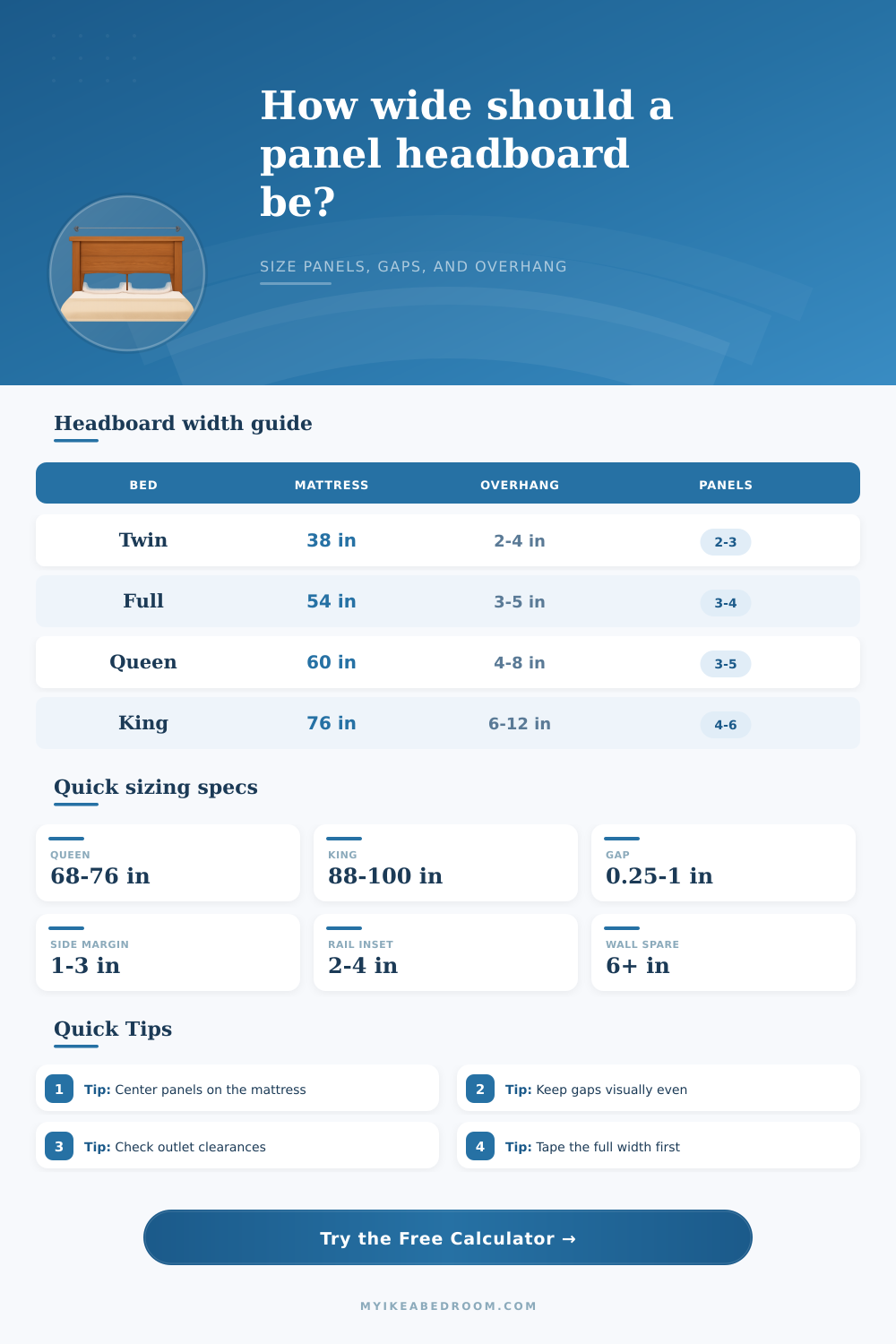
| Twin or twin XL | 38 in / 97 cm | 42 to 46 in with 2 to 4 in side overhang. | Two or three vertical panels usually stay proportional. |
| Full or double | 54 in / 137 cm | 60 to 64 in with 3 to 5 in side overhang. | Three or four panels work well with framed edges. |
| Queen | 60 in / 152 cm | 68 to 76 in with 4 to 8 in side overhang. | Three, four, or five panels depending on panel style. |
| King | 76 in / 193 cm | 88 to 100 in with 6 to 12 in side overhang. | Four, five, or six panels keep fields from looking oversized. |
| California king | 72 in / 183 cm | 84 to 96 in with 6 to 12 in side overhang. | Four or five panels suit the narrower long-bed proportion. |
| Panel count | Best use | Visible panel width cue | Layout note |
|---|---|---|---|
| 2 panels | Twin beds, simple split headboards, or pairs of wide upholstered pads. | Often 17 to 22 in each. | Keep the center joint perfectly aligned to the mattress centerline. |
| 3 panels | Full, queen, or low headboards where a center panel is desired. | Often 17 to 24 in each. | Works well when bedside art or sconces also use a central axis. |
| 4 panels | Queen and king beds with modern, even repetition. | Often 14 to 23 in each. | A good default when the room has strong horizontal furniture lines. |
| 5 panels | King beds, wide queens, and statement walls. | Often 15 to 20 in each. | Center panel helps a bed read symmetrical even if nightstands differ. |
| 6 panels | Large kings, wall-zone panels, or narrow slat-like construction. | Often 12 to 17 in each. | Use consistent reveal gaps so the repetition feels intentional. |
| Detail | Typical range | What it affects | Check before cutting |
|---|---|---|---|
| Reveal gap | 0.25 to 1 in / 0.6 to 2.5 cm | Total panel field width and the rhythm between panels. | Multiply by panel count minus one; small gaps add up quickly. |
| Outer stile or margin | 1 to 3 in / 2.5 to 7.6 cm | How framed or open the outside edge feels. | Use the same margin both sides unless the wall condition demands otherwise. |
| Mounting rail inset | 2 to 4 in / 5 to 10 cm | Rear cleat, bracket, or batten length. | Leave enough material at the edge for strength and fasteners. |
| Wall spare | 6 in / 15 cm or more | Room for trim, outlets, switches, curtains, and bedside movement. | Measure the actual obstruction-free zone, not the full wall width. |
| Nightstand composition | Bed plus two stands and gaps | Whether the headboard feels narrow, balanced, or intentionally wide. | Very wide headboards can crowd lamps and switch plates. |
| Example | Finished width | Panels and gaps | Practical reading |
|---|---|---|---|
| Compact twin guest bed | 44 in / 112 cm | Two panels, 0.5 in reveal, 1.5 in margins. | Clean, narrow, and easy to center on a small wall. |
| Full bed with simple framed panels | 62 in / 157 cm | Three panels, 0.5 in reveals, 2 in margins. | Enough overhang to cover bedding without becoming a wall feature. |
| Balanced queen headboard | 72 in / 183 cm | Four panels, 0.5 in reveals, 2 in margins. | Strong default width for a queen with standard nightstands. |
| Wide queen statement headboard | 84 in / 213 cm | Five panels, 0.75 in reveals, 2.5 in margins. | Best when wall zone and nightstand spacing are generous. |
| Classic king panel headboard | 92 in / 234 cm | Five panels, 0.5 in reveals, 3 in margins. | Wide enough to frame the bed while leaving bedside furniture readable. |
| King wall-zone feature | 108 in / 274 cm | Six panels, 0.75 in reveals, 3 in margins. | Acts more like a furniture wall; check outlets and sconce spacing. |
Center the layout on the mattress first. A headboard can be wider than the bed, but the panel pattern should still read centered from the sleeping position.
Subtract gaps before dividing panels. If you divide the finished width first, repeated reveals can make every cut piece too wide.
Leave real wall spare. Curtains, switch plates, sconces, baseboard returns, and outlet covers all reduce the usable headboard zone.
Tape the full finished width. Mark the bed, nightstands, side overhang, and panel joints before committing to a wide custom build.
When custom making a headboard, you might start to worry that it will be either too narrow to fit on your bed frame or so wide that it touches the nightstands. Not only did you pick out what wood stain to use, but also how many panels? Well now you want to know if all these decisions will work in room and not look funny?
The math is simple. But as humans we’re terrible at judging size of a gap between fixed objects, like the walls in this case. First of all, most folks begin their calculations by measuring width of their mattress, a reasonable beginning place, but only part of the equation.
How to Choose the Right Headboard Width
Do you want an overhang beyond the surface where you will sleep? In small spaces, say a room housing twin bed, you can get away with just two inches on either side. But with king bed, matching mattress width makes for shrunken appearance. Typically, at least 6-12 extra inches per side make for sense of weight and anchoring to the wall.
Once you enter your desired style into calculator above, it will compute the math for you… No mental arithmetic required while standing in lumber aisle and trying to determine whether or not this board is long enough. Subtracting the details first is realy the key to this. I know people often just divide their total width into the panels they want and assume that’s good enough.
However, this result in panels that are slightly wider than needed. This happens because you didn’t account for the reveal spaces between them, the outer margins, or the stiles that frame all those panels. Quarter inch doesn’t sound like much until you multiply it by four or five times over a span of seven feet. Those little fractions add up to inches and throw everything else out of whack. It’s a small thing, but it is very important when you are working on something that needs to look balanced.
The second silent killer of good design is wall clearance. Maybe you think you’ve got a big ten-foot wide wall where you can hang some kind of statement headboard. But then there are outlets, curtain rods, sconces, and door trim that all eat into that space before long.
By leaving yourself a minimum of six inches of empty wall on both ends, you won’t have furnitures touching things it wasn’t intended to touch, nor will it look like it’s boxy and boxed-in. That empty space lets the eye breathe and let you move bedding around without battling with electrical plates.
The reference table on the page lays this out as a sanity check against your own measurements: it’s a reference table that suggests common widths for each bed size. Think about what happens when your headboard meets your nightstands. Ideally, width of the headboard matches the outer edge of both bedside tables, plus a little space for gap between the bed and the table.
This creates a unifying block of furnitures that doesn’t feel haphazard and thrown together. Having a much larger headboard than your side tables overwhelms the space; having a headboard that is narrower than expected can make it seem like your nightstands are left all alone.
Finally, remember: while there are exact mathematically precise ways to do things, a panel headboard is realy all about visual balance, not an exercise in strict geometric precision. It’s supposed to be a focal point for the bed but not overpower the whole look of the room.
Before you make any permanent cuts, tape out whatever width you like on wall. Then measure the centerline of your mattress and note where panels would extend compared to your existing curtain or outlet placements. If it looks good in real life, then the numbers works themselves out.
Once you get the proportions right, what starts as a basic woodworking exercise becomes the room’s centerpiece. It acts as a confident anchor for the bed instead of a compromise.