Sofa Arm Height Calculator
Estimate comfortable sofa arm height from seat height, cushion sink, elbow support, posture, arm style, side-table alignment, and rounding tolerance.
📌Sofa Presets
Presets load common seating scenarios and calculate immediately. Adjust the seated elbow measurement if you have a real person and cushion sample to test.
⚙Arm Height Settings
Sofa arm height result
Enter seat, elbow, cushion, and table details to calculate a comfortable arm height.
📊Calculated Specs
📑Reference Tables
| Sofa Type | Seat Height | Arm Height | Best Use |
|---|---|---|---|
| Low lounge | 15-17 in | 21-24 in | Relaxed TV seating |
| Standard sofa | 17-19 in | 24-27 in | Everyday living rooms |
| Formal sofa | 18-20 in | 26-30 in | Upright conversation |
| Deep sectional | 16-18 in | 22-26 in | Lounging and naps |
| Arm Style | Usable Top | Adjustment | Note |
|---|---|---|---|
| Track arm | Flat | 0 in | Most predictable support |
| Rolled arm | Rounded | +0.4 in | Top feels softer but higher |
| Pillow arm | Soft pad | -0.3 in | Compresses under forearm |
| Sloped arm | Angled | -0.5 in | Use front and rear average |
| Wood arm | Firm thin | +0.2 in | Needs accurate elbow height |
| Use Case | Arm Rise | Table Gap | Comfort Aim |
|---|---|---|---|
| Lounging | 6-8 in | 0-3 in | Low shoulder strain |
| Reading | 8-10 in | 0-2 in | Forearm support |
| Formal | 9-12 in | -1-1 in | Upright posture |
| Napping | 7-10 in | 0-4 in | Pillow friendly |
| Side Table | Target | Readable Gap | Reach Note |
|---|---|---|---|
| Low table | 20-23 in | 0-2 in | Best beside low arms |
| Standard table | 23-26 in | 0-2 in | Works with most sofas |
| Tall table | 26-29 in | -1-1 in | Match taller track arms |
| Tray table | 24-28 in | 1-3 in | Keep clear of pillows |
💡Practical Tips
When you sit down on couch after long day of work, you feel your shoulders raise in tension. Sometimes, that’s not due to the firmness of cushions. It’s often because of height of the arms. It feels intuitive when getting sofa arms right (until you measure them). Because the comfort zone is small. Too high, and you’ll hunch over to reach your arm up. Too low, and you’ll bang into side table or have to hold your forearm out unsupported. Two inches can be all the difference between a comfy lounge and a stiff neck.
When purchasing a sofa most people only consider height of the seat. They get out their tape measure, record number from cushion top to the floor and move along. They don’t realize that arm height can also be equally important to long term comfort particularly if you intend to use sofa beyond short periods of time.
Why Armrest Height Is Important
Arm height doesn’t exist in a vacuum. It’s a formula involving the cushion (how much will it compress when I sit down?), your body and everything else around you. A stiff frame may appear to offer plenty of clearance but that will all vanish when you sink into the cushion. Sitting down on an uncompressed sofa in a store can make measuring inaccurate. The math shift once weight is applied.
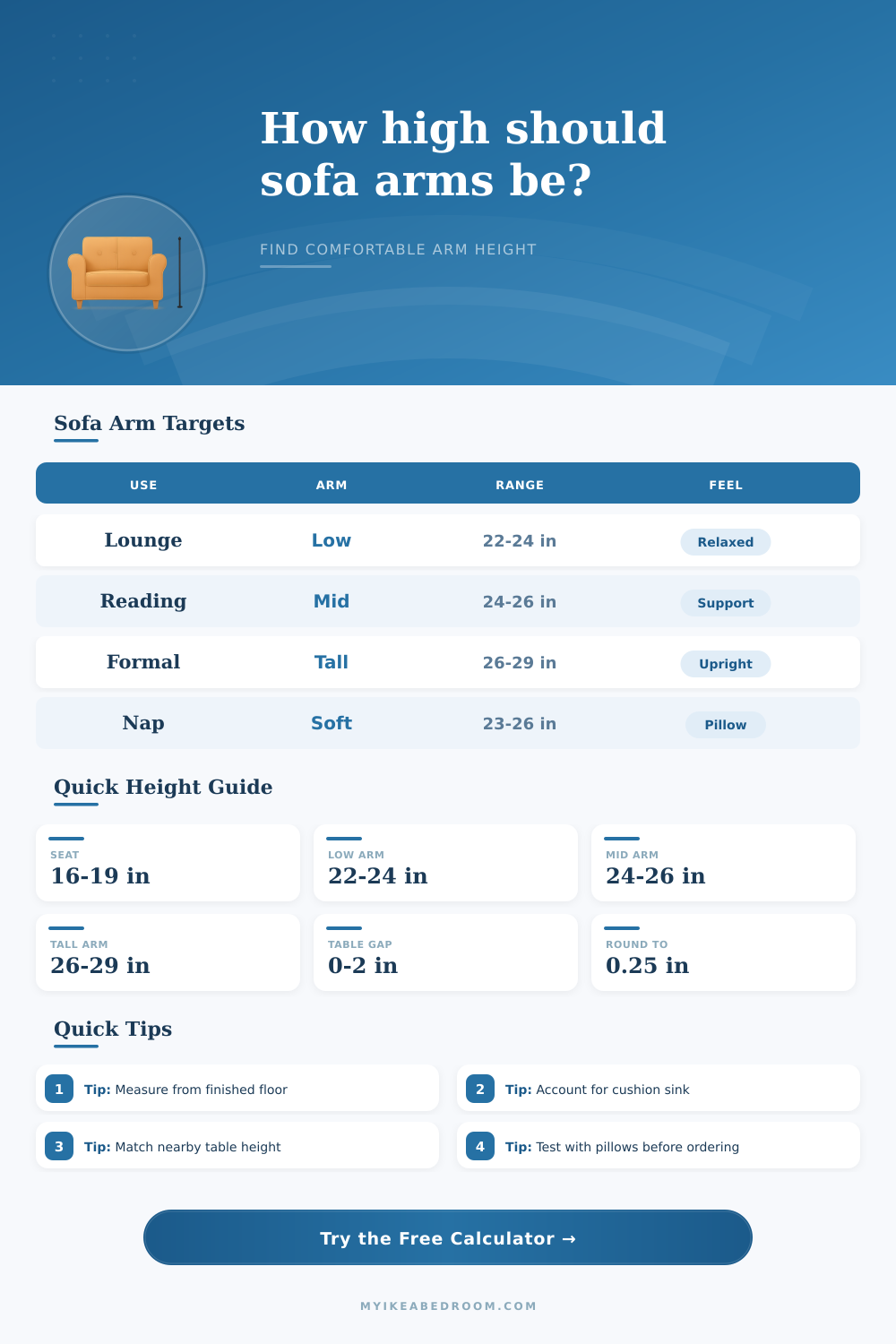
So how do you get it right? First, find where your elbow naturally sits when you are sitting comfortabley, not while you are standing up with arm hanging at your side. As you sink back onto a sofa, your body angle change. Your shoulders move down, which lowers your elbows a bit from their position on the sofa. The illustration above captures all this by adjusting for cushion compression. Enter depth of cushion you think you’ll sink into, allowing for softness as foam squishes under your body’s weight. Next, enter your elbow height when seated. The output range provide an approximation of support that positions your arms neutrally, supporting your forearms but not straining them. It turns subjective comfort into objective measurements.
Surprisingly, the usability of an arm come down to its style as well. A straight track arm provides a flat and predictable place to rest. Your forearm knows right where it should sit. Soft pillow top arms or even rolled arms acts differently. Often, the highest part of the arm sits above where your forearm actualy makes contact. So, even though wood structure itself may not change much in height, you’ll want to adjust it downward until you feel as comfortable on that piece as you do on a piece with a straight track arm. Similarly, when the arm has a soft pillow top, it compress more easily under load. When building or designing a sofa, don’t assume you can simply select a generic size based off of a catalog. Adjust for the material. A thin, firm arm should be made a little taller then a thick, plush arm to offer similar ergonomic support.
But remember, there’s more to it than just your body. Think about what other furnitures will be near the sofa. What about those side tables? In most lived-in living rooms, these are not extra items. Remotes, lamps, drinks, you name it. When the side tables is noticeably taller or shorter than the sofa arms, it throws off the visual rhythm of the room. But worse yet, it makes reaching for a lamp a challenge. You want that little bit of distance between table height and arm height so that all can easily stay within reach without bumping elbows into hard surfaces. For quick checks of what these heights should be relative to each other, we included some reference tables in the calculator. That way, you won’t make the common mistake of purchasing a sofa, only to find out later that no existing table fits with it!
Designers sometimes forget about social aspects of arm height as well. Lounger-friendly low arms communicate casual comfort and relaxation. Upright-sitting high arms suggests formality. They make it easier to sit up straight for reading or conversation (but harder to nap). Want to get cozy and stretch out? Use lower support. Prefer dinner parties or business discussions? Maybe higher arms will help keep conversation flowing and the listeners alert. You can play with this in our calculator by toggling between the different use cases and sliding target range to match.
In conclusion: The right sofa arm height is a balance between feeling squeezed and feeling supported. It provides that “ahh” feeling of your body being held up. And it’s about moving beyond the look of a sofa and into the experience of sitting on it through the course of the day. Knowing what to account for (cushion sink, where your elbows will rest, how tables align) eliminates the guessing game and puts you in a place where you know it’ll work, not just hoping it might. When you do eventually take a seat and let go, that difference between hopeful and certain is everything.