Sofa Seat Depth Calculator
Find a sofa seat depth that fits your posture, leg length, back pillows, cushion firmness, frame build, and room clearance before you choose or build a couch.
Pick a realistic sofa scenario, then tune the measurements for the people, pillows, and walkway in your room.
What the calculator separates
Net seat depth is the usable depth from the front of the sofa cushion to the compressed back pillow.
Cushion cut depth adds the front crown or overhang that wraps past the support deck.
Overall sofa depth adds back pillows, rear frame thickness, and the cushion front so you can check the room footprint.
Clearance left compares that footprint against the wall-to-traffic depth you entered.
| Sofa use | Net seat depth | Back pillow stack | Best fit note |
|---|---|---|---|
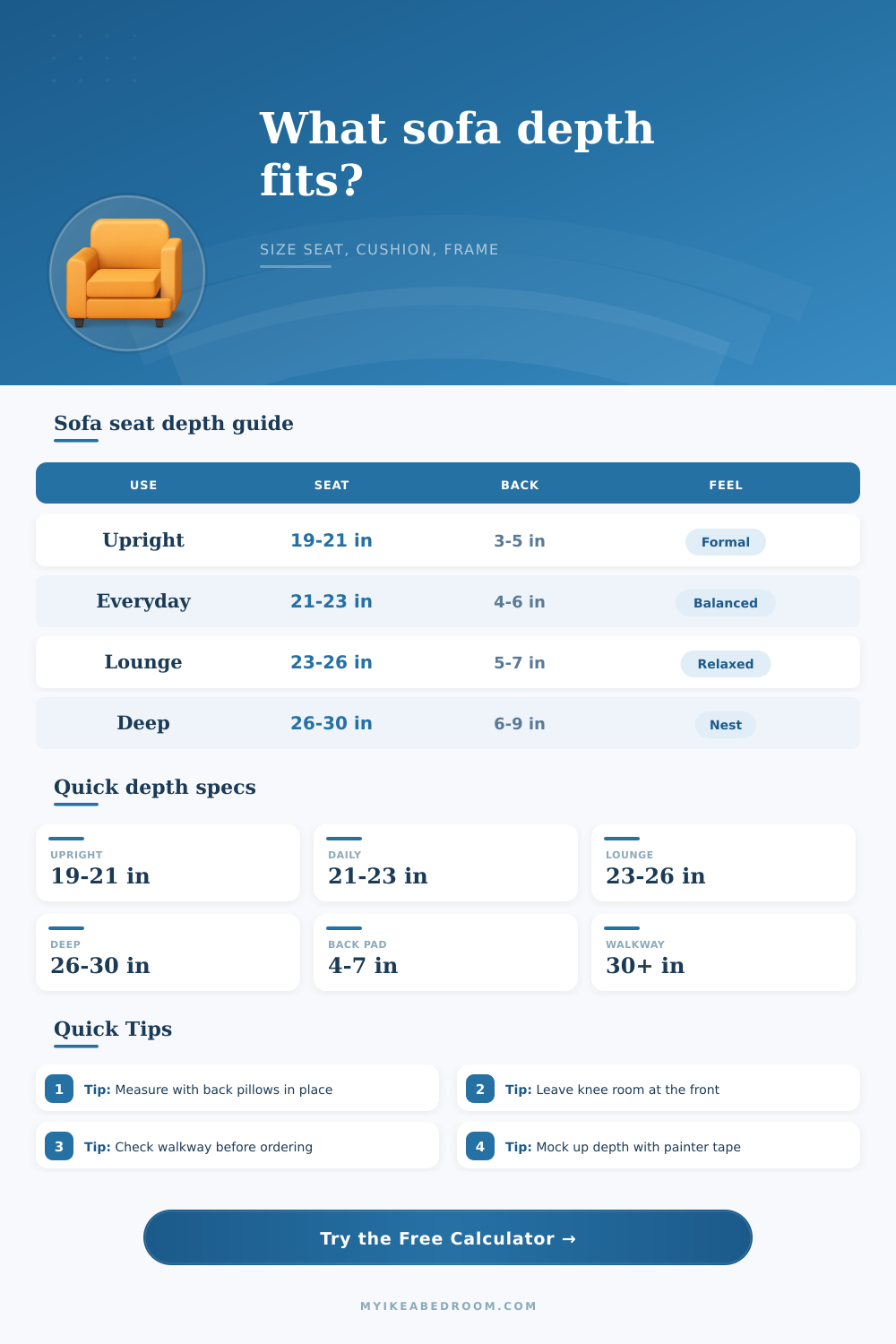
| Formal conversation sofa | 19 to 21 in | 3 to 5 in | Upright posture, shorter sitting sessions, and tidy room layouts. |
| Everyday family sofa | 21 to 23 in | 4 to 6 in | Balanced support for mixed heights and normal TV viewing. |
| Relaxed lounge sofa | 23 to 26 in | 5 to 7 in | Better for leaning back, side sitting, and adding throw pillows. |
| Deep sectional corner | 26 to 30 in | 6 to 9 in | Works when people expect to tuck legs or nest into pillows. |
| Dining settee or bench sofa | 18 to 20 in | 2 to 4 in | Keeps hips closer to a table and helps feet stay planted. |
| Component | Typical allowance | Calculator role | Why it changes fit |
|---|---|---|---|
| Compressed back pillow | 3 to 7 in | Added behind net seat depth. | Thicker pillows reduce room for the sitter if the frame depth is fixed. |
| Loose throw pillows | 1 to 4 in | Usually included in back thickness. | They make a deep sofa feel adjustable for shorter users. |
| Back rail or rear frame | 3 to 8 in | Added to overall sofa depth. | Track arms and tight backs are often slimmer than rolled backs. |
| Front crown or overhang | 0.5 to 2 in | Added to cushion cut depth. | It softens the edge while slightly increasing room projection. |
| Arm or apron setback | 0 to 3 in | Included in overall projection. | Rolled arms or inset bases can change where the sofa visually lands. |
| Room condition | Clear space target | Calculator check | Planning note |
|---|---|---|---|
| Main walkway in front | 30 to 36 in | Available room depth minus sofa depth. | Use the higher end where people pass while others sit. |
| Coffee table gap | 14 to 18 in | Subtract table gap from clearance goal. | Enough for reaching drinks without pinching knees. |
| Opposite media console | 30 in or more | Use console face as the traffic line. | Allows drawers, doors, and daily cleaning access. |
| Bedroom sofa at bed foot | 24 to 30 in | Use tighter goal only for low-traffic spots. | Check blanket overhang and walking route around the bed. |
| Open-plan living room | 36 in or more | Use the larger walkway goal. | Helps the sofa divide the room without blocking circulation. |
| Example sofa | User and posture | Net seat target | Likely overall depth |
|---|---|---|---|
| Compact apartment sofa | Mixed users, upright sitting | 20 to 22 in | 34 to 37 in with slimmer back pillows. |
| Standard three-seat sofa | Family TV room, relaxed posture | 22 to 24 in | 37 to 41 in depending on frame thickness. |
| Deep movie sofa | Adults lounging with soft cushions | 24 to 27 in | 40 to 45 in with thick back cushions. |
| Sectional corner seat | Side sitting and nested pillows | 27 to 30 in | 43 to 50 in for the corner module. |
| Dining settee | Table seating with feet planted | 18 to 20 in | 29 to 34 in with a thin back pad. |
Measure the seat with back pillows in place. Showroom specs may list overall depth, but comfort comes from the usable cushion depth.
Use pillows for shorter users. A deep sofa can work for mixed heights when loose pillows reduce the effective seat depth.
Check height and depth together. Taller seats usually feel better with slightly shallower depth so feet can stay planted.
Tape the projection on the floor. Mark the overall sofa depth before you commit to a deep frame in a narrow room.
In interior design, you often fall in love with something that looks great in showroom. However, it might not work well in your house. For example, you might buy a sofa because it has beautiful shape. Then you get it home and discover that it doesn’t support your knees, nor does it fit comfortabley into the room.
The problem isn’t usually the style; it’s almost always the depth (the distance between the front of the seat and back cushion). Most of us don’t think about this dimension when we is shopping for furnitures, as long as sofa width fits and the fabric sample looks nice. However, it determines how comfortable you will feel sitting in that chair. You might sit upright like a guest on a formal date, or you might sink right into it for a movie marathon. If you get it wrong, you’ll know the moment it arrives: It simply won’t feel right.
How to Choose the Right Sofa Depth for Comfort
This is where the calculator comes into play. Instead of staring at a spec sheet full of measurements that include fat back rails and cushy pillows (which aren’t going to support your backbone), it separates out the decorative fluff from usable portion. See the breakdown of what’s included above. Plug in your own body metrics and let the calculator do all the math for you; no need to worry about converting and coefficients. It takes your base dimensions and spits out comfort zones based off how you sit.
Begin with a rough idea of how tall you are and where your thighs end. That establishes seat-depth recommendation so that your feet aren’t dangling and your shins aren’t wedged into the front edge. (The system will guess at your thigh length if you don’t enter this measurement; better to measure from your hip to knee.) Why? Because the bottom of cushion should be positioned just shy of the back of your knee, which prevents impeded circulation. Either too much room behind the knee make for back strain when you slouch forward, while too little results in blood-flow cutoff due to pressure. It’s a delicate balance, but one with real physical benefits.
Without altering actual physical size of the cushion, they change the perceived depth by varying how firm the cushion is. On a soft cushion (feather insert or soft foam) the cushion will squish and make a deeply cushioned seat appear even more deeply cushioned then it is. If you have a very firm high density foam, it doesn’t give way as much, resulting in same feeling and measurement of depth. So the seat that measures as twenty four inches deep might feel like thirty on a plush design, and not quite long enough on a tight back moddern piece. That’s why calculator takes into account the added inches you lose due to a cushion sinking. That way when you finally get to sit down, you’re not taken by surprise!
The other side of that coin is room clearance. If you can’t reach the coffee table because there’s a sofa in the way, then that sofa won’t work no matter how deep it is. What’s left after subtracting total projection from your traffic-to-wall space? Ideally, 30 inches is enough space for a comfortable lane to pass by. Anything less than 30 inches starts to feel cramped and dangerous when you’re holding drinks.
The calculator automatically verifies this clearance, alerting you when total footprint of the furniture intrudes on the room itself. It won’t let you get away with not facing up to the spatial facts until after you buy. Surprisingly, depth is also managed through pillows! Not only do they look good, but thicker back pillows gives you the lumbar support you need while reducing seating surface. Take these away and you risk having a deeper sofa than you wanted. You may end up resting against the rigid frame of the sofa rather than back cushions.
Pillow thickness is a parameter of the tool. Since cushion thickness affects how you sit, you can adjust it to match either loose throws or built-in sofa cushions. In turn, this lets us make one sofa comfortable for multiple users or for multiple sitting styles. Before you order, mock up the depth on your floor using painter tape. You’ll see how it works (or doesn’t) with existing furnitures nearby, rugs, and open doorways. Visualize what happens in three dimensions; then you won’t regret anything.
The calculator will give you the numbers, but the reference tables on the page illustrate how different standard presets compare to your custom inputs. If you’re comparing deep lounge models versus more upright formal sofas, they’ll have different back and seat allowance ranges. Run your final results through those and use them as sanity checks. A sofa is, at heart, a sit-down machine. It succeeds or fails according to the fit between its shape and yours (and the shape of the rest of your room).
People generally focus on width; they look at the overall bulk and then get stuck thinking they need a sofa that looks good, rather than one that feels right. Instead, notice the part where you sit: the usable seat depth, not the overall bulk. A great fit feels like it dissapears into comfort, so you stop noticing the furniture completely. Then you’ve got it right.