Roller Shade Roll Diameter Calculator
Estimate the finished roll diameter, radius buildup, tube turns, cassette clearance, bracket projection, and fabric length allowance for roller shades using fabric thickness, shade drop, tube size, retained wraps, and hem allowances.
Choose a common shade setup, then adjust fabric thickness, tube size, drop, wraps, hem allowance, and cassette clearance for your exact window.
| Shade drop | 0.30 mm screen | 0.40 mm standard | 0.55 mm blackout | 0.70 mm thermal |
|---|---|---|---|---|
| 48 in / 122 cm | 2.09 in / 53 mm | 2.25 in / 57 mm | 2.48 in / 63 mm | 2.68 in / 68 mm |
| 60 in / 152 cm | 2.28 in / 58 mm | 2.50 in / 64 mm | 2.78 in / 71 mm | 3.04 in / 77 mm |
| 72 in / 183 cm | 2.46 in / 63 mm | 2.72 in / 69 mm | 3.08 in / 78 mm | 3.37 in / 86 mm |
| 84 in / 213 cm | 2.63 in / 67 mm | 2.93 in / 74 mm | 3.34 in / 85 mm | 3.68 in / 94 mm |
| 96 in / 244 cm | 2.79 in / 71 mm | 3.13 in / 80 mm | 3.58 in / 91 mm | 3.98 in / 101 mm |
| Part | Common size | Metric size | Use case | Clearance note |
|---|---|---|---|---|
| Small tube | 1.00 in OD | 25 mm OD | Narrow light shades | Needs slim fabric |
| Standard tube | 1.25 in OD | 32 mm OD | Most bedroom shades | Good all-purpose core |
| Large tube | 1.50 in OD | 38 mm OD | Wide or tall shades | Less deflection |
| Heavy tube | 2.00 in OD | 51 mm OD | Patio door shades | Larger starting roll |
| Compact cassette | 3.00 in inside | 76 mm inside | Small windows | Check blackout rolls |
| Deep cassette | 4.00 in inside | 102 mm inside | Tall rollers | More margin for fabric |
| Project | Drop and width | Fabric thickness | Tube | Planning result |
|---|---|---|---|---|
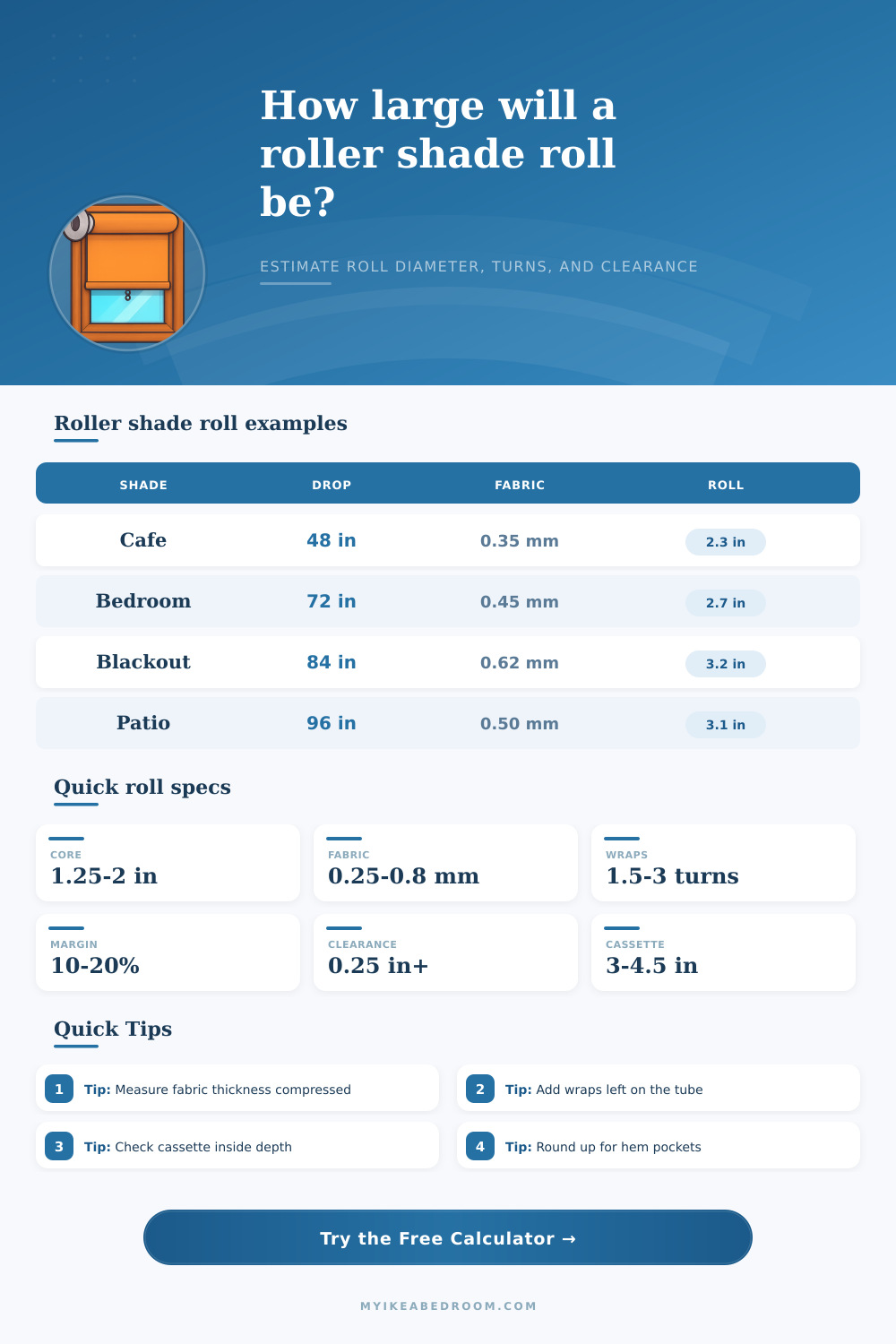
| Small cafe shade | 48 in drop, 28 in wide | 0.30 mm screen | 1.00 in | About 2.0 in roll with margin |
| Bedroom blackout | 72 in drop, 36 in wide | 0.55 mm coated | 1.25 in | About 3.1 in roll with margin |
| Patio door shade | 96 in drop, 72 in wide | 0.50 mm solar | 1.50 in | About 3.4 in roll with margin |
| Thermal nursery shade | 64 in drop, 34 in wide | 0.70 mm thermal | 1.25 in | About 3.2 in roll with margin |
| Dual roller front shade | 84 in drop, 48 in wide | 0.85 mm layered | 1.50 in | About 4.2 in roll with margin |
| Step | Formula | Purpose | Common input | Output |
|---|---|---|---|---|
| Fabric length | Drop + hem + top + wraps | Total wound length | 72 in + 5 in | Roll length |
| Wrap length | Wraps x pi x core | Fabric left on tube | 2 wraps | Tube hold |
| Roll diameter | sqrt(core^2 + 4Lt/pi) | Spiral buildup | L and thickness | Raw diameter |
| Safety margin | Raw x margin percent | Practical fit | 10% margin | Final diameter |
| Clearance | Cassette - final - free space | Fit check | 3.25 in depth | Pass or tight |
Measure the fabric, not the catalog description. Coatings, blackout layers, texture, and seam folds change thickness enough to affect a cassette fit. A compressed caliper reading usually gives a better roll estimate than a nominal material label.
Keep retained wraps in the calculation. The shade should not unroll to bare tube at full drop. Add the wraps that stay bonded to the tube, plus top attachment and hem allowances, before checking final roll diameter.
Every DIY roller shade project has this moment when reality smacks you between the eyes, rather than the pretty swatch of fabric you chose. You measured the drop precisely for your master bedroom. You selected the lovely blackout stuff and ordered the regular old tube hardware. And then you try rolling it up… only to discover that it’s not gonna fit into your cassette housing after all. It is an inch too long, it is frustrating. All that great clean line are ruined.
Why? Because most of us measure fabric length, but we don’t think about volume. When you roll a cylinder up, its diameter doesn’t change at the same rate as its length. The diameter grow in jumps that change depending on thickness and how hard you press it down. This complicated geometry become simple in our calculator where you can see finished size before you cut the fabric. It accounts for the hem allowance, the retained wraps and the core tube.
How to Calculate Roller Shade Size
On average most installers will retain 2 wraps (turns) of fabric on the fully extended tube. They do this to keep the hose from slipping out of place and to ensure it stay tensioned. The calculator use these retained turns as part of the starting diameter. Most rough estimates don’t consider this detail. It also calculates the air gap between each layer and recognizes that a tight woven vinyl sheet differ than a loose weave.
The unseen problem is fabric weight. Even at the same width, three-tenths of a millimeter will yield a typical screen shade; seven-tenths will get you thermal blackout. Four-tenths doesn’t sound like much until it’s wrapped around a tube forty or fifty times. Multiply quickly. What may only appear as a thin two-inch diameter roll versus a plump three-inch one isn’t necessarily based off overall length of the drop, but the buildup of thickness.
Woven textures also compress more so then coated ones, which take up more radial space per inch of travel. So if you’re considering a textured linen type of thing, know the roll will be larger than math would indicate with a smooth vinyl. But here’s where the number of wraps matters: You don’t want too few, because then the shade won’t engage with the clutch mechanism; or too many, because that wastes space inside the bottom of the cassette. Most people suggest a good rule of thumb is one-and-a-half to three wraps. That’s where you get the sweet spot of mechanical security and spatial efficiency.
If you have some particular hardware that wants extra grip, or maybe you’re using an especially slippery fabric so you want to secure it with more wraps, well, the tool give you the ability to dial it in to match.
That’s when the dream hits the wall: clearance. The internal depth of cassette housing is fixed, typically at about three to four inches. If your calculated roll diameter is any larger, either the fascia won’t close or the mechanism will jam. It’s good practice to include some kind of safety margin, since reality in the field seldom aligns with ideal theory. The brackets add projection; the bottom bars stick out; the walls are never perfectly flat. Add those small imperfections to the 10-15 percent margin and you’re no longer having to rethink everything from scratch.
The page has reference tables to give you a quick benchmark for common setups. These indicate what a normal seventy-two inch drop do in various weights of materials. As you can see, going from a light screen to a thermal blackout will add almost an inch to the overall diameter. When you’re dealing with a recessed window frame, that’s a big difference. The table also points out how larger tube cores mitigates the effect of thicker fabrics; that’s why we see thicker aluminum tubes on heavy patio doors.
Then there’s physical verification. If you can obtain a fabric sample, measure it with calipers. Catalog thickness listings does not take into account changes caused by compression. Measure the inside depth of your cassette housing yourself. Don’t rely on specs in the brochures. When you’ve got those real-world measurements, enter them into the calculator and check for fit. You’ll know right away whether you need a bigger tube core, a thinner fabric, or a deeper fascia. This takes the guesswork out and puts the plan back in.
The math has been done in advance, and that’s what makes a good-looking shade look easy. There are no signs of any hardware and no mechanisms stuck shut. There are no messy, ugly lines. You should of paid for just the clean lines. Knowing how little things add up to big issues is what separates the headache-filled afternoon of adjustments from the slick install. Measure twice, count once; then follow the math with the geometry of your hardware selection.